

The first time I cracked open a ripe Feijoa, the aroma hit me like a perfume bomb of pineapple, mint, and strawberry. Standing there in the middle of my San Diego grove, sticky juice running down my thumb, I knew this wasn’t just another shrub—it was a tropical treasure that demanded respect.
Most folks know this plant as the Pineapple Guava or by its scientific handle, Acca sellowiana, but locally we sometimes call it the “Guavasteen” due to its deceptive likeness to the mangosteen. If you are growing this beauty in a container, the dirt you shovel around its roots is the single biggest factor determining whether you get a bumper crop or a stick with yellow leaves.

Within three months, eight of them had dropped every single leaf because the roots had rotted in the stagnant muck. That failure cost me a season’s harvest, but it forced me to perfect a mix that mimics the volcanic, well-draining slopes of South America where these plants originated.
Ever wonder why your container plants stall and refuse to grow despite regular watering and feeding?
The answer usually lies hidden below the surface. A Feijoa’s root system is fibrous and shallow, acting less like a drill and more like a net. It needs to breathe. When you trap those roots in dense soil, it’s like trying to run a marathon while breathing through a straw. You need a substrate that holds moisture without holding its breath. In our coastal climate, where the marine layer hangs heavy in the morning and burns off by noon, managing that moisture balance is an art form.
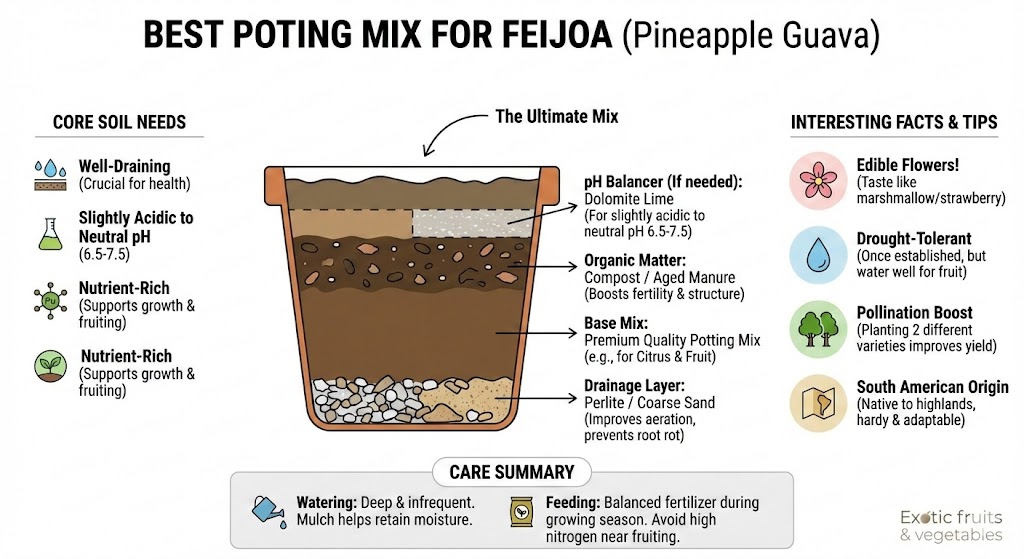
Deconstructing the Perfect Feijoa Foundation
Before we start mixing, you need to understand the mechanics of what goes into the pot. You cannot simply dig up dirt from your backyard and expect it to work in a container; ground soil compacts into a brick once you sever it from the earth’s ecosystem. In a pot, gravity works differently, and the “perched water table”—a zone of soggy soil at the bottom of the pot—can easily suffocate deep roots.

For Acca sellowiana, we aim for a pH between 5.5 and 7.0. They prefer things slightly on the acidic side. If your mix is too alkaline, which is common here given our hard tap water, you will see chlorosis—that’s when the leaves turn pale yellow while the veins stay green, screaming for iron.
Avoid “moisture control” potting mixes sold at big box stores. These contain hydrogels that hold water too long for Feijoas, leading to root rot in our cooler coastal winters.
The Base: Peat Moss vs. Coco Coir
The base of your mix provides the structure. I used to use exclusively peat moss, but it can become hydrophobic—repelling water like a waxed car hood—if it dries out completely. Nowadays, I lean toward coconut coir (coco peat). It wets easily and lasts longer.
However, coir often comes with high salt content, which burns Feijoa leaf tips. You must buy “buffered” and washed coir. If you stick with peat moss, add a tablespoon of limestone per gallon of mix to offset its extreme acidity.
The Aerators: Perlite and Pumice
This is where drainage happens. Perlite is that white, Styrofoam-looking volcanic glass. It’s cheap and light, but it floats to the top over time. Through our work with Exotic Fruits and Vegetables farm, we switched to pumice for our larger specimen trees.
Pumice is heavier, locks into the soil structure, and doesn’t float away when you water heavily. It creates permanent air pockets that allow the roots to exchange gases.
The Nutrition: Compost and Bark Fines
Inert ingredients like peat and perlite offer zero nutrition. You need organic matter. I use high-quality composted forest products or pine bark fines. Pine bark is acidic, which Feijoas love, and it decomposes slowly, providing a slow-release structure that prevents the soil from collapsing into sludge.
Think of the soil not just as an anchor, but as a battery. The organic matter stores the nutrient charge, while the mineral components (perlite/sand) ensure the energy flows freely without short-circuiting the system.
My Proven “San Diego Gold” Potting Recipe
After years of tweaking, I have settled on a ratio that handles our scorching July heat and our damp “May Gray” mornings equally well. This mix provides fast drainage but retains enough moisture so you aren’t chained to the hose every four hours. It mimics the forest floor environment where these plants naturally thrive.
The Golden Ratio: 40% High-Quality Potting Base (Coir/Peat), 30% Aeration (Pumice/Perlite), and 30% Organic Matter (Compost/Pine Bark).
Here is the exact method I use to mix a 20-gallon batch, which is perfect for a standard half-whiskey barrel planter:
- Hydrate the Base: If using a coir brick, soak it in 5 gallons of water until fully expanded. If using peat, fluff it up and moisten it until it feels like a wrung-out sponge.
- Add the Aeration: Pour in your pumice or perlite. I use a coarse grade, roughly 1/4 to 1/2 inch in size. Dust masks are mandatory here; inhaling silicate dust is a serious health hazard.
- Incorporate Organics: Mix in the compost or composted pine bark. This darkens the mix and introduces beneficial microbes that help break down fertilizer.
- The Nutrient Kick: Add 1 cup of worm castings and 1/2 cup of slow-release organic fertilizer (4-4-4 or similar) directly into the soil. This puts food right where the roots will seek it.
- The Toss: Turn the pile over with a shovel at least 10 times. You want a homogeneous blend where you can’t see clumps of any single ingredient.
To test your mix, grab a handful and squeeze it hard. It should form a loose ball that crumbles apart easily when you poke it. If it drips water, add more aeration. If it falls apart instantly without holding shape, add more compost.
Comparing Soil Amendments for Feijoa
To help you visualize why specific ingredients matter, I’ve broken down the characteristics of the most common soil additives I keep in the barn. Understanding these properties allows you to adjust the mix if you live in a hotter inland valley or right on the misty coast.
| Amendment | Water Retention | Aeration Capability | pH Impact |
|---|---|---|---|
| Sphagnum Peat Moss | High | Low | Acidic (3.5-4.5) |
| Coconut Coir | High | Low | Neutral (5.5-6.8) |
| Coarse Perlite | Low | High | Neutral (7.0) |
| Pine Bark Fines | Medium | Medium | Acidic (5.0-6.0) |
| Vermiculite | Very High | Low | Neutral (7.0) |
I rarely use vermiculite for Feijoa. It holds too much water and collapses over time, leading to the soggy bottom conditions we are trying to avoid. In our climate, we need porosity over absorption.
Potting Up and Ongoing Maintenance
Choosing the right pot is just as critical as the soil. I once killed a vigorous two-year-old sapling by moving it from a 1-gallon pot directly into a 15-gallon container. The massive volume of soil held water that the small root ball couldn’t drink fast enough, and the soil went sour. The anaerobic bacteria took over, and the plant suffocated.
Never increase your pot size by more than 2-4 inches in diameter at a time. This “stair-stepping” approach encourages dense root colonization and prevents waterlogging in the unused soil zones.
When you pot your Feijoa, plant it slightly high. The trunk flare—where the roots meet the stem—should be visible just above the soil line. If you bury the stem, you invite collar rot, which is practically a death sentence for these trees.
The Role of Mycorrhizae
When I plant, I always sprinkle a teaspoon of mycorrhizae fungi on the root ball. In the wild, these fungi form a symbiotic relationship with the roots, effectively extending their reach by 100 times.
In a sterile potting mix, you need to introduce them manually. It makes a massive difference in how well the plant takes up phosphorus, which is essential for blooming and fruit set.
Watering: The Litmus Test
How do you know when to water? Ignore the calendar. Stick your index finger into the soil up to the second knuckle. If it feels cool and damp, walk away. If it feels dry, it’s time to irrigate.
If the soil feels dry at a depth of 2 inches, apply water until roughly 20% of what you poured runs out the bottom drainage holes.
This runoff flushes out accumulated salts from our tap water and fertilizers. If you don’t flush the pot, the salt buildup will eventually burn the roots, looking exactly like drought stress. I learned this when my “Nazemetz” variety started showing brown, crispy tips despite daily watering; it was salt burn, not thirst.
Using a fabric pot (grow bag) naturally air-prunes the roots, preventing them from circling and becoming pot-bound. Feijoas thrive in these breathable containers, often doubling their growth rate compared to plastic pots.
Troubleshooting Common Soil Issues
Even with the best mix, things can go sideways. Here is a checklist of symptoms I look for during my morning walk-through:
- Green moss on soil surface: You are overwatering, or the mix is too dense. Increase airflow and let the pot dry out further between waterings. Scrape off the moss to let the soil breathe.
- White crust on soil surface: Salt buildup. Flush the pot with 3-4 gallons of rainwater or distilled water to leach the minerals out of the substrate.
- Soil shrinking away from pot edges: The peat or coir has dried out completely. You need to bottom-water (place the pot in a tub of water) for 30 minutes to rehydrate the hydrophobic core.
- Mushrooms growing: Generally a good sign! It means your organic matter is breaking down and fungal life is active. Unless they are taking over, leave them be.
“The best fertilizer is the gardener’s shadow.” — Unknown. I live by this. Inspecting your soil daily tells you more than any meter ever will.
I tried using uncomposted wood chips in a mix once to save money. As they decomposed, they robbed the soil of nitrogen (nitrogen drawdown), turning my lush green Feijoa yellow in weeks. Always use fully composted material.
What’s the real secret to success? It’s accepting that soil is alive. It degrades over time. Every 2 to 3 years, you must pull that Feijoa out, trim the roots (like giving the plant a haircut), and refresh the mix with new organic matter and aeration.

Final Thoughts from the Field
Growing Feijoas in containers allows those of us with limited space or poor ground soil to enjoy this exotic delicacy. By controlling the rhizosphere—the root zone—you control the destiny of the fruit. You don’t need a degree in chemistry, just a shovel and some common sense.
Our team at Exotic Fruits and Vegetables loves seeing home growers succeed with these resilient plants. When you mix your own soil, you stop being just a consumer of garden products and become a true cultivator. You know exactly what your plant is eating, drinking, and breathing.
Get your hands dirty, mix that batch of soil this weekend, and I promise you, when you taste that first gritty, sweet-tart fruit from your own patio, you’ll know exactly why we go to all this trouble. It’s a flavor you simply cannot buy in a store.



Just mixed my own potting mix for feijoa using 30% perlite, 20% vermiculite, and 50% coconut coir. Anyone tried similar ratios?
Regarding your potting mix ratios, ellis.white, it’s great that you’re experimenting with different combinations. However, keep in mind that feijoa plants prefer a mix with good water-holding capacity and aeration. You may want to consider adding some organic matter like compost or well-rotted manure to your mix
Thanks for the advice! I’ll definitely look into adding some organic matter to my mix. Do you have any recommendations for compost brands?
There are many good compost brands out there, ellis.white. Some popular options include E.B. Stone Organics and Worm Power. Just be sure to choose a compost that’s specifically designed for container gardens
Just harvested my first feijoa fruit and I’m hooked! For those in cooler climates, have you tried using row covers or other methods to protect your plants from frost? I’m in zone 9b and want to ensure my plants make it through the winter
Row covers can be a great way to protect your feijoa plants from frost, feijoa_fan42. You can also try using frost blankets or bringing your plants under cover during extreme cold snaps. Just be sure to provide enough ventilation to prevent moisture buildup
That’s really helpful, thanks! I was thinking of trying some row covers from Agribon. Have you heard anything about their products?
Agribon is a great brand, feijoa_fan42. Their row covers are lightweight and breathable, making them a good choice for protecting plants from frost. Just be sure to follow the manufacturer’s instructions for use
I’ve been growing feijoa in containers for years, but I never thought about the root system being so shallow. Does anyone know if a 5-gallon pot is too small for a mature plant?
A 5-gallon pot can be a good size for a mature feijoa plant, crafty_lady22, but it ultimately depends on the plant’s variety and growth habits. Make sure to prune your plant regularly to maintain a healthy size and promote fruiting
I’ve found that using a well-draining potting mix and avoiding overwatering has been key to keeping my feijoa plant healthy. However, I’m curious about fertilization – what are some recommended fertilizers for container-grown feijoa?
Has anyone experimented with adding worm castings to their potting mix? I’ve heard it can really boost plant health, but I’m not sure about the ideal amount to add. Currently using a mix from Miracle-Gro
I’m planning to build my own self-watering container for my feijoa plant using a 10-gallon plastic bin and some PVC pipes. Has anyone tried a similar project? Any tips or recommended materials would be appreciated
For those growing feijoa in tropical climates, have you noticed any issues with pests or diseases? I’m in Hawaii and I’ve been having some problems with root rot – any advice would be greatly appreciated
From a soil science perspective, it’s interesting to note that feijoa plants prefer a slightly acidic to neutral soil pH, around 6.0-7.0. Does anyone have experience with adjusting the pH of their potting mix using lime or sulfur?
Adjusting the pH of your potting mix can be a bit tricky, soil_scientist. It’s generally recommended to avoid making drastic changes to the pH, as this can shock the plant. Instead, try to maintain a consistent pH range and use pH-adjusting materials like dolomitic limestone or elemental sulfur as needed