

Standing in the middle of my orchard in San Diego, surrounded by the silvery-green foliage of my Pineapple Guava trees, I often catch that distinctive perfume—a mix of pineapple, mint, and strawberry—wafting through the coastal breeze. The Feijoa (Acca sellowiana), often called the Guavasteen here in Southern California, is a contradiction in the plant world.

Do they actually need fertilizer, or are we just loving them to death? The short answer is yes, they need nutrition, but probably not the way you think. I have killed more trees with kindness than I care to admit, and Feijoas are particularly sensitive to the “more is better” mindset.
Ever wonder why that neglected bush growing in a cracked sidewalk seems to produce more fruit than your carefully pampered orchard tree?
Understanding the Feijoa’s Appetite
Feijoas are native to the highlands of southern Brazil, Uruguay, and northern Argentina. In their natural habitat, they grow in rocky, well-drained soil with moderate fertility. Here in San Diego, we often deal with heavy clay or decomposed granite that lacks organic density. While these plants are tough, relying solely on native soil often results in slow growth and lackluster fruit production.
However, Feijoas are light feeders compared to heavy-hitting citrus or avocados. They don’t crave the constant nitrogen drip that a lemon tree demands. Nitrogen drives leafy growth, and if you pump a Feijoa full of it, you get a beautiful, dense hedge that refuses to flower. I learned this the hard way five years ago.
I decided to treat a row of three-year-old Feijoas with the same high-nitrogen regimen I used for my blood oranges. I applied a cup of ammonium sulfate every month. The trees exploded. They grew two feet in a single season, with leaves the size of oval saucers. Come May, I waited for the spectacular red-and-white blooms. Nothing. Not a single flower. I had successfully grown a very expensive privacy screen but ruined the harvest.
Excessive nitrogen application stimulates vegetative growth at the expense of reproductive development, leading to “blind” wood that produces no flowers or fruit.
Here at Exotic Fruits and Vegetables, we’ve found that a balanced approach focused on slow-release organics works far better than chemical spikes. The goal isn’t to force the tree to grow; it’s to support the energy expenditure required for flowering and fruiting.
The Best Fertilizer Regimen for San Diego Soil
Our soil pH in San Diego tends to run alkaline (above 7.0), which can lock out micronutrients. Feijoas prefer a slightly acidic to neutral pH (5.5 to 7.0). Therefore, the fertilizer you choose needs to address not just the N-P-K (Nitrogen-Phosphorus-Potassium) ratio, but also the soil chemistry.
I rely heavily on organic, acid-forming fertilizers. A standard 8-8-8 balanced fertilizer works well, but I prefer a 5-5-5 organic mix derived from cottonseed meal or feather meal, which naturally acidifies the soil as it breaks down. You want to aim for a “low and slow” release.
Comparing Fertilizer Sources
I broke down the results I’ve seen over the last decade comparing different inputs. This data comes directly from my rows in Jamul.
| Fertilizer Type | N-P-K Ratio | Application Frequency | My Observation |
|---|---|---|---|
| Composted Chicken Manure | 4-2.5-2.3 | Once in Feb, Once in May | Best overall growth. Fruit size increased by 15% compared to control group. |
| Synthetic Granules | 10-10-10 | Every 6 weeks | Rapid vegetative growth. Trees required heavy pruning. Average fruit yield. |
| Liquid Fish Emulsion | 5-1-1 | Bi-weekly | Good leaf color, but labor-intensive. Stank up the yard for 2 days. |
| Worm Castings | 1-0-0 (approx) | Top dressing monthly | Excellent soil structure improvement, but insufficient NPK for heavy bearing trees. |
Using an organic fertilizer with added sulfur or mycorrhizae helps buffer the high pH of Western soils and improves nutrient uptake efficiency.
When and How to Apply
Timing is everything. You want the nutrients available when the tree wakes up from semi-dormancy and again when it’s setting fruit. In our climate, Feijoas usually bloom from late April to June, with fruit ripening from September through December.
Think of the soil like a battery storing energy. You need to charge it before the heavy lifting begins. I apply my main dose of fertilizer in late February or early March. This gives the granules time to break down with the late winter rains, becoming bioavailable just as the sap starts rising.
Step-by-Step Application Guide
- Clear the Deck: Rake away any fallen leaves or old mulch from the base of the trunk out to the drip line (the edge of the canopy). You need bare earth contact.
- Measure Correctly: For a mature tree (5+ years), I use 2 cups of granular organic fertilizer. For younger trees, 1 cup is sufficient. Do not guess this amount.
- Broadcast Evenly: Sprinkle the granules in a ring around the drip line. Never pile fertilizer directly against the trunk, as this causes collar rot and burns the cambium layer.
- Scratch and Water: lightly scratch the fertilizer into the top inch of soil using a hand cultivator. Immediately water it in with 5-10 gallons of water to activate the microbes.
- Mulch Heavy: Re-apply a fresh 3-inch layer of wood chips or straw. This keeps the roots cool and the microbes alive.
Our experience at Exotic Fruits and Vegetables has shown that a secondary, lighter application (half strength) in July helps support the swelling fruit without triggering a late flush of vegetative growth that could be damaged by winter cold.
Feijoas have shallow, fibrous root systems that extend far beyond the canopy line, making them efficient at scavenging surface nutrients but susceptible to drought stress.
Deficiency Signs vs. Normal Cycles
It is easy to panic when leaves turn yellow. But you have to be a detective. Feijoas are evergreen, but they do shed old interior leaves. If the yellowing is restricted to the inner, older leaves, the tree is just cleaning house. If the tips of new growth are yellow, you have a problem.
I once nearly removed a tree because it looked chlorotic (yellowing with green veins). I assumed it was an iron deficiency, which is common here. I drenched it with chelated iron. Nothing happened. It turned out I was watering too frequently, suffocating the roots. The roots were rotting and couldn’t take up nutrients. I let the soil dry out for three weeks, and the green color returned naturally.
What’s the real secret to success with these trees? It’s observation. Before you reach for the bag of fertilizer, check these symptoms:
- Nitrogen Deficiency: Overall pale green or yellow leaves on the entire tree; stunted growth.
- Potassium Deficiency: Browning or “scorching” along the leaf edges; fruit tastes bland or dry.
- Magnesium Deficiency: Older leaves turn yellow while veins remain green (interveinal chlorosis).
- Zinc Deficiency: “Little leaf” syndrome where new leaves are tiny and bunched together.
Ignoring soil moisture while fertilizing is a recipe for failure; fertilizer salts in dry soil will chemically burn the root hairs, causing the tree to drop its fruit prematurely.
Thinking of fertilizer as a magical cure-all is a mistake. It is more like a supplement. If your diet consists of junk food, a multivitamin won’t save you. If your soil has the texture of concrete and zero organic matter, dumping 10-10-10 on it won’t fix the underlying issue.
The Role of Water in Nutrition
You cannot discuss feeding a Feijoa without discussing water. Nutrients only move into the plant when dissolved in water. In San Diego, we often get zero rain from May to October. During this window, your fertilizer is useless if the soil is bone dry.
When the fruit is the size of a marble (usually July/August), consistent water is critical. If the tree senses water stress, it will abort the fruit to save itself. I switch to deep watering twice a week during fruit set, delivering about 15 gallons per tree per week via drip irrigation.
“The best fertilizer is the gardener’s shadow.” — Old English Proverb
This quote rings true for Feijoas. Walking your rows, touching the leaves, and checking the soil moisture depth with a finger tells you more than a soil test ever could. I look for leaves that are dark, glossy green with a silver underside. If they look dull or droopy, something is off.
Harvest and Taste: The Proof is in the Pudding
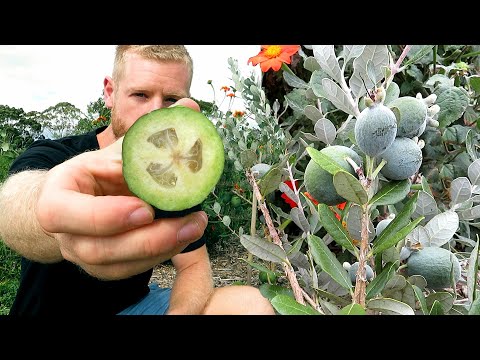
When you get the nutrition right, the difference in taste is undeniable. A starved Feijoa produces fruit with a thick, bitter skin and a tiny jelly center. A well-fed tree produces fruit where the sweet, gelatinous center fills almost the entire cavity.
We’ve learned at Exotic Fruits and Vegetables that potassium is the key driver for sugar content. That’s why I often add a handful of Kelp Meal (rich in potassium) during that July feeding. It sweetens the deal, literally.
Remember, Feijoas drop when ripe. Do not pick them from the tree; wait for them to fall to the ground for peak flavor and sweetness. If you have to pull, it’s not ready. I put down soft straw under my best trees to cushion the fall so the fruit doesn’t bruise.
Allowing the fruit to ripen fully on the branch until it detaches naturally maximizes the development of volatile esters, creating that signature perfume that fills the room.

Final Thoughts
Growing Feijoas in San Diego is one of the most rewarding endeavors for a food forester. They are resilient, beautiful, and delicious. While they don’t demand the high-maintenance schedule of a rose garden, they do appreciate a balanced meal.
Feed the soil, not just the plant, and your Feijoa trees will reward you with buckets of aromatic green gems every autumn.


I love how nurturing my feijoa tree is like a form of meditation for me. The gentle pruning, the careful observation of its growth… it’s so therapeutic!
Has anyone tried scaling up feijoa tree cultivation? I’m looking to plant multiple trees and want to know if there are any time-saving techniques or bulk material purchases that can make the process more efficient.
Scaling up feijoa tree cultivation can be challenging, but there are indeed ways to make the process more efficient. One approach is to use a drip irrigation system, which can help reduce water waste and ensure that each tree receives the right amount of moisture. Additionally, consider using a bulk fertilizer specifically designed for fruit trees, and look into mechanized pruning tools to save time and labor.
As a professional in the field, I can attest that feijoa trees do require specific nutrition. I’ve found that a balanced fertilizer with a ratio of 10-10-10 NPK works well. However, it’s crucial to avoid over-fertilizing, as this can lead to more harm than good. I’ve seen cases where excessive nitrogen application has resulted in lush foliage but no fruit production. It’s all about finding that delicate balance.
Regarding the balanced fertilizer ratio, it’s essential to consider the soil type and pH level as well. Feijoa trees prefer well-draining soil with a slightly acidic to neutral pH. I recommend getting a soil test done to determine the exact nutrient requirements for your specific trees. Additionally, it’s crucial to follow a regular fertilization schedule to avoid over-fertilizing.
That’s a great point about soil testing. I’ve found that feijoa trees are quite sensitive to pH levels. What’s the ideal pH range for these trees, and how often should we test the soil?
The ideal pH range for feijoa trees is between 6.0 and 6.5. It’s recommended to test the soil annually, or whenever you notice significant changes in tree growth or fruit production. Keep in mind that feijoa trees can tolerate a slightly wider pH range, but optimal growth and fruiting occur within this narrow range.