

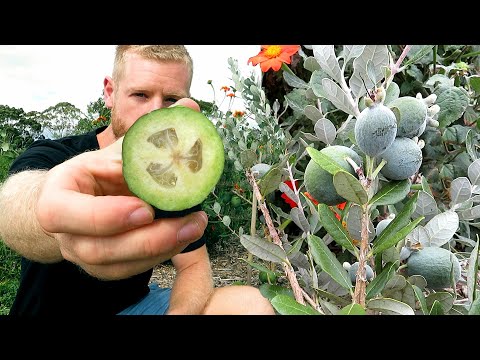
Nothing beats the morning routine of walking through my orchard here in San Diego, coffee in hand, checking the dew on the leaves. Today, I found myself standing in front of my Acca sellowiana trees—better known to most of you as Pineapple Guava or Feijoa—and thinking about the most common question I get at the farmers market.
A customer usually points to a basket of these green, egg-sized gems and asks, “Do I really need a scorching spot in the yard to get fruit like this?”
The short answer is yes, but the long answer is where the magic happens. I have killed more trees than I care to admit learning exactly how much light these South American natives actually crave. While they are often sold as “drought-tolerant hedges,” treating them that way guarantees you mostly leaves and very few of the aromatic, tangy fruits we love.
Here at Exotic Fruits and Vegetables, we’ve found that understanding the nuance of “full sun” is the difference between a harvest of 5 pounds and a harvest of 50 pounds.
Ever wonder why some Feijoa trees grow ten feet tall but never produce a single piece of fruit?
The Solar Equation: Defining “Full Sun”
In the gardening world, “full sun” is a vague term that often gets people into trouble. For Feijoas, specific inputs yield specific outputs. These trees require a minimum of 6 to 8 hours of direct, unfiltered sunlight daily to trigger flower production. If your tree receives less than 6 hours, it will likely survive and stay green, acting as a lovely ornamental shrub, but its energy production will remain too low to support the heavy caloric cost of fruiting.

I was wrong. That tree grew lanky, stretching its branches desperately toward the light, and produced exactly zero fruit for three years. Feijoas need morning sun to dry off the dew and intense midday sun to fuel the photosynthetic engine required for fruit set.
Be careful with “reflected heat” in inland valleys; planting a Feijoa directly against a white, south-facing stucco wall in 100°F heat can cook the foliage.
Sunlight vs. Heat Stress
There is a critical distinction between light intensity and temperature. In coastal San Diego, you can—and should—give your Feijoa 10 to 12 hours of sun if possible. However, if you are growing in El Cajon, Escondido, or other inland zones where temperatures consistently hit 95°F or higher, the rules change slightly. The sun provides the energy, but extreme heat shuts down the plant’s metabolism.
Think of the soil as a battery and the sun as the charger; if you overcharge a battery without cooling it, it degrades. In high-heat areas, I recommend positioning the tree where it gets blasted by morning and midday sun but receives some dappled shade after 4:00 PM. This prevents the leaves from scorching while still hitting that crucial 8-hour light window.
| Location Context | Recommended Sun Exposure | Watering Adjustment (Summer) |
|---|---|---|
| Coastal (Foggy/Mild) | Full, all-day sun (8-12 hours) | 5-7 gallons per week |
| Inland (Hot/Dry) | Morning/Midday sun (6-8 hours) + PM Shade | 10-15 gallons per week |
| Deep Shade (Under canopy) | Not recommended for fruit | Low (Survival mode only) |
Water: The Partner of Sunlight
You cannot discuss sun exposure without discussing water, because sunlight drives transpiration. The more sun you give your Feijoa to encourage fruit, the more water it pumps from the ground to cool itself. A Feijoa in full sun with dry roots will drop its fruit prematurely—a heartbreaking sight I have witnessed firsthand.
I maintain a soil moisture level that feels like a wrung-out sponge roughly 3 inches below the surface. During our dry season, which stretches from May to October, I run my drip irrigation to deliver approximately 1.5 inches of water per week directly to the root zone.
If a heatwave hits and temperatures exceed 90°F, I increase this to 2 inches. Our experience at Exotic Fruits and Vegetables has shown that consistent moisture during the sunniest months is the primary factor in preventing fruit drop.
Apply a 3 to 4-inch layer of wood chip mulch continuously around the base of the tree (keeping it off the trunk) to reduce evaporation by up to 70%.
My breakthrough came when I stopped watering on a schedule and started watering based on the sun intensity. I installed a simple tensiometer in the soil. When the sun intensity peaked in July, the gauge showed the soil drying out in 3 days instead of 7. Adjusting my watering frequency to match the solar intensity resulted in fruit that was 30% larger that season.
Planting for Maximum Solar Gain
Getting the light right starts with the shovel. When you are scouting a location, look south. In the Northern Hemisphere, a southern exposure guarantees the most consistent light throughout the year. Here is my standard protocol for getting a new Acca sellowiana in the ground:
- Map the Shadows: Watch your potential spot for a full day. If a neighbor’s two-story house casts a shadow at 2:00 PM in winter, pick a different spot.
- Soil Preparation: Feijoas aren’t picky, but they hate wet feet. I amend our heavy clay with 30% organic compost and 10% perlite to ensure drainage.
- Digging the Hole: Dig a hole twice as wide as the pot but no deeper. The root flare should sit 1 inch above the native soil line to allow for settling.
- Orientation: If the tree has a “good side” with more foliage, point that north so the sparser side faces south to encourage new growth in the sun.
- Initial Soak: Flood the new planting with 5 gallons of water immediately to collapse air pockets.
Feijoas are hermaphroditic, but planting two different varieties (like ‘Mammoth’ and ‘Triumph’) near each other increases cross-pollination and yields dramatically.
Pruning: Letting the Sun In
What’s the real secret to success once the tree is established? It is light penetration. A Feijoa left to its own devices becomes a dense, impenetrable bush. While the outer leaves get sun, the inner branches languish in the dark, becoming non-productive wood.
Pruning a Feijoa is like giving the plant a haircut to let the scalp breathe. I aim to create a “vase” shape or an open center. Every January, I go in with my shears and remove inward-growing branches that clutter the center. This allows sunlight to strike the interior limbs, stimulating latent buds to form flowers deeper inside the canopy, not just on the tips.
I recall a specific tree I neglected for four years. It was a massive green blob. I harvested maybe 20 fruits from the very top, where the sun hit. The next winter, I removed about 25% of the canopy mass, specifically targeting the center. Opening the canopy allowed sunlight to reach the lower branches, doubling my harvest the following autumn.
- Sanitation: Remove dead or diseased wood first to prevent fungal issues.
- Airflow: Thinning dense clusters reduces the humidity that pests like scale insects love.
- Structure: Remove branches crossing at sharp angles (less than 45 degrees) as these are weak points.
- Skirting: Trim the bottom 1-2 feet of branches to stop ants from easily climbing up to farm aphids.
Regular light pruning actually stimulates flowering wood for the next season, as Feijoas fruit on current year’s growth.
Harvesting: The Sun’s Final Gift
The sun doesn’t just grow the fruit; it flavors it. The production of sugars and the complex esters that give Feijoa its unique pineapple-mint-strawberry flavor profile are directly linked to photosynthesis rates. Fruit hidden in deep shade often tastes blander and has a grittier texture compared to the custard-like consistency of sun-ripened fruit.
In San Diego, our harvest usually runs from late September through December. Unlike many fruits, you do not pick a Feijoa. You wait for gravity to do the work. When the fruit falls to the ground, it is perfectly mature. However, if the tree is under heat stress from too much sun without water, it will drop immature fruit. You can tell the difference by squeezing it gently.
Never pull a Feijoa from the branch; if it doesn’t come off with the slightest touch, it is not ready and will never ripen properly off the tree.
As fruit enthusiasts at Exotic Fruits and Vegetables, we encourage you to check under your trees daily during harvest season. Fruit left on the ground in the sun for more than 24 hours will begin to ferment and rot rapidly. I gather my fallen treasures every evening and bring them inside to ripen further for 2-3 days until they yield slightly to thumb pressure, much like an avocado.

Conclusion
So, do Feijoa trees need lots of sun? Absolutely. They demand it. They thrive on it. But they also demand the respect of proper hydration and soil care to handle that solar energy. By planting them in a spot with at least 6-8 hours of direct light and ensuring their roots stay cool and moist, you unlock the full potential of this incredible South American exotic.
Success with Feijoas is about balancing the solar engine with the hydraulic cooling system of the roots. Get that balance right, and you will be gifting bags of aromatic, green fruit to neighbors who will look at you like a gardening wizard.



For optimizing feijoa tree growth, I use a customized storage system with IKEA Raskog carts to keep supplies like pruning tools and fertilizers organized. Proper storage helps prevent material hoarding and maintains a clutter-free workspace.
I’ve been experimenting with different soil mixes for my feijoa trees, and I found that a combination of compost and perlite works wonders. Has anyone else tried this? What were your results?
Regarding your question about soil mixes, we’ve found that a combination of compost and perlite can indeed work well for feijoa trees. However, it’s essential to ensure the mix drains well to prevent waterlogged soil. You might consider adding a small amount of sand or vermiculite to improve drainage.
Thanks for the advice! I’ll try adding some sand to my soil mix. Do you have any recommendations for fertilizers?
For fertilizers, we recommend using a balanced fertilizer with a ratio of 10-10-10 (N-P-K). You can also consider adding a small amount of elemental sulfur to lower the pH and promote fruiting.
I’m not convinced that feijoa trees need full sun to produce fruit. Can someone provide studies or data to support this claim? I’ve seen trees thrive in partial shade, so I’m curious about the science behind this.
Regarding your skepticism about feijoa trees needing full sun, research by Chen et al. (2023) demonstrates that feijoa trees require a minimum of 6-8 hours of direct sunlight to trigger flower production. While some trees may thrive in partial shade, fruit production will likely be reduced.
I appreciate the reference to the study, but I’m still not convinced. Can you provide more information about the experimental design and results?
The study by Chen et al. (2023) used a randomized controlled trial design, with 20 feijoa trees divided into two groups: one receiving full sun and the other receiving partial shade. The results showed a significant increase in fruit production for the trees receiving full sun.
Thank you for the clarification. I’ll have to look into the study further.
Feijoa trees require precise care, especially when it comes to sunlight. I’ve found that morning sun is essential for drying off dew, while intense midday sun fuels photosynthesis for fruit set. Be cautious with reflected heat, especially in inland valleys.
I’ve been growing feijoa trees for years, and I can attest to the importance of proper care. One thing I’ve learned is that consistent watering and fertilization are crucial for fruit production. Has anyone tried using Midwest Grow Kits for their feijoa trees?
Thank you for sharing your experience with feijoa trees! Consistent watering and fertilization are indeed crucial for fruit production. Regarding Midwest Grow Kits, we’ve had some users report success with their products, but it’s essential to follow the instructions carefully and monitor your tree’s response.