

If you walked into my backyard in San Diego right now, you wouldn’t need to see the plant to know it’s there. The smell of a ripening Feijoa is unmistakable—a complex perfume that hits you like a mix of strawberry, pineapple, and mint.
While many growers assume you need an orchard to cultivate these beauties, I am here to tell you that growing Acca sellowiana in a pot is not only possible, but it often produces superior fruit compared to ground-planted trees in our heavy clay soils.
Also known as Pineapple Guava or Guavasteen, this plant is a standout performer for patio growers. I remember the first time I tried to grow one in a container; I treated it exactly like a citrus tree, and it nearly died on me within six months.

This guide isn’t about generic gardening advice. I’m going to walk you through exactly how I manage my container orchard, from the specific soil mix I hand-blend to the pollination tricks that doubled my yield last season. We are going to turn your patio into a productive micro-farm.
Selecting the Right Vessel and Variety
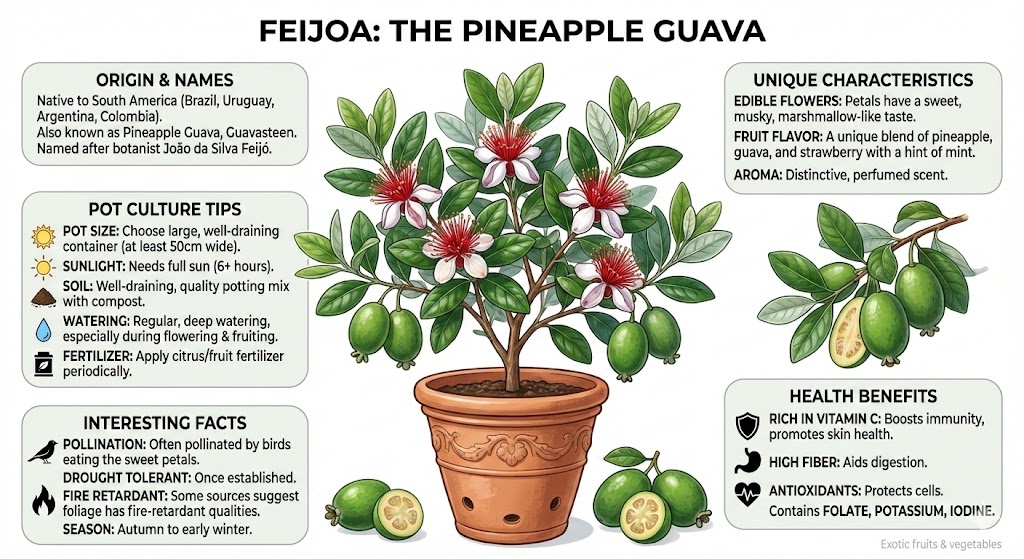
You cannot stick a Feijoa in a standard 5-gallon nursery pot and expect fruit. The root system of this plant is vigorous and fibrous. I use 20-gallon resin pots for my mature bushes. Resin is superior to terracotta in our San Diego climate because terracotta wicks moisture away from the soil too aggressively when temperatures hit 90°F in August.
If you want a mobile garden, put that pot on heavy-duty casters immediately; wet soil in a 20-gallon pot weighs upwards of 150 pounds.
Never start a small 1-gallon transplant directly in a 20-gallon pot. The excess soil will hold too much moisture around the small root ball, leading to root rot. Step it up gradually: 1 gallon to 5 gallons, then to 15 or 20 gallons once the roots fill the space.
Variety selection is just as critical as the pot. While ‘Coolidge’ is the self-fertile standard you see at big-box stores, I find its flavor slightly one-dimensional. I prefer growing ‘Nazemetz’ or ‘Mammoth’, even though they require a second plant for cross-pollination. The flavor profile of ‘Nazemetz’ is far sweeter, with a pulp that is less gritty.

The “Exotic” Soil Recipe
Garden soil is the enemy of container plants. It compacts into a brick that suffocates roots. You need a mix that holds moisture but allows oxygen to flow freely. Think of the soil as a battery storing nutrients and water; if the internal chemistry is off, the plant won’t charge.
My go-to mix for Feijoa is simple but precise:
- 40% high-quality potting soil (coco coir based)
- 30% pine bark fines (improves drainage and acidity)
- 20% coarse perlite (for aeration)
- 10% worm castings (for biology)
I also mix in 1 cup of dolomite lime per cubic foot of soil. Feijoas prefer a pH between 5.5 and 7.0, and our local water tends to be alkaline, so the lime helps buffer the pH while adding calcium.
Ever wonder why your potted plants thrive for three months and then suddenly stagnate? It is usually because the organic matter in the pot has decomposed, causing the soil level to drop and compact, choking off oxygen to the feeder roots.
Sunlight, Water, and the Feeding Schedule
In San Diego’s coastal zones, my Feijoas sit in full sun for 8 to 10 hours a day. However, if you are inland where temperatures exceed 95°F regularly, you must provide afternoon shade.
A potted root system gets much hotter than roots in the ground. I once ruined an entire batch by leaving black plastic pots exposed to the direct afternoon sun during a heatwave; the soil temperature cooked the roots, and the plants dropped every single leaf within a week.
Watering is where most people fail. You cannot rely on a schedule. You must rely on weight and touch. Lift the edge of the pot. If it feels light, water it until you see 10-20% of the water flow out the bottom. In summer, I am watering my 20-gallon pots with about 2 gallons of water every 3 days. In winter, that drops to once every 10 days.
Mulch is non-negotiable for containers. Apply a 2-inch layer of wood chips or straw to the top of the pot. This reduces evaporation by 50% and keeps the surface roots cool and active.
Fertilizing for Fruit, Not Just Leaves
Feijoas are heavy feeders, but they are salt-sensitive. Using high-salt synthetic fertilizers can burn the leaf tips. I use a slow-release organic fertilizer with an NPK ratio of roughly 5-5-5. I apply 1 cup scratched into the surface soil every 8 weeks from March through September.
Our experience at Exotic Fruits and Vegetables has shown that supplementing with liquid kelp extract once a month significantly improves the plant’s resistance to heat stress. The trace minerals in kelp act like a multivitamin, strengthening the cell walls against extreme temperature fluctuations.
The Art of Pollination and Harvesting
This is the part that confuses most growers. You might see flowers, but no fruit. Why? Even self-fertile varieties produce more fruit with cross-pollination. The flowers are edible and taste like cotton candy—really, try the petals—but don’t eat the center pistol if you want fruit.
Here is my manual pollination method for maximum yield:
- Wait until mid-morning when the pollen is fluffy and dry.
- Locate a flower with yellow, dusty pollen on the anthers (the tips of the red stamens).
- Use a small artist’s paintbrush to collect the pollen.
- Brush that pollen onto the stigma (the single long central stalk) of a flower on a different plant.
- Repeat this every 3 days during the bloom season, which usually runs May through June here.
In their native South America, Feijoas are pollinated by large birds that eat the sweet petals. In the USA, bees and mockingbirds do the job, but they are often inefficient. Hand pollination guarantees fruit set.
When is it Ripe?
Feijoa is tricky because the fruit remains green when ripe. It does not change color like a strawberry. If you pick it from the tree, it will be unripe and rubbery. The fruit is only truly ripe when it falls off the tree on its own. I give my bushes a gentle shake every morning in October and November. Whatever drops is ready to eat. If you pull it and the stem resists, walk away.
I once tried to force harvest a week early for a market event. The fruit was tart, hard, and astringent. I ended up having to compost 15 pounds of fruit because I was impatient. Don’t make my mistake.
Varieties Comparison for Container Growing
Not all Feijoas behave the same in a pot. Here is a breakdown of how the top varieties perform based on my trials over the last five years.
| Variety | Fruit Size | Flavor Profile | Container Suitability |
|---|---|---|---|
| Coolidge | Medium | Mild, standard guava flavor | Excellent (Self-fertile) |
| Nazemetz | Large | Sweet, non-gritty, pear-like | Good (Needs pollinator) |
| Mammoth | Very Large | Softer, highly aromatic | Moderate (Can get lanky) |
| Apollo | Large | Very sweet, thin skin | Excellent (Upright growth) |
Troubleshooting Common Issues
Even with the best care, things go wrong. Let’s look at the most common panic moments for Feijoa growers.
Yellowing Leaves: If the older leaves are turning yellow and dropping, you likely have a nitrogen deficiency or the pot is root-bound. If the new leaves are yellow with green veins, that is iron chlorosis, usually caused by watering with alkaline tap water which locks out iron uptake.
Scale insects are the bane of my existence. They look like little brown bumps on the stems. They suck the sap and leave sticky honeydew. I scrape them off manually with a toothbrush dipped in isopropyl alcohol. Do not use heavy oils in summer; you will burn the leaves.
Fruit Splitting: This happens when you have inconsistent watering. If you let the pot dry out completely and then flood it, the fruit expands faster than the skin can stretch. Consistency is key.
What’s the real secret to success? It’s observation. I spend 5 minutes every morning just looking at the leaves. Are they drooping? Is the color fading? Catching these signs early prevents disaster.
Pruning: The Haircut Technique
Pruning a Feijoa is like giving a poodle a haircut; you can’t really hurt it, but you can definitely make it look ugly. I prune in late winter after the danger of frost has passed but before the spring flush. My goal is to keep the center of the bush open to sunlight. This prevents powdery mildew and ensures the interior leaves get enough light to photosynthesize.
“Prune for air, not just for shape. If a bird can’t fly through your bush, the air can’t circulate either.”
For containers, I keep the height capped at 6 feet. Any higher and the wind in San Diego will tip the pot over. I pinch the tips of the new growth in summer to encourage bushiness rather than lanky vertical growth.

Why It’s Worth the Effort
Growing Feijoa in a pot gives you a tropical experience in a temperate climate. The fruit is rich in Vitamin C and fiber, but more importantly, the flavor is something you cannot buy in a supermarket. Commercial Feijoas are picked under-ripe for shipping, which ruins the texture.
Through our work with Exotic Fruits and Vegetables farm, we emphasize that growing your own food connects you to the seasons. There is a specific joy in shaking a bush on a crisp November morning and gathering a bowl of green gems for breakfast. The spoonable, jelly-like center of a perfectly ripe Feijoa is a reward that money simply cannot buy.
We at Exotic Fruits and Vegetables believe in maximizing small spaces. You don’t need acreage. You need a 20-gallon pot, good soil, and the patience to let the fruit drop when it’s ready. Start with one ‘Coolidge’ and one ‘Nazemetz’, keep them well-mulched, and you will be harvesting pounds of fruit within three years. Get growing.



I’ve combined feijoa with other plants in container gardens, it’s all about compatibility and soil mix – what’s your take on using resin pots vs terracotta?
Regarding the choice between resin and terracotta pots, resin is indeed superior in our San Diego climate due to its ability to retain moisture without wicking it away too aggressively. This is particularly important for feijoa, which requires consistent soil moisture to thrive.
That makes sense about the resin pots, but what about using a combination of both for better drainage and moisture retention?
Using a combination of both resin and terracotta could be an innovative approach, but it would require careful consideration of the materials’ interactions and potential effects on soil moisture and pH levels.
As a soap maker, I appreciate the attention to detail in growing feijoa – the pH levels and soil composition are crucial, similar to creating the perfect soap recipe. What’s the ideal pH range for feijoa and how do you maintain it in a container?
The ideal pH range for feijoa is between 6.0 and 6.5. Maintaining this range in a container involves carefully selecting the soil mix and avoiding over-fertilization, which can disrupt the pH balance. Regular pH testing is also essential to ensure the soil conditions remain optimal for the plant’s growth.