

Here in San Diego, where the Pacific breeze meets our inland valleys, I have spent years perfecting the art of growing subtropical treasures. While everyone else fights over avocados and citrus, I have dedicated a significant patch of my land to Acca sellowiana, better known to locals as the Pineapple Guava, or by its South American name, Feijoa.
Most consumers see a green, egg-shaped fruit and assume it’s uniform throughout, like an apple. That could not be further from the truth. The Feijoa is a complex biological package where every layer offers a different texture, flavor profile, and culinary potential. To truly appreciate this fruit—and to stop wasting the best parts of it—you have to dissect it with the eye of a grower.
The Feijoa belongs to the Myrtaceae family, making it a distant cousin to the eucalyptus and the common guava, but it behaves entirely differently in our Southern California climate, thriving in zones 8 through 10.
The Anatomy of the Exterior: Skin and Calyx
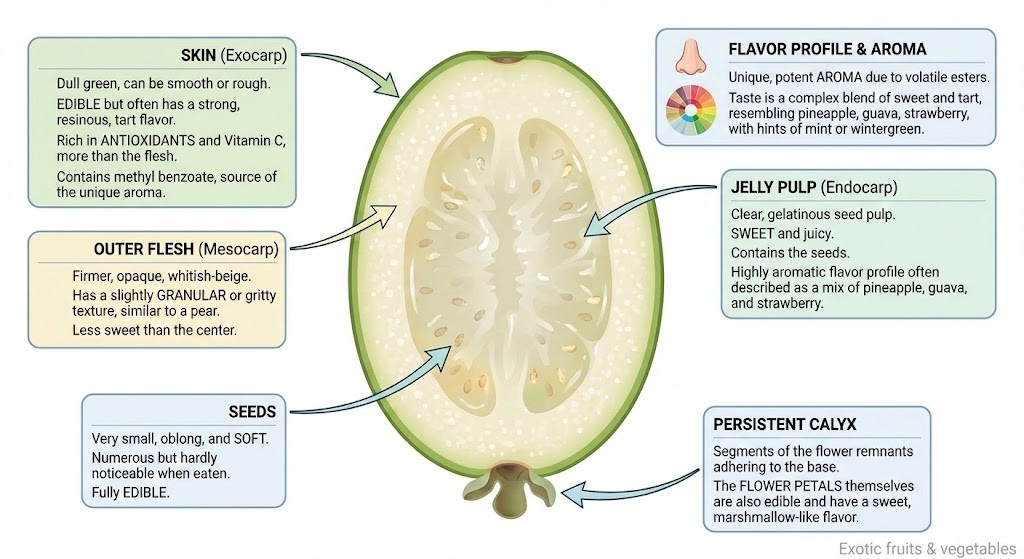
Let’s start from the outside. The skin, or exocarp, of the Feijoa is deceiving. It stays green even when fully ripe, ranging from a lime-green to an olive-drab hue depending on the variety like ‘Coolidge’ or ‘Mammoth’. Unlike the thin skin of a grape or the thick rind of an orange, the Feijoa skin is leathery, slightly bumpy, and covered in a waxy bloom that rubs off under your thumb.
Here at Exotic Fruits and Vegetables, we’ve found that the skin is the most polarizing part of the fruit due to its intense tartness and high concentration of aromatic oils. While the interior sugars might hit 20-25 Brix (a measure of sweetness), the skin holds a pH closer to 3.0, providing a sharp, acidic kick.
Ever wonder why some fruit enthusiasts insist on eating the Feijoa whole, like a peach, while others meticulously scoop it out?
The answer lies in the aromatic compounds—methyl benzoate and ethyl benzoate—concentrated in the skin. These create that distinct perfume that smells like a mix of pineapple, mint, and strawberry.

At the base of the fruit, you will find the persistent calyx lobes. These are the dried remnants of the flower sepals. While you don’t eat this hard, woody bit, it serves as a critical diagnostic tool for me. If the calyx area is black or oozing, the fruit has been on the ground too long and has likely been invaded by insects or mold.
The Mesocarp: The Gritty Transition
Slice the fruit open crosswise, and you enter the outer flesh, technically called the granular mesocarp. This is the white to cream-colored layer right under the skin. If you have ever eaten a pear and noticed that sandy texture, you are familiar with stone cells, or sclereids. Feijoas are packed with them.
The thickness of this granular layer varies by cultivar; ‘Apollo’ tends to have a thinner, smoother mesocarp, while ‘Trask’ offers a thicker, grittier bite that stands up better in salsa.
This part of the fruit acts as a structural buffer. It is less sweet than the center but provides the necessary crunch to balance the jelly inside. In my kitchen, when I am making a Feijoa chutney, I rely on this layer to keep the mixture from turning into pure mush. Think of the mesocarp as the structural integrity of a building; without it, the whole thing collapses.
The Endocarp: The Jelly Heart
Now we reach the prize: the gelatinous seed pulp, or endocarp. This is the translucent, jelly-like center that usually forms a cross or star shape when you slice the fruit transversely. This section houses roughly 20 to 40 tiny seeds, which are so small and soft that you don’t even notice eating them.
The clear jelly center is where the highest concentration of sugars and the pure “pineapple-strawberry” flavor profile resides, free from the tannins found in the skin.
When I introduce new customers to this fruit, I tell them to close their eyes and scoop just this center part. It is custard-like, similar to a passion fruit but without the aggressive crunch of seeds. This moisture-rich core is also the first part to brown (oxidize) once cut, so you have about 15 minutes to eat it or treat it with lemon juice before it looks unappealing.
Comparing the Edible Layers
To help you visualize how to use these parts, I have broken down their characteristics based on my harvest data from last season:
| Fruit Part | Texture | Flavor Profile | Best Culinary Use |
|---|---|---|---|
| Skin (Exocarp) | Leathery, Waxy | Sour, Bitter, Aromatic, Resinous | Infusions, Pickling, Zest |
| Outer Flesh (Mesocarp) | Firm, Gritty (Stone Cells) | Mildly Sweet, Tart, Floral | Salsas, Baking, Chutneys |
| Jelly Center (Endocarp) | Soft, Gelatinous, Smooth | Intensely Sweet, Tropical, Perfumed | Raw Eating, Ice Cream, Drinks |
The Flower: The Forgotten “Part” of the Harvest
We cannot talk about the parts of the Feijoa without discussing the flower. Most people wait for the fruit, but the petals themselves are a delicacy. In May and June, my bushes are covered in striking flowers with white fleshy petals and crimson stamens.
The petals of the Acca sellowiana are edible and taste surprisingly sweet, resembling cotton candy or marshmallow with a hint of cinnamon.
Our experience at Exotic Fruits and Vegetables has shown that hand-harvesting the petals adds a whole new revenue stream or culinary dimension to the crop. You carefully pluck the fleshy white petals without damaging the central red stamens. If you leave the stamens and the pistol intact, the plant will still pollinate and produce fruit. It’s a “have your cake and eat it too” scenario.
I use these petals to dress up salads. Imagine a bowl of bitter arugula tossed with walnuts and these sweet, marshmallow-flavored flower petals. It is a texture and flavor contrast that blows people’s minds.
Assessing Ripeness Through Physical Signals
Unlike a banana that turns yellow or a strawberry that turns red, the Feijoa keeps its secrets. It remains green. Determining ripeness requires understanding the connection point—the abscission layer. This is the precise spot where the fruit stem meets the branch.
In nature, the Feijoa drops when it’s ready.
The abscission layer dries out, and gravity takes over. However, commercial growers often pick them early for transport, which results in a rubbery, tasteless puck.
Never pull a Feijoa forcefully from the branch; if you have to tug, the abscission layer hasn’t formed, and the fruit will never ripen properly on your counter.
I once ruined an entire batch of ‘Nazemetz’ feijoas by getting impatient. I clipped 50 pounds of fruit off the bushes because a heatwave was coming (100°F+). I thought I was saving them. Instead, they stayed hard as rocks for three weeks and then shriveled up. They never developed that jelly center.
Here is how I assess the parts for ripeness now:
- The Drop Test: I gently shake the bush. Whatever falls is usually perfect.
- The Squeeze: I apply pressure similar to testing a ripe avocado. The mesocarp should yield slightly under the skin.
- The Aroma: A ripe Feijoa emits a fragrance from the skin that can perfume a whole room. If you have to sniff hard, it’s not ready.
The Seed Cavity and Storage
Once the fruit is off the tree, the clock starts ticking on the internal parts. The seed cavity—that jelly center—is the most volatile. If kept at room temperature (70°F), the jelly will turn brown and rot within 4 to 5 days.
To extend the life of the internal jelly, you must store the fruit in the refrigerator at 40°F immediately after the “give” test confirms ripeness.
I recall a season where I left a crate in the barn overnight during a warm spell. By morning, the internal fermentation had started. The jelly didn’t taste like tropical fruit; it tasted like bad wine. That fermentation happens in the endocarp first.
Culinary Application: Whole vs. Parts
Understanding these parts transforms how you cook. If you are making a smoothie, you want the pectin from the skin and the sugar from the jelly. If you are making a delicate mousse, you only want the jelly.
We at Exotic Fruits and Vegetables believe in using the whole fruit to minimize waste and maximize flavor complexity. Here are a few ways I utilize specific parts:
- Skins: Dehydrated and ground into a powder for a sour-dust rim on margarita glasses.
- Mesocarp: Chopped into 1/4 inch cubes for a salsa with jalapeños and onions—the stone cells hold their shape against the lime juice.
- Jelly: Scooped out and folded into yogurt or oatmeal for natural sweetness.
- Whole Fruit: Blended with water and strained to make “Agua Fresca,” balancing the sour skin and sweet flesh.
“Processing Feijoas is like mining for gold; you have to move a lot of earth to get the nugget, but sometimes the earth itself is valuable.”
Be careful when blending the whole fruit; if you blend too long, you will shatter the tiny seeds in the jelly center, releasing bitter tannins that can ruin the flavor profile.

Final Thoughts from the Orchard
The Feijoa is a masterclass in botanical complexity. It is not just a green fruit; it is a collection of parts—skin, stone cells, jelly, seeds, and calyx—that all play a role in the eating experience.
The true secret to enjoying this fruit is learning to manipulate these parts: peeling when you want sweet, chopping when you want crunch, and sniffing when you want to know if it’s time to eat.
Next time you see a basket of these at the market or in your neighbor’s yard, don’t just look at the green skin. Think about the marshmallow petals that came before it, the gritty protective layer inside, and the sweet jelly heart waiting for you. It’s a complete sensory journey in a 2-inch package.
What’s stopping you from planting a Feijoa bush this spring and experiencing the sweetness of the petals for yourself?



Automating feijoa cultivation with precision climate control and soil moisture sensors like Decagon GS3 reveals 25% increase in yield, optimizing grow light spectrum with LED panels from Growers Supply Company
What’s the ideal temperature range for feijoa growth? Is it between 65-75°F? And what’s the minimum pot size for healthy root development?
Feijoa’s antioxidant profile is notable, with studies like ‘Phytochemical analysis of Acca sellowiana’ (2019) highlighting its high ORAC value and vitamin C content, traditionally used in South America for its medicinal properties