

The first time I smelled a ripe feijoa in my San Diego orchard, I thought someone had spilled cheap perfume near the compost pile. It was intense, floral, and undeniably tropical. Now, fifteen years later, that scent signals one of my favorite times of the year.
I have seen gorgeous, twenty-year-old feijoa trees in El Cajon that produce absolutely zero fruit simply because the owners treat them like a privacy fence rather than a fruit tree. Proper pruning is the bridge between a decorative shrub and a bumper crop of tangy, gritty, delicious fruit. It requires a shift in mindset from “maintenance” to “optimization.”
In their native highlands of southern Brazil and Uruguay, these trees grow in thickets, but in cultivation, we need to manipulate their architecture to maximize solar capture.
Understanding the Beast Before You Cut
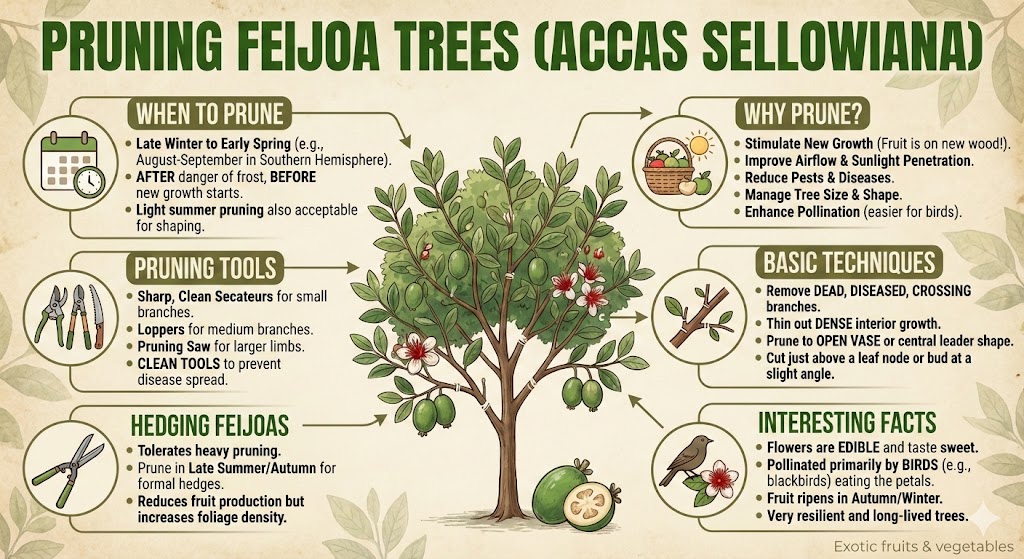
Before grabbing your shears, you must understand how this specific species behaves. Feijoas are unique because they fruit on the current season’s growth. This is a game-changer. It means if you prune heavily in late summer or winter, you are not cutting off future fruit buds—you are actually stimulating the wood that will bear flowers in late spring. However, timing is critical.
Here at Exotic Fruits and Vegetables, we’ve found that the absolute best time to prune feijoa trees in San Diego is late winter, typically late February to early March. You want to catch the tree just before it wakes up for the spring flush. Pruning stimulates growth; if you prune too early in winter, you risk stimulating tender new shoots that a rogue January frost could zap.
If you prune too late in May, you cut off the flower buds that are just starting to form.
Have you ever noticed that the fruit inside a dense bush is smaller and less sweet than the fruit hanging on the outer edges?
That flavor difference is purely a function of sunlight. Sugar production in the fruit is directly linked to the photosynthesis occurring in the nearest cluster of leaves. Think of the tree’s leaves as solar panels and the fruit as the battery; if you shade out the panels with a dense, unkempt canopy, your battery never charges fully. Pruning acts like cleaning the dust off those solar panels.
The Toolkit for Success
Don’t just grab the rusty shears sitting in the bottom of a bucket. Feijoas are tough, but they can succumb to fungal issues if you aren’t careful. I use a very specific kit for my orchard maintenance:
- Bypass Pruners: I use Felco 2s, but any high-quality bypass shear works. Anvil pruners crush the stem, inviting disease.
- Pruning Saw: For removing those thick, woody trunks at the base that are over 1.5 inches in diameter.
- Disinfectant: A spray bottle with 70% Isopropyl alcohol. I spray my blades between every single tree.
- Gloves: Feijoa bark is flaky, but the inner twigs can be surprisingly scratchy.
Never skip the alcohol spray. I once transferred a fungal dieback from a sick guava to three healthy feijoas because I was too lazy to walk back to the shed for my disinfectant.
Step-by-Step Pruning for Maximum Yield
The goal here is to create a “vase” shape or an open center. We want birds—who are the primary pollinators for feijoas along with bees—to easily navigate the branches. If a hummingbird can’t fly through your tree, neither can the sunlight.
- The 3 D’s: Start by removing anything Dead, Damaged, or Diseased. This is non-negotiable. Cut these back to healthy green wood or all the way to the trunk collar.
- Lift the Skirt: Feijoas love to send out low, sprawling branches that drag on the soil. This is an invitation for ants and snails. I trim all lower branches to create a clear trunk space of at least 18 to 24 inches from the ground.
- Clear the Center: Look down into the tree from the top. Can you see the main crotch where the trunk splits? If not, start thinning. Remove vertical water shoots growing straight up from the center. These are vegetative drains that block light.
- Eliminate Crossers: Identify branches that are rubbing against each other. The friction creates wounds that invite pests. Always keep the branch growing outward and remove the one growing inward.
- Heading Cuts: Once the structure is clean, shorten the remaining long branches by about 20% to encourage side branching. Remember, more side branches on new wood equals more flowers.
The most critical rule is to never remove more than 30% of the tree’s total canopy in a single year, as this causes shock and sunscald on the bark.
I switched to the “open center” method three years ago and saw my harvest weight increase from 15 pounds per tree to nearly 45 pounds per tree.
Hedge vs. Tree: A Yield Comparison
Many San Diegans use Pineapple Guava as a hedge. While it makes a dense, beautiful screen, hedging is the enemy of fruit production. When you use hedge trimmers, you create a “surface shell” of leaves. The interior of the hedge becomes a dead zone of leafless sticks because no light penetrates.
Through our work with Exotic Fruits and Vegetables farm, we emphasize that if you want fruit, you must grow it as a tree, or at least a modified informal hedge. I compiled some data from my own orchard comparing three rows of feijoas managed differently over a 4-year period.
| Pruning Style | Average Yield per Plant | Fruit Size | Maintenance Time |
|---|---|---|---|
| Formal Boxed Hedge | 4.2 lbs | Small (Golf ball) | High (Monthly trim) |
| Natural Unpruned Bush | 12.5 lbs | Mixed (mostly small) | None |
| Open-Center Tree Form | 38.0 lbs | Large (Chicken egg) | Medium (Twice yearly) |
My Personal “Oops” Moment
I wasn’t always this systematic. Six years ago, I decided to do a “hard reset” on an old, overgrown feijoa in July. It was 95°F in the shade. I thought I was helping the tree by removing half the canopy to let it breathe. Within three days, the exposed bark on the main trunk turned white and cracked—severe sunscald. The tree didn’t die, but it dropped every single fruit it was holding and took two full years to recover its vigor.
Never expose previously shaded dark bark to direct San Diego summer sun without painting it with a 50/50 mix of white interior latex paint and water.
That experience taught me that pruning is like surgery. You don’t perform major surgery when the patient is running a marathon. You do it when they are resting. In the heat of summer, your tree is running a metabolic marathon trying to stay hydrated.
Water and Nutrition Post-Prune
After you have made your cuts in early spring, the tree is going to send a chemical signal to grow. You need to support that urge. I apply a balanced organic fertilizer—usually a 5-5-5 or a 10-10-10—immediately after pruning. I scatter about one cup of granular fertilizer for every year of the tree’s age, up to a maximum of 8 cups for mature trees, right at the drip line.
Do not just sprinkle it on dry dirt. Water it in deep. In our sandy loam soils here in San Diego, I run the drip irrigation for 2 hours to ensure the nitrogen pushes down to the root zone. Then, I re-apply a fresh layer of mulch.
A 3-inch layer of wood chip mulch helps retain soil moisture and regulates root temperature, simulating the forest floor of the feijoa’s native habitat.
What’s the real secret to success with post-pruning care? Consistency. You can’t just feed it once and walk away. I follow up with a half-strength liquid fish emulsion drench in May and July. This keeps the new growth—the wood that will hold next year’s fruit—strong and flexible.

Conclusion
Pruning feijoas is an art form that rewards you with edible masterpieces. It feels counterintuitive to cut away healthy branches, but you are essentially trading wood for fruit. You are telling the tree, “Stop focusing on getting bigger, and start focusing on reproduction.”
Remember that feijoa flowers are edible too—the petals taste like cotton candy—so don’t feel bad if you accidentally prune off a few buds; just eat them right there in the garden.
Our team at Exotic Fruits and Vegetables loves adding these petals to salads for a burst of sweetness, but we leave most on the tree to transform into the main event. By taking the time to open up your tree this spring, you aren’t just gardening; you are engineering a harvest. So, sharpen those shears, wait for that late February window, and give your feijoas the breathing room they deserve.


I sell feijoas at $3.50/lb, and customers love ’em! Simple signage with tasting tips helps move product. Currently, I’m looking to expand my customer base for these unusual fruits.