
There is a specific kind of magic that happens in San Diego when the marine layer burns off around 11:00 AM, and the sun hits the orchard. If you are standing near a fig tree, the air suddenly smells like honey and green leaves. I have been chasing that smell and the fruit that produces it for a long time. While everyone else is clamoring for the dark purple Black Missions or the bright green Kadotas, I want to talk to you about the workhorse of my orchard: the Brown Fig, specifically the varieties like the Brown Turkey.
You might hear them called by their scientific handle, Ficus carica, but out here in the dirt, we call them everything from “San Piero” and “Aubique Noire” to simply “California Browns.” Whatever you call them, these trees are survivors. They tolerate our alkaline soils better than most exotics, and they produce fruit that tastes like jam right off the branch. But don’t let their hardiness fool you; treating a fig tree like a cactus is the quickest way to get dry, tasteless fruit.
My grandfather used to say that a fig tree is the only tenant that pays rent twice a year—once with the breba crop in June and again with the main crop in late summer.
Understanding the Brown Turkey and Its Cousins
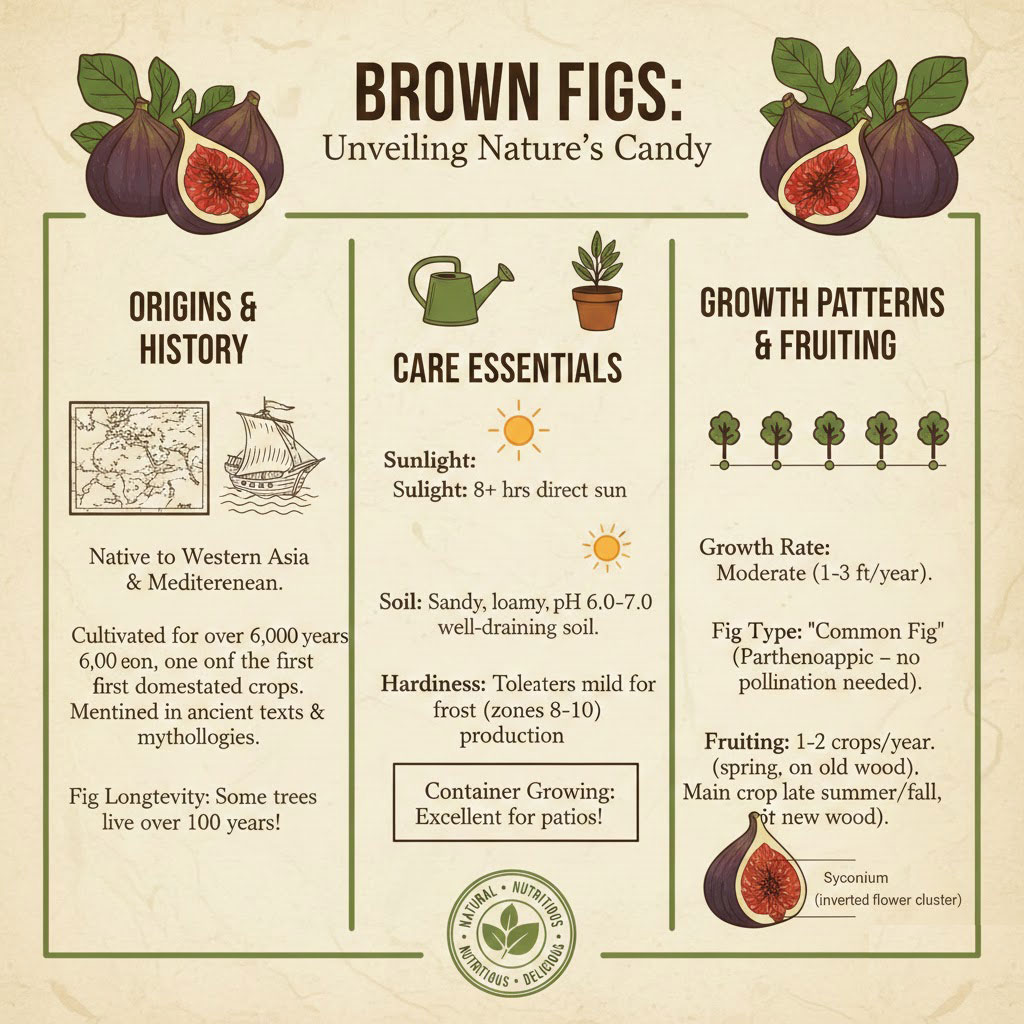
Why do we bother with the brown varieties when the darker figs get all the market attention? It comes down to reliability and flavor profile. A properly ripened Brown Turkey fig isn’t just sweet; it has a nutty, melon-like undertone that you don’t get in the sugar-bomb profile of a Black Mission. The skin is copper-colored to deep purple-brown, often cracking slightly when it’s at peak sweetness.
Here at Exotic Fruits and Vegetables, we’ve found that the Brown Turkey variety acts as the perfect gateway fruit for new growers because it forgives minor watering mistakes that would cause other varieties to drop their fruit instantly. However, understanding the botany is crucial. These trees are self-pollinating, meaning you don’t need a wasp or a second tree to get fruit. This is a huge advantage for urban farmers in San Diego who might only have space for one large container or a single spot in the yard.
The “fruit” of the fig is actually an inverted flower. Those tiny crunchy bits inside aren’t just seeds; they are individual achenes, each one a fruit in its own right.
Site Selection and Soil Preparation
I cannot stress this enough: figs love their feet dry and their heads in the oven. In our coastal San Diego climate, this means you need a spot that gets a minimum of 8 to 10 hours of direct sunlight. If you plant a brown fig in the shade of a fence or a large oak, you will get lush, beautiful green leaves and absolutely zero fruit.
You want a soil pH between 6.0 and 6.5. If your soil is heavy clay, do not just amend the hole. You need to build a raised bed or mound the planting site 8 to 12 inches high. I mix 40% native soil with 30% compost and 30% pumice or coarse sand. This mixture acts like a high-quality coffee filter—it lets the water pass through while retaining just enough moisture to keep the feeder roots happy.
Never plant a fig tree near your septic tank or sewer line. Fig roots are aggressive hydraulic engineers; they can smell water through concrete and will crack pipes to get to it.
Watering: The Art of Balance
Many guides tell you to “water regularly.” That advice is useless. Here is the math: a mature brown fig tree in full canopy during a San Diego July needs approximately 15 to 20 gallons of water per week. I break this down into two deep soakings. You want the water to penetrate at least 24 inches deep. Shallow watering encourages shallow roots, which leads to fruit drop the second we get a Santa Ana heatwave.
Think of the soil as a battery that stores moisture. You need to charge it fully, then let it discharge slightly before charging it again. If you keep it at 100% saturation constantly, the roots rot. If you let it hit 0%, the tree goes into survival mode and sheds its fruit to save energy.
Ever wonder why your figs split open right before they are ripe? It’s usually inconsistent watering—a sudden deluge of water after a dry spell causes the fruit to expand faster than the skin can stretch.
Nutritional Requirements
Figs are not heavy feeders compared to something like a citrus tree, but they do have specific cravings. Excess nitrogen is the enemy. If you pump your fig tree with high-nitrogen fertilizer, it will grow six feet of gorgeous green branches and produce absolutely no figs. It’s the plant equivalent of a bodybuilder with no functional strength.
I use a granular fertilizer with an NPK ratio of 5-5-5 or 8-8-8. I apply 1 pound for every year of the tree’s age, capping at 10 pounds for a fully mature tree, split into three applications: late winter (February), late spring (May), and mid-summer (July). Our experience at Exotic Fruits and Vegetables has shown that adding a cup of bone meal to the spring feeding significantly increases the structural integrity of the fruit skin, reducing splitting.

Pruning Strategies
Pruning a brown fig is like directing traffic; you have to close off some roads to make sure the main highway flows smoothly. We aim for an “open vase” structure. This means clearing out the center of the tree to let light hit the inner branches.
- Winter Pruning: When the tree is dormant (January for us), remove any of the “Three Ds”: Dead, Damaged, or Diseased wood.
- The 50% Rule: Cut back the previous year’s growth by half. This stimulates new growth, which is where the main crop forms.
- Sucker Removal: aggressively remove the shoots coming from the base of the trunk. They suck energy away from fruit production.
- Summer Pinching: Pinch off the tips of branches once they grow 5-6 leaves. This forces the tree to stop growing outward and start pumping sugar into the developing fruit.
Sterilize your pruning shears with rubbing alcohol between cuts. It takes five seconds and prevents the spread of Fig Mosaic Virus, which creates mottled yellow leaves and stunted fruit.
Harvesting: The Waiting Game
This is where patience pays the rent. Figs do not ripen after being picked; if you pull it off the tree hard and green, it will stay hard and green forever. I watch the neck of the fruit. When the fig droops on its stem and the neck looks slightly shriveled, gravity is telling you it’s ready.
The skin should be soft to the touch, almost like a water balloon that isn’t quite full. You might even see a drop of nectar oozing from the ostiole (the eye at the bottom). That is the “tear of joy,” and it means the sugar content is peaking.
Harvest Comparison: Brown Turkey vs. Common Market Varieties
| Feature | Brown Turkey | Black Mission | Kadota |
|---|---|---|---|
| Skin Color | Copper/Brown to Purple | Deep Purple/Black | Yellow/Green |
| Flavor Profile | Mild, Melon-like, sweet | Rich, Berry-like, intense | Honey, less sweet |
| Harvest Window | Long (June – Oct) | Mid (Aug – Oct) | Late (Sept – Nov) |
| Splitting Risk | Moderate | High | Low |
I once had a breakthrough when I realized the ants were better harvest indicators than my calendar. If I saw a line of Argentine ants marching up the trunk, I knew the sugar levels were hitting 20 Brix. Of course, you don’t want them eating your profits. I use Tanglefoot—a sticky resin—on the trunk to stop them. Do not apply it directly to the bark; wrap the trunk in masking tape first, then apply the sticky stuff to the tape.
There is nothing more heartbreaking than reaching for a perfect, drooping fig only to find the backside has been hollowed out by beetles or birds. Net your trees once the fruit starts to color change.
Troubleshooting Common Issues
Even in our paradise climate, things go wrong. Here is a breakdown of what you might face:
- Rust: If leaves develop orange spots and drop early, it’s usually fungal rust caused by humidity. Clean up fallen leaves instantly to prevent reinfection next year.
- Sour Fruit: If the fig smells like vinegar on the tree, it has fermented inside. This is usually caused by vinegar flies entering the eye. Brown Turkey figs have a moderately open eye, making them susceptible.
- Drop: Young trees often drop fruit because they aren’t strong enough to support it. It’s heartbreaking, but normal for the first 2-3 years.
We’ve learned at Exotic Fruits and Vegetables that consistency is the cure for 90% of these problems. Consistent water prevents splitting. Consistent cleanup prevents pests. Consistent observation prevents heartbreak.
Be careful with the white milky sap (latex) that bleeds from cut branches or unripe fruit. It is phototoxic and can cause nasty skin burns if exposed to sunlight.

The Payoff
Growing Brown Figs is a long-term relationship. The first year, you worry. The second year, you hope. By the third year, you are overwhelmed with abundance. Last season, I harvested 47 pounds of fruit from just three mature trees. That is a lot of fig jam, dried figs, and fresh eating.
When you slice open a warm Brown Turkey fig, the flesh should be an amber-pink color, glistening with juice. It tastes like the culmination of all that soil prep, pruning, and watering. The best way to eat a fig is standing right next to the tree, wiping the dust off on your shirt, and eating it whole, skin and all.
If you have a patch of dirt in San Diego—or anywhere with a hot summer—put a Brown Turkey in the ground. It asks for very little and gives back sweetness in abundance. Just watch out for those roots near your pipes.