Standing in the middle of my orchard in the San Diego backcountry, with the morning marine layer just burning off the hills, I often get asked the same question by visitors. They look at the gnarled, twisting branches of my *Ficus carica* trees and ask, “Do these things actually produce fruit every single year?” It is a fair question, especially if you have ever stared at a stick in the mud in your backyard for three years waiting for a single fruit. The short answer is yes. Fig trees are biologically programmed to be annual producers, and in our Zone 10 climate, they are often twice-a-year producers.
However, nature rarely deals in absolutes without a few caveats. While the genetics of the tree aim for reproduction annually, the specific conditions in your yard dictate whether you get a harvest or just a nice shade tree. I have learned the hard way that a fig tree is not a “set it and forget it” cactus; it is a high-performance machine that needs specific inputs to yield output. If your tree is skipping years, it isn’t resting; it is stressing.
Technically, a fig is not a fruit but a syconium—an inverted flower. The flowers bloom inside the pear-shaped pod. When you eat a fig, you are consuming hundreds of tiny flowers and the seeds that result from them. This unique structure is why they are so sensitive to environmental changes.
The Two-Crop Potential in California
One of the reasons we love growing figs here in Southern California is the potential for a double harvest. Understanding this cycle is critical because many new growers prune off their first crop by mistake. We deal with two distinct fruiting phases: the Breba and the Main Crop.
The Breba crop grows on the previous year’s wood—the hardened, gray branches from last season. These start swelling in late winter and usually ripen around June. They are often larger but can be less flavorful and more prone to dropping if the spring weather fluctuates. I remember one specific spring where temperatures swung from 55°F to 95°F in three days; my entire Breba crop on the ‘Desert King’ variety turned yellow and dropped instantly.
Have you ever noticed that the first figs of the season sometimes taste watery or lack that deep, jammy sweetness found in late summer?
The Main Crop forms on new, green growth produced in the current spring. These are the figs that ripen from late August through October. They are generally smaller, sweeter, and more abundant. Here at Exotic Fruits and Vegetables, we’ve found that focusing on the main crop yields better results for processing jams and drying, as the sugar content is significantly higher due to the intense summer sun.

Why Your Tree Might Be Empty
If you have a mature tree that refuses to fruit, you are likely committing one of three sins: over-fertilizing, under-watering, or pruning at the wrong time. I once ruined an entire season’s harvest on my prize ‘Panache’ tree by trying to be too kind to it.
I dumped three wheelbarrows of fresh chicken manure around the base in February. The nitrogen content was so high that the tree grew five feet of lush, beautiful green branches, but it produced zero figs. The tree was so busy consuming nitrogen and building foliage that it forgot to reproduce.
Never use high-nitrogen lawn fertilizers near your fig trees. A 20-0-0 mix will force vegetative growth at the expense of fruit. Instead, use a balanced 5-5-5 organic mix or a fertilizer lower in nitrogen and higher in phosphorus/potassium to stimulate fruit set.
The Water Equation
There is a myth that figs are drought-tolerant. They are drought-tolerant regarding *survival*, meaning they won’t die if you don’t water them for a month. But they are not drought-tolerant regarding *production*. To get juicy, expansive fruit, you need water.
During fruit set, a lack of water causes the tree to abort the fruit to save itself. In our sandy loam soil, I apply approximately 15 to 20 gallons of water per week per mature tree during the heat of July and August. If the soil dries out completely down to 4 inches, the fine feeder roots die back, and the fruit shrivels.
Our experience at Exotic Fruits and Vegetables has shown that a 3-inch layer of wood chip mulch extends the hydration window by 40%, keeping the root zone cool and moist even when air temperatures hit 100°F.
Troubleshooting Your Harvest
If you are looking at your tree and scratching your head, use this diagnostic table. These are the real issues I see in orchards across San Diego County.
| Symptom | Likely Cause | Specific Remedy |
|---|---|---|
| Tree grows fast, leaves are huge, no fruit | Excess Nitrogen | Stop feeding immediately; pinch off the growing tips of every branch. |
| Fruit forms but turns yellow and drops (young tree) | Tree Maturity | Patience. Trees under 3 years old often drop fruit. Wait until year 4. |
| Fruit drops in summer (mature tree) | Inconsistent Watering | Install drip lines to deliver 2 gallons per hour for 4 hours, twice weekly. |
| Fruit is dry and woody inside | Lack of Heat/Sun | Ensure 8+ hours of direct sun; prune overhanging shade trees. |
Pruning: The Art of Subtraction
Pruning is terrifying for beginners, but it is essential for annual fruiting. An unpruned fig tree eventually becomes a tangled mess where sunlight cannot penetrate the center. Fruit produced in deep shade will never develop proper sugar levels and will often sour before ripening.
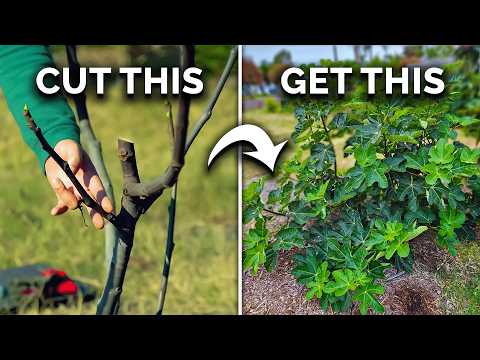
I prune my trees in late January when they are fully dormant. My goal is an “Open Vase” shape. I want to be able to throw a football through the middle of the tree without hitting a branch. This airflow reduces rust fungus and allows the sun to hit the ripening fruit directly.
- Remove the 3 Ds: Cut out all Dead, Damaged, and Diseased wood flush to the trunk.
- Clear the Center: Remove any branches growing inward or crossing the center line.
- Select Scaffolds: Choose 4 to 6 main structural branches and remove the rest.
- Heading Cuts: Cut back the remaining branches by one-third to stimulate new fruiting wood for the Main Crop.
Hard pruning stimulates a vigorous Main Crop. Don’t be afraid to remove up to 50% of the tree’s mass if it has become overgrown; figs are incredibly resilient and will bounce back stronger.
Varieties That Deliver Every Year
Not all figs thrive in every microclimate. In San Diego, we have coastal zones and inland valleys, and the variety you choose must match your heat units. Through our work with Exotic Fruits and Vegetables farm, we have tested dozens of cultivars to see which ones are reliable annual producers.
If you want guaranteed fruit every year without needing a pollination wasp (Caprification), stick to these “Common” parthenocarpic types:
- Black Mission: The gold standard for California. It produces two heavy crops annually and has a rich, earthy flavor.
- Brown Turkey: While not the most complex flavor, it is a workhorse that fruits reliably even in poor soil and cooler coastal weather.
- Violette de Bordeaux: A dwarf variety perfect for pots. It produces small, purple figs with an intense raspberry jam flavor.
- White Genoa: Excellent for cooler coastal areas as it resists souring in humidity better than the dark varieties.
The Pest That Steals the Harvest
I cannot talk about fig growing in San Diego without mentioning the Green Fig Beetle (*Cotinis mutabilis*). These iridescent green nightmares arrive just as the fruit softens. They don’t just eat the fruit; they dive-bomb it, turning your prize figs into a fermented mush.
Do not use pesticides on ripening fruit. Instead, use “bait traps.” Hang a jug of diluted grape juice and yeast near the tree. The beetles will fly into the jug and drown, leaving your figs alone.
Knowing When to Harvest
The biggest tragedy I see is people picking figs too early. Unlike avocados or bananas, figs stop ripening the moment you sever them from the branch. If you pick a fig that is firm and standing up straight, it will taste like latex and cardboard forever.
You must wait for the “neck bend.” The fruit should droop on its stem, becoming soft to the touch, almost like a water balloon that is not quite full. You might even see small “sugar cracks” in the skin or a drop of nectar at the eye (ostiole). That is the moment of perfection. If you pick it then, you are tasting sunshine.
“A ripe fig is a heavy fig. If it feels light and airy, it’s either dry or hollow. You want it to feel dense with syrup.”
Final Thoughts from the Orchard
Growing figs is one of the most rewarding pursuits for a San Diego gardener. The trees are tough, they provide beautiful shade, and they offer a fruit you simply cannot buy in a grocery store with the same quality. The shelf life of a perfectly ripe fig is about 48 hours, which is why growing your own is the only way to experience the true flavor.
Farming is about observation more than intervention. Watch your leaves, check your soil moisture with your finger, not a gauge, and get ready for a harvest that will ruin store-bought fruit for you forever. The best fertilizer is the gardener’s shadow.