There is a specific moment in late August here in San Diego that I live for. It is that split second when you gently squeeze a ‘Panache’ Tiger Stripe fig, and it gives just slightly under your thumb, drooping on its stem like a heavy, sugar-filled teardrop. That is the universal sign of perfection. Whether you know them by their scientific name, Ficus carica, or just as the backyard snack that the scrub jays always seem to find first, growing figs is a pursuit of passion. But to get that jammy, honey-like interior, you have to move beyond just planting and watering. You have to understand how to feed them properly to unlock that potential.
I remember staring at my first orchard block in the San Pasqual Valley years ago, completely confused by the sheer volume of conflicting advice available. Some folks said figs thrive on neglect and should be ignored, while others treated them like delicate orchids that needed constant babying. The truth, as I have discovered, lies somewhere in the middle. Figs are robust survivors in our specific Mediterranean climate, but they need specific nutritional inputs to transform from leafy bushes into fruit-producing powerhouses.
Native to the Middle East and Western Asia, figs are uniquely adapted to hot, dry summers and mild winters. They don’t just “eat” fertilizer; they utilize nutrients to support two potential crops: the breba crop on last year’s wood and the main crop on new growth.
Here at Exotic Fruits and Vegetables, we’ve found that understanding the biology of the tree is the first step to proper feeding. If you dump nitrogen on a tree at the wrong time, you are essentially telling it to build a skyscraper when it should be furnishing the rooms. You end up with twelve feet of gorgeous green leaves and absolutely zero fruit to show for your effort.
The Great Nitrogen Trap: My Rookie Mistake
Let’s get real about failures because that is how we actually learn to farm better. I once ruined an entire season’s harvest on my prized ‘Black Mission’ trees. I had access to a truckload of fresh, “hot” chicken manure and thought I was doing the trees a massive favor by top-dressing them heavily in late spring. I assumed more fuel meant more fruit.
Never apply fresh, uncomposted manure directly to your fig trees. The ammonia levels can burn the feeder roots, and the excessive nitrogen shock sends the tree into a vegetative frenzy, causing it to drop every single fruitlet to focus on making leaves.
The result was heartbreaking. My trees grew three feet in a month and looked tropical and lush. But when harvest time came around in August, I had nothing but shade. I learned the hard way that figs require a delicate balance. They need enough energy to grow, but enough stress to fruit. It is a dance between vegetative growth and reproductive growth, and you are the choreographer.
What Your Soil Actually Needs
Before you buy a single bag of fertilizer, you have to look at your soil. In San Diego, we often deal with clay-heavy adobe that holds nutrients well but drains poorly, or decomposed granite (DG) that drains too fast. Understanding your soil texture is half the battle in fertilization.
Have you ever wondered why your neighbor’s neglected tree produces more fruit than your pampered one? The answer usually lies in the soil’s existing nutrient bank and the lack of human interference disrupting the cycle.
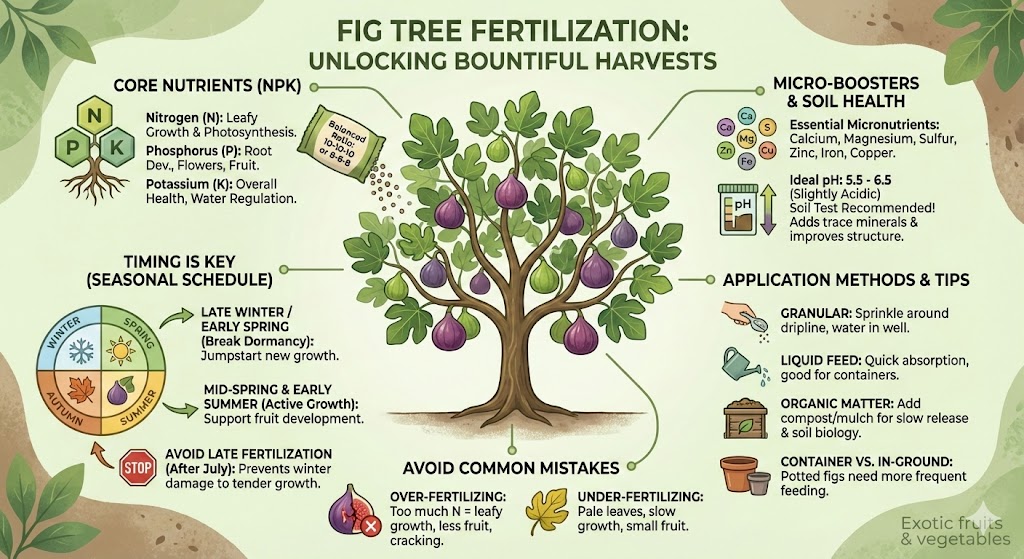
Figs generally require an N-P-K (Nitrogen-Phosphorus-Potassium) ratio that is balanced, or slightly lower in nitrogen once the tree is established. I look for an analysis close to 8-8-8 or 10-10-10. This provides a steady baseline of nutrition without pushing the tree too hard in any one direction.
However, the “P” and “K” are where the magic happens for fruit quality. Phosphorus aids in root development and fruit set, while Potassium is like the tree’s immune system and sugar regulator. If you want figs that taste like honey and berry jam rather than watered-down cardboard, you must prioritize Potassium levels in your feeding schedule.
A Practical Fertilization Schedule
Timing is everything in farming. You cannot force-feed a dormant tree, and feeding a tree that is shutting down for winter is a recipe for frost damage on new growth. You have to work with the seasons.
Here is the specific schedule I use for my in-ground trees to maximize yield:
- Late Winter (February): As soon as I see the buds swelling (the “breba” awakening), I apply 30% of the year’s fertilizer. This wakes the tree up and fuels the initial push.
- Late Spring (May): Once the main crop fruitlets appear on the new green growth, I apply another 30%. This supports the elongation of the branches that carry the main crop.
- Mid-Summer (July): I apply the final 40% to help the fruit ripen and sugar up. This is the quality application.
- Late Summer/Fall (August-onward): **STOP.** No more nitrogen. You want the growth to harden off before winter arrives.
A general rule of thumb for quantity is to use ½ pound of balanced fertilizer for every year of the tree’s age, up to a maximum of 10 pounds for a fully mature tree.
For those of you who love data as much as I do, here is a breakdown of what specific organic amendments provide for your orchard:
| Amendment | Primary Nutrient | My Usage Notes |
|---|---|---|
| Blood Meal | Nitrogen | Fast-acting. Use only in early spring if leaves are yellow. |
| Bone Meal | Phosphorus | Slow-release. I mix 1 cup into the planting hole for new trees. |
| Kelp Meal | Potassium/Micros | The secret weapon for flavor. I apply 1 cup per inch of trunk diameter. |
| Feather Meal | Nitrogen | My preferred organic nitrogen source. Slower release than blood meal. |
Organic vs. Synthetic: The Flavor Factor
I strictly use organic fertilizers for my fruit production. While synthetic blue crystals act like a sugar rush for plants giving them immediate energy, they do nothing for the soil structure. Think of soil as a battery; organic matter charges that battery so it can provide steady power over time. Synthetics bypass the battery and plug directly into the wall—effective, but risky.
Our experience at Exotic Fruits and Vegetables has shown that organic fertilizers, specifically those rich in calcium and micronutrients, significantly reduce the incidence of fruit splitting. Splitting happens when water uptake is inconsistent. Organic matter acts as a sponge, regulating moisture so the tree doesn’t drink too fast after a rainstorm.
Using composted green waste as a mulch not only feeds the tree slowly over time but also keeps the root zone cool. Figs have shallow feeder roots that hate the baking San Diego sun.
Potted Fig Trees: A Different Animal
Growing figs in containers—half-wine barrels or 15-gallon nursery pots—is incredibly popular here. But a potted fig is like a pet in a cage; it is 100% dependent on you for survival. You cannot rely on a thrice-yearly feeding schedule because the environment is totally artificial.
The rules change for pots because nutrients wash out of the drainage holes every time you water. If you treat a pot like the ground, your tree will starve.
- Frequency: Feed “weakly, weekly.” I use a liquid fish emulsion and kelp blend diluted to half-strength every week during the growing season.
- Soil Mix: Use a mix of 40% potting soil, 30% perlite, and 30% pine bark fines. This ensures drainage and air to the roots.
- Flushing: Once a month, water the pot until water flows freely out the bottom for 2 minutes to wash out salt buildup.
Salt buildup from synthetic fertilizers is the number one killer of potted figs. If you see white crust on the soil surface or brown, crispy leaf edges, flush that soil immediately!
Troubleshooting Nutrient Deficiencies
Your tree talks to you. You just have to learn its language. I walk my orchard every morning, coffee in hand, looking for signs. Visual diagnostics are your best tool.
If the older leaves at the bottom of the branch turn yellow while the top leaves stay green, you have a Nitrogen deficiency. The tree is cannibalizing the old leaves to send mobile nutrients to the new growth. If the new leaves are yellow with green veins, you are likely looking at an iron deficiency, often caused by our alkaline tap water locking out nutrients.
What’s the real secret to success when you see these issues? Don’t panic and overcorrect. Many people see a yellow leaf and dump a pound of fertilizer, which often kills the tree.
Most nutrient “deficiencies” are actually watering issues preventing uptake, specifically root rot from wet feet. Check your watering first. Figs hate having wet feet and will shut down their roots if they can’t breathe.
The “Exotic” Touch
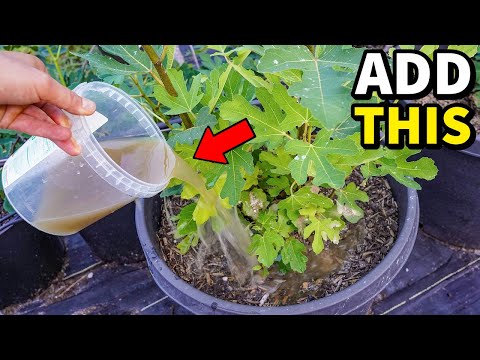
We at Exotic Fruits and Vegetables believe in feeding the soil biology, not just the plant. I brew my own compost tea—bubbling water with worm castings, molasses, and kelp meal for 24 hours. This injects millions of beneficial bacteria and fungi into the root zone. These microscopic critters break down the fertilizer and hand-feed it to the roots.
“The best fertilizer is the gardener’s shadow.” – This old saying holds true. Observation beats calculation every single time.
Final Thoughts on Feeding Your Ficus
Growing figs is a long game. You might not see the results of your soil amendments for three to six months. That is okay. Gardening teaches us patience in a world that demands instant gratification. It connects us to the slower rhythm of nature.
Remember, a fig tree is a survivor. It wants to grow. Your job is simply to clear the obstacles and provide the raw materials. Start with a soil test, stick to organic granular fertilizers with a balanced NPK, and never neglect the Potassium if you want high-quality fruit.
Avoid “Weed and Feed” products anywhere near your fruit trees. The herbicides used to kill dandelions can easily be absorbed by your fig’s extensive surface roots, twisting and deforming the growth permanently.
If you treat your soil right, your fig tree will reward you with bowls full of sweet, sticky goodness that you just can’t buy in a supermarket. Focus on building healthy soil rich in organic matter, and the tree will largely take care of itself.
Now, go check your trees, get your hands dirty, and get ready for a bumper crop this season. Happy growing!