
There is absolutely nothing in the grocery store that compares to a fig ripened on the branch under the warm San Diego sun. When you bite into a properly grown Ficus carica, you aren’t just eating fruit; you are eating jam that grew on a tree. I have been cultivating these ancient fruits on my plot here in Southern California for years, and the difference between a cardboard-flavored store-bought fig and one harvested at peak ripeness is night and day.
Locals here often call them “Higos,” nodding to our region’s rich history, but whatever you call them, they are perfectly suited to our Mediterranean climate. While many people think figs are bulletproof, they actually have specific demands if you want bumper crops rather than barren branches. Through our work with Exotic Fruits and Vegetables farm, we have learned that while the tree will survive almost anywhere in zones 9 and 10, getting it to thrive requires precision.
Did you know that a fig isn’t technically a fruit in the botanical sense? It is actually an inverted flower cluster called a syconium, where the flowers bloom inside the fleshy casing. That crunch you feel when eating one isn’t a seed; it’s an individual achene, which is the true fruit.

Selecting the Right Variety for Our Microclimate
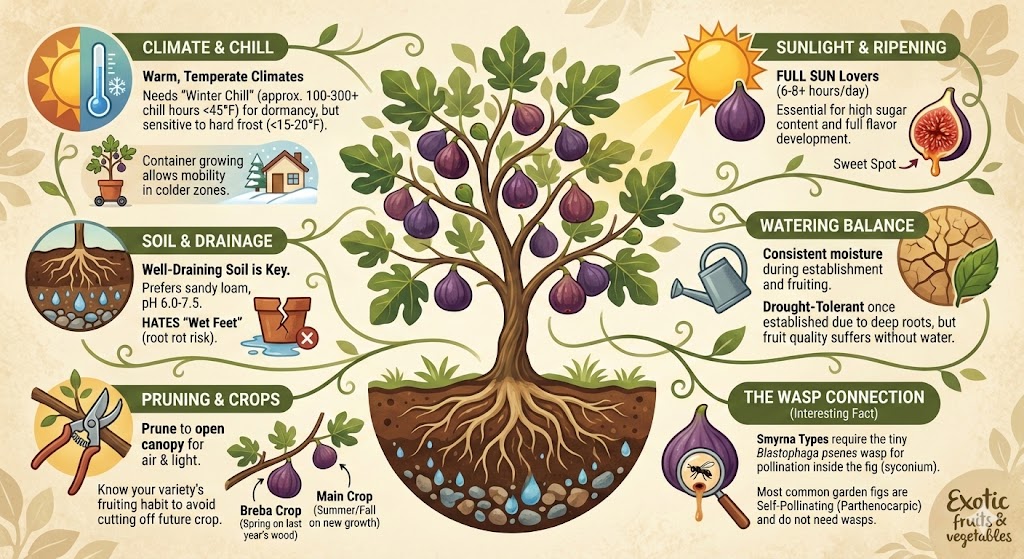
Not all figs behave the same way, especially when you are dealing with the microclimates of San Diego County. I once ruined an entire batch by planting a Smyrna variety without realizing it required a specific wasp for pollination that simply doesn’t exist in my neighborhood. You must choose “common” figs that are self-fertile and do not require pollination to set fruit.
Here at Exotic Fruits and Vegetables, we’ve found that three varieties consistently outperform the others in our coastal and inland valleys. I currently devote about a quarter of an acre specifically to these top performers because they handle our mild winters and hot harvest seasons with grace.
Top Performing Varieties
| Variety Name | Skin/Flesh Color | Flavor Profile | San Diego Harvest Window |
|---|---|---|---|
| Black Mission | Purple-Black / Red | Rich, earthy, berry-like | June (Breba) & August-October |
| Panache (Tiger Fig) | Green-Yellow Stripe / Strawberry | Bright, berry, moderate sweetness | Late August to November |
| Brown Turkey | Brown-Purple / Pink | Mild, sugary, melon-like | July to September |
Have you ever noticed that the first crop of the year tastes different than the second? That first harvest, called the “breba” crop, grows on last year’s wood, while the sweeter main crop grows on new growth produced during the current spring.
Soil Preparation: The Foundation of Flavor
Many gardening guides will tell you that figs tolerate poor soil, but “tolerate” does not mean “produce award-winning fruit.” If you want sugary, jammy interiors, you need to treat the soil like a pantry storing nutrients for a hungry teenager. My soil is naturally heavy clay, which retains too much water and can rot the roots, so I had to aggressively amend it.
For every planting hole, which I dig 24 inches wide and 18 inches deep, I mix the native soil with 40% compost and 10% pumice or perlite. This creates a sandy loam texture that drains excess water while retaining moisture. The target soil pH for optimal nutrient uptake in figs is between 6.0 and 6.5. I test my soil annually in January using a digital probe; if the pH drops below 6.0, I add agricultural lime at a rate of 5 pounds per 100 square feet to bring it back into balance.
I learned the hard way that high-nitrogen fertilizers are the enemy of fruit production. One season, I used a generic lawn fertilizer (29-0-4) near my trees, and while the leaves grew to the size of dinner plates, I harvested exactly zero figs that year because the tree focused entirely on vegetative growth.
Watering and Sunlight Requirements
San Diego receives an average of only 10 inches of rain per year, mostly in winter, which means irrigation is non-negotiable. However, the timing is critical. I use drip irrigation lines with 1-gallon-per-hour emitters spaced 12 inches apart in a ring around the dripline of the tree. Young trees need consistent moisture to establish their root systems.
Think of water as the delivery trucks that bring the sugar to the fruit. If the trucks stop running, the factory shuts down. During the peak heat of July and August, when temperatures hit 85°F or higher, I water my established trees with 30 gallons of water spread over two sessions per week. If the leaves look droopy in the evening, that is normal, but if they are still droopy the next morning, you are underwatering.
Be incredibly careful about inconsistent watering during the ripening phase. If you let the soil dry out completely and then flood it with water, the fruit will split open like a burst balloon, ruining the texture and inviting ants immediately.
Sunlight Exposure
Figs are solar panels; they need direct energy to produce sugar. I plant my trees on a south-facing slope where they receive a minimum of 8 to 10 hours of direct sunlight daily. Any less than 6 hours, and the fruit will remain hard and flavorless. If you are planting near a structure, position the tree on the south or west side to capture the reflected heat from the wall.
Planting and Pruning: A Step-by-Step Guide
Pruning is essentially like giving the plant a haircut that dictates how it will grow for the next year. I keep my trees pruned to an open vase shape, which keeps the center of the tree open to airflow and sunlight. This reduces the risk of fungal diseases like rust, which can thrive in our coastal marine layer.
Our experience at Exotic Fruits and Vegetables has shown that maintaining a manageable height is crucial for harvesting without a ladder. I top my trees at 7 feet every winter. Here is the planting process I use for new stock:
- Site Selection: Choose a spot with 8+ hours of sun and at least 15 feet of distance from buildings or pipes, as fig roots are notoriously invasive.
- Digging: Excavate a hole twice the width of the pot and just as deep. Rough up the sides of the hole with a shovel so roots can penetrate the native clay.
- Placement: Set the tree in the hole so the root flare is 1 to 2 inches higher than the surrounding soil grade to allow for settling.
- Backfilling: Fill with your amended soil mix, tamping down gently with your boot every few inches to remove air pockets.
- Mulching: Apply a 3-inch layer of wood chip mulch in a 3-foot radius around the trunk, keeping the mulch 4 inches away from the bark to prevent rot.
- Initial Water: Flood the basin with 5 to 10 gallons of water immediately to seal the soil around the roots.
Never prune or harvest figs without wearing long sleeves and gloves. The milky white sap that bleeds from cut branches contains furocoumarins, which are phototoxic and can cause severe blistering burns on your skin when exposed to sunlight.
Pest Management and Troubleshooting
In San Diego, we don’t have many issues with cold damage, but we do have the Green Fruit Beetle, also known locally as the Figeater beetle. These metallic green clumsily flying tanks can devour a ripe fig in hours. I vividly remember walking out one morning to harvest a basket of Panache figs only to find hollow skins hanging from the tree—the beetles had eaten the insides of 40% of my crop.
I now bag my best fruit clusters in organza mesh bags (4×6 inches) once they start to swell and change color. It costs about $15 for 100 bags, but it saves hundreds of dollars worth of fruit. Additionally, gophers love fig roots. I plant every single tree inside a 15-gallon wire gopher basket made of 3/4-inch galvanized mesh.
Here are the common signs of stress I monitor weekly:
- Yellowing lower leaves: Usually indicates a nitrogen deficiency or overwatering. I apply a fish emulsion liquid feed (5-1-1) to correct this.
- Rust-colored spots on leaves: Fig Rust fungus. I remove fallen leaves immediately to prevent reinfection and improve airflow.
- Fruit dropping prematurely: Often caused by rapid temperature fluctuations or lack of water during the swelling stage.
- Ant trails on trunk: They are farming aphids or eating ripe fruit. I apply Tanglefoot sticky barrier on the trunk wrapped in masking tape.
For fertilizer, I rely on a balanced organic granular mix with an N-P-K ratio of 5-5-5 or 8-8-8. I apply 1 pound of fertilizer for every year of the tree’s age, up to a maximum of 10 pounds for mature trees, split into three applications: late winter, late spring, and mid-summer.

The Harvest: Timing is Everything
What is the real secret to success with figs? Patience. Unlike bananas or avocados, figs stop ripening the moment you sever the stem from the branch. If you pick them firm, they will remain firm and tasteless forever. You must wait until the fruit droops completely on its neck and feels soft to the touch, almost like a water balloon that isn’t quite full.
I check my trees daily starting in August. The fruit usually ripens from the bottom of the branch upwards. When you see a “tear” of syrup at the eye (ostiole) of the fruit, that is the signal that sugar content is at its maximum. At Exotic Fruits and Vegetables, we always recommend harvesting in the early morning while the fruit is still cool to prolong its shelf life, which is notoriously short—usually only 3 to 5 days in the refrigerator.
“Growing a fig tree is a commitment to the future, but eating a warm fig straight off the tree is the best way to live in the present.”
Growing Ficus carica in San Diego is one of the most rewarding agricultural pursuits you can undertake. The trees are resilient, beautiful, and provide a delicacy you simply cannot buy. By managing your water carefully, pruning for light, and protecting your harvest from the local wildlife, you can enjoy pounds of sweet, sticky fruit every summer. Remember to test your soil pH annually and adjust your watering based on the heat index. Now, grab a shovel and get planting!