
You might think I’m crazy for growing fruit trees inside my house when I live in San Diego, a place with arguably the best growing climate in the continental United States. But even here, where the sun shines 266 days a year, I crave total control over the environment for my most prized delicate specimens.
Growing the Common Fig, or Ficus carica as the botanists call it (or simply “Higo” if you are talking to my neighbors here in Southern California), indoors allows you to bypass the seasons and enjoy that jammy, sweet goodness regardless of whether you live in sunny San Diego or snowy Minnesota.
Historically, figs were one of the first plants ever cultivated by humans, predating wheat by a thousand years. Bringing them indoors connects you to an ancient agricultural lineage, adapted for your living room.
I remember the first time I tried to bring a standard ‘Mission’ fig inside. It was a disaster. I treated it like a houseplant, stuck it in a dark corner, and watered it whenever I remembered. Within three weeks, it had dropped every single leaf, looking like a sad stick in a fancy pot. That failure taught me that indoor fruit production isn’t about luck; it is about replicating a Mediterranean ecosystem in a corner of your living room.
Selecting the Right Cultivar: Size Matters
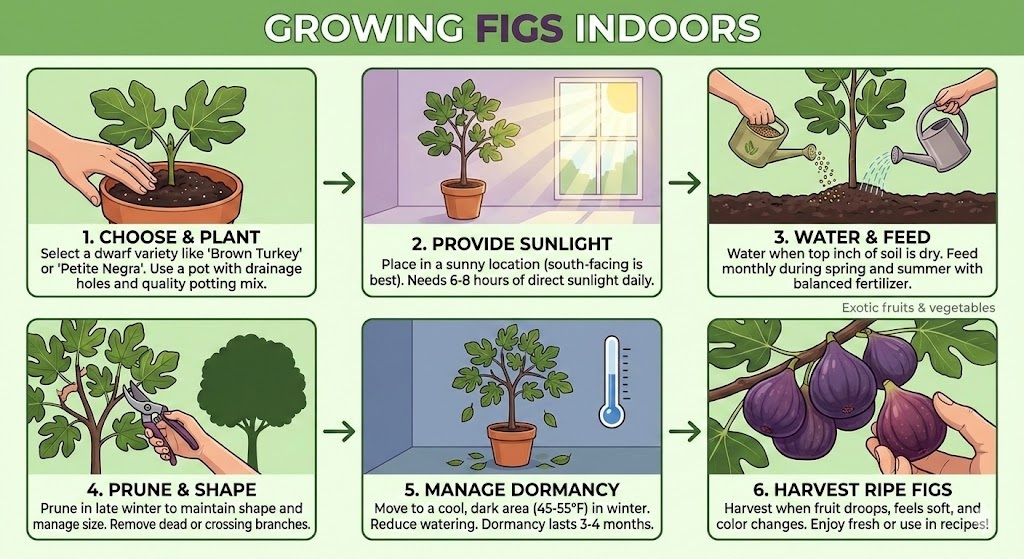
You cannot just dig up an orchard tree and expect it to thrive next to your sofa. Standard figs want to grow 30 feet tall and spread their roots just as wide. For indoor cultivation, you need genetic dwarfs or varieties that handle heavy pruning without sulking.
Here at Exotic Fruits and Vegetables, we’ve found that the ‘Petite Negra’ and ‘Little Miss Figgy’ varieties are the absolute champions for indoor growing, often producing fruit at just 1-2 feet tall.
I currently grow a ‘Violette de Bordeaux’ in my sunroom. It offers a complex, berry-like flavor profile that rivals any fine wine. If you buy a ‘Brown Turkey’, understand that while it is robust, the flavor is often one-dimensional compared to the smaller, more intense varieties.
| Variety Name | Mature Indoor Height | Flavor Profile | Skin Color |
|---|---|---|---|
| Petite Negra | 3-4 feet | Sweet, berry-like, intense | Black/Deep Purple |
| Little Miss Figgy | 4-6 feet | Sweet, nutty | Dark Purple |
| Violette de Bordeaux | 3-5 feet | Rich raspberry jam | Purple-Black |
| Panache (Tiger Stripe) | 6-8 feet (needs pruning) | Strawberry, moderately sweet | Yellow/Green Striped |
The Soil Setup: Building the Foundation
Most commercial potting mixes are death sentences for figs because they hold too much water. A fig tree’s roots need to breathe just as much as they need to drink. I mix my own substrate, and I recommend you do the same to avoid root rot, which is the number one killer of indoor trees.
My go-to recipe is simple but effective. I use 40% high-quality organic potting soil, 30% perlite (for aeration), 20% pine bark fines (for structure), and 10% worm castings (for biology). This mix drains water almost instantly. When you water, it should flow out of the bottom of the pot within 10-15 seconds. If it pools on top, your soil is too heavy.
Never use garden soil in containers. It compacts into a brick, suffocating roots and introducing pathogens that thrive in the stagnant indoor air.
Think of the soil not just as dirt, but as a battery that holds nutrients and moisture. If the battery is faulty (compacted soil), the device (your tree) won’t charge, no matter how much you plug it in (water/fertilize).
Lighting: The Non-Negotiable Factor
Let’s be honest: can you really grow a fruit tree with just ambient room light? Absolutely not. Figs require a minimum of 6 to 8 hours of direct sunlight daily. Indoors, even a south-facing window often filters out 30-50% of the light intensity due to glazing and screens.
Ever wonder why some indoor fruit trees grow tall and spindly with large gaps between leaves? It’s a desperate cry for help called etiolation—the plant is literally stretching to find a light source.
I supplement my indoor figs with full-spectrum LED grow lights. You don’t need the purple-hued ones; get a white light that outputs at least 2,000 lumens per square foot of canopy. I position my lights about 12-18 inches above the top leaves and run them on a timer for 12 hours a day. This consistency triggers the tree to focus on fruit production rather than survival.
Watering and Humidity
Watering is where most people fail. They stick to a schedule—”I water every Monday”—instead of reading the plant. Indoor HVAC systems dry out the air, creating a desert-like atmosphere that figs hate. While they originate from hot climates, they thrive near coastal humidity.
I use the “lift test.” I know exactly how much my 5-gallon pot weighs when dry versus wet. When I lift the pot and it feels surprisingly light, I water it until 20% of the water runs out the drainage holes. This flushes out accumulated salts from fertilizers.
Do not let your fig tree sit in a saucer of standing water for more than 30 minutes, or you will invite Pythium root rot that can kill a healthy tree in less than a week.
My breakthrough came when I stopped misting leaves (which does almost nothing) and started using a pebble tray. I place the pot on a saucer filled with rocks and water. As the water evaporates, it creates a humidity bubble directly around the foliage.
Feeding the Beast
Figs are hungry plants, but they are specific about their diet. If you pump them full of high-nitrogen fertilizer (like Miracle-Gro), you will get beautiful, lush, giant leaves and absolutely zero fruit. Nitrogen promotes green growth; potassium and phosphorus promote fruit.

Pruning: The Art of Control
Pruning an indoor fig is like giving a poodle a haircut; if you don’t do it, things get matted and messy fast. You are the architect of the tree’s shape. I aim for an “open vase” structure, removing central branches to let light hit the inner leaves.
“A fig tree should be open enough that a bird could fly through it without touching its wings.” — Old Italian Gardening Saying
I pinch the tips of new growth once a branch reaches 5 or 6 leaves. This “pinching” stops the branch from lengthening and forces the tree to send energy back down the stem, stimulating the formation of figs at the leaf nodes.
The Pollination Myth
What’s the real secret to getting fruit without bees or wasps inside your house? Genetics. In the wild, figs require a specific wasp for pollination. However, the varieties we grow for home consumption are parthenocarpic. This means they produce fruit without fertilization.
You do not need to worry about hand-pollination or buying bugs. If your tree is healthy and the variety is Common, it will set fruit all on its own.
Troubleshooting Common Indoor Issues
Even with perfect care, things go wrong. I once fought a battle with spider mites that nearly claimed my entire collection. I brought in a new plant without quarantining it, and within days, my fig leaves looked stippled and dusty.
Here is a quick checklist for common symptoms:
- Yellowing lower leaves: usually indicates nitrogen deficiency or overwatering. Check the soil moisture first.
- Fruit shriveling and dropping: uneven watering. The tree panics from drought and dumps the “expensive” fruit to save itself.
- Webbing on leaves: Spider mites. Wipe leaves with a damp cloth and increase humidity immediately.
- Sticky residue on leaves: Scale or aphids. Look for small bumps on the stems and scrape them off.
- Leggy growth: Insufficient light. Move closer to the window or upgrade your grow lights.
The Harvest: Patience Pays Off
Ripening a fig indoors tests your patience. A fig will sit at a green, hard stage for weeks, doing absolutely nothing. Then, seemingly overnight, it swells, changes color, and softens. This final swell is where the sugars develop.
Never pick a fig until the neck droops and the fruit is soft to the touch, because figs absolutely do not ripen or sweeten once removed from the tree.
I wait until the skin starts to slightly crack or wrinkle. That is when the flavor is concentrated and syrupy. Eating a warm fig straight off your indoor tree, with the rain or snow falling outside the window, is a luxury money can’t buy.

Step-by-Step to Your First Indoor Fig
If you are ready to start, follow this path:
- Acquire a 5-gallon pot: Ensure it has multiple drainage holes. Fabric pots work great for root aeration.
- Mix your soil: Combine potting soil, perlite, and pine bark as described above.
- Plant at the same depth: Do not bury the trunk deeper than it was in the nursery pot, or the bark will rot.
- Place in maximum light: South window plus supplemental LED light.
- Water thoroughly: Soak it until water runs clear from the bottom.
- Wait and Observe: Don’t panic if it drops a few leaves during the transition.
One major downside to indoor figs is the sticky white sap (latex) they exude when cut. It is a skin irritant for many people, so always wear gloves when pruning.
Through our work with Exotic Fruits and Vegetables farm, we have seen that people who succeed with indoor figs are the ones who pay attention to the environment rather than just the plant. They monitor the humidity, they check the light levels, and they adjust.
Growing Ficus carica indoors is a relationship. It demands consistency, but it rewards you with fruits that taste like honey and berry jam wrapped in soft skin. If you can keep the light high and the watering consistent, you will have a productive tree for decades. So, clear a spot by the window, get your hands dirty, and enjoy the process.