

There is something magical about walking through my orchard in late November. Most of San Diego is settling down for our mild winter, but one tree is throwing a party. I’m talking about the Strawberry Tree, or Arbutus unedo if you want to get technical with the Latin binomials.
While my neighbors are staring at bare branches, I am looking at a tree covered in drooping clusters of white, bell-shaped flowers right alongside bright red, bumpy fruit. It is a multitasking marvel that fits perfectly into our coastal Mediterranean climate.
Have you ever seen a tree that flowers and fruits at the exact same time?
Many people confuse this with the Muntingia calabura (Jamaica Cherry) or just assume it is a tree that grows actual strawberries. Let me clear that up immediately: these are not strawberries. In Europe, they call it the Killarney Strawberry Tree or the Cain Apple.
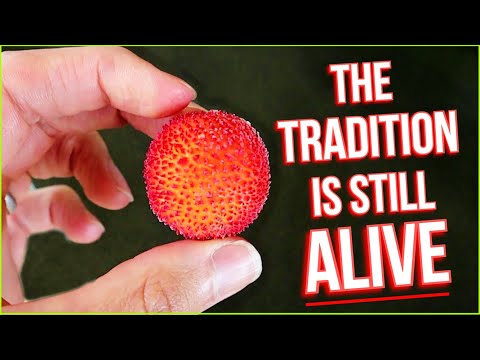
The fruit looks like a lychee that decided to wear a strawberry costume. The taste is complex—think of a mix between a peach, a guava, and an apricot, with a texture that can be slightly mealy if you wait too long to harvest.

Why You Should Be Eating (and Growing) Arbutus Unedo
The primary reason I dedicated valuable acreage to this plant isn’t just because it looks pretty. The health benefits are staggering, yet hardly anyone in the States talks about them. This isn’t just a landscape shrub; it is a nutritional powerhouse.
The Latin name unedo comes from Pliny the Elder, who famously said “unum edo,” meaning “I eat only one.” Historians argue whether he meant they were so good you only need one, or so distinctive that one is enough.
Here at Exotic Fruits and Vegetables, we’ve found that the nutritional profile of these ruby-red globes is vastly superior to many common store-bought fruits. They are packed with antioxidants, specifically flavonoids and tannins. These tannins give the unripe fruit a serious pucker-power—similar to biting into a green persimmon—but they also provide potent anti-inflammatory properties. When fully ripe, that astringency fades into a pleasant sweetness.
The Vitamin C content is where this fruit truly shines. A standard orange gives you about 53mg of Vitamin C per 100g. The Strawberry Tree fruit averages around 180mg per 100g. You are getting over three times the immune-boosting power in the same volume of fruit.
Nutritional Comparison: Strawberry Tree vs. Common Fruits
I put together this table to show you exactly how the Arbutus unedo stacks up against fruits you likely already have in your kitchen.
| Nutrient (per 100g) | Strawberry Tree (Arbutus unedo) | Common Strawberry | Orange |
|---|---|---|---|
| Vitamin C | 180 mg | 58.8 mg | 53.2 mg |
| Dietary Fiber | 6.5 g | 2.0 g | 2.4 g |
| Sugar Content | 20 g (approx) | 4.9 g | 9.3 g |
| Antioxidant Activity | High (Anthocyanins) | Moderate | Moderate |
Beyond the vitamins, the leaves possess medicinal properties too. I steep the dried leaves to make a tea that acts as a diuretic and an antiseptic for the urinary tract. It’s an old European folk remedy that actually holds up.
Cultivating Success in San Diego Soil
Growing Arbutus unedo in San Diego feels like cheating because our climate mimics its native Mediterranean habitat almost perfectly. However, I have killed a few in my time, and I want to save you that heartache.
Do not treat this tree like a standard fruit tree. If you treat it like a citrus or an avocado, you will kill it within two seasons.
The biggest mistake I made early on was ignoring soil pH. These plants belong to the Ericaceae family, which makes them cousins to blueberries and rhododendrons. They crave acidic soil. My farm in San Diego sits on clay that tends to lean alkaline, with a pH around 7.5.

Now, when I plant them, I follow a strict protocol:
- Excavation: I dig a hole that is 3 times as wide as the root ball but no deeper than the pot.
- Amendment: I mix the native soil 50/50 with acidic planting mix or peat moss. I add 1 cup of soil sulfur per plant at the time of planting.
- Drainage Check: I fill the hole with water before planting. If it doesn’t drain in 4 hours, I build a mound or raised bed 12 inches high.
- Mulching: I apply 3 inches of pine bark mulch (not dyed wood chips) to keep the roots cool and slowly acidify the soil as it breaks down.
Pro Tip: If you have hard water (which most of us in San Diego do), add a tablespoon of white vinegar to your watering can once a month to help maintain that acidity.
Watering is another area where new growers stumble. Once established, these trees are incredibly drought-tolerant. They are the camels of the fruit world. However, for the first two years, they need consistent moisture. I give my young trees 5 gallons of water every week during the summer. Once they hit year three, I cut that back to a deep soak every three weeks.
Harvesting: The Waiting Game
Harvesting requires patience. The fruit takes a full 12 months to mature. This leads to that beautiful phenomenon where the tree holds last year’s ripening fruit and this year’s new flowers simultaneously.
Never pick the fruit when it is orange. It looks ripe, but it will taste like a bland, mealy potato.
You want the fruit to be a deep, dark red and soft to the touch. It should practically fall into your hand. If you have to pull hard, it’s not ready.
I remember my first substantial harvest. I brought in about 15 pounds of fruit, excited to make jam. I threw them in the pot, skin and all. The result was delicious, but the texture was gritty because the skin has these tiny, rough tubercles. The secret to excellent Strawberry Tree jam is passing the cooked pulp through a fine-mesh sieve to remove the gritty skin bits before adding your sugar.
Our experience at Exotic Fruits and Vegetables has shown that this extra step transforms a rustic, somewhat sandy paste into a luxurious, smooth preserve that pairs incredibly well with goat cheese.
Culinary Applications
What can you do besides eating them fresh?
- Fermentation: In Portugal, they distill these berries into a potent brandy called Aguardente de Medronhos. I’ve made a small batch of fruit wine that hit about 14% ABV and had a lovely amber color.
- Baking: The flesh works well in muffins, similar to how you would use dried apricots.
- Raw Garnish: Sliced thin, the red bumpy exterior looks alien and beautiful on top of a vanilla bean panna cotta.
- Sorbet: The natural pectin content gives sorbet a creamy texture without adding dairy.
The Landscape “Double Duty”
Why do we settle for boring hedges when we could eat them? That is a question I ask every client who wants to plant a privacy screen.
Arbutus unedo ‘Compacta’ is a dwarf variety that stays under 8 feet, making it perfect for suburban backyards where space is tight but privacy is needed.
I use the standard variety as a windbreak for my more delicate sub-tropicals. They can grow to 20 feet and handle the salt air coming off the Pacific Ocean without blinking. Their root systems are non-invasive, meaning I can plant them near my irrigation lines without worrying about them crushing the pipes—a nightmare I’ve had with figs.
Another benefit is pollination support. Because they bloom in late autumn and winter, they provide a critical nectar source for bees when almost nothing else is flowering. Think of the Strawberry Tree as a gas station for pollinators in the middle of a desert highway. My hive activity stays higher through December specifically because these trees are in bloom.
“The best time to plant a tree was 20 years ago. The second best time is today.” – Chinese Proverb
This proverb hits home with the Strawberry Tree because they are slow growers. They might only put on 12 inches of growth a year. But this slow growth results in incredibly dense, hard wood. In fact, the wood makes excellent charcoal, though I can rarely bring myself to cut one down.
Troubleshooting Common Issues
Even with the best care, things happen. Here are the specific issues I encounter in San Diego:
Leaf Spot: If you see purple or brown spots on the leaves, it’s usually Septoria leaf spot. This happens during our “June Gloom” or wet winters.
I don’t use heavy fungicides. Instead, I prune the interior of the tree to increase airflow. Think of pruning like giving the plant a haircut that lets the wind blow through its scalp. If the leaves stay dry, the fungus can’t thrive.
If you see the leaves curling and turning brown at the tips, you are likely under-watering or the soil salinity is too high. A heavy flush with fresh water usually resolves this.
As fruit enthusiasts at Exotic Fruits and Vegetables, we always recommend this tree to beginners because it bridges the gap between ornamental gardening and farming. It is forgiving, beautiful, and feeds you when the rest of the garden is dormant.
So, if you have a sunny spot and a little patience, get an Arbutus unedo in the ground. Your bees, your health, and your winter landscape will thank you.
Final Verdict: The Strawberry Tree is the most underutilized edible landscape plant in California. Don’t let the “unedo” name scare you off; you’ll definitely want to eat more than one.








Can I substitute the Strawberry Tree fruit with something else? I don’t have access to it in my area. Maybe something like a combination of cranberries and apricots could work? I’m looking for a similar mix of antioxidants and Vitamin C. Anyone have experience with this?
About substituting the Strawberry Tree fruit, while cranberries and apricots do offer some similar benefits, they don’t perfectly replicate the Strawberry Tree’s unique nutritional profile. However, if you’re looking for alternatives, you might consider combining cranberries with another fruit high in Vitamin C, like kiwi or pineapple, to get closer to the Strawberry Tree’s antioxidant and Vitamin C content. Keep in mind that substitutions can affect the final product’s taste, texture, and nutritional value, so some experimentation may be necessary to find the right balance.
I’m fascinated by the nutritional profile of the Strawberry Tree fruit, particularly the high Vitamin C content. As a soap maker, I appreciate the importance of using natural ingredients with high antioxidant properties. The fact that the fruit has 180mg of Vitamin C per 100g is impressive. I’d love to explore using this fruit in my soap recipes, potentially combining it with other natural ingredients like coconut oil and shea butter to create a nourishing and moisturizing soap. Has anyone experimented with using Strawberry Tree fruit in their soap making?
Regarding the use of Strawberry Tree fruit in soap making, it’s essential to note that the fruit’s high water content and delicate nature may require special handling to ensure it doesn’t spoil or affect the soap’s texture. However, the antioxidant properties could be beneficial for skin health. If you decide to experiment, please share your findings and any tips you discover. As for the nutritional profile, the Strawberry Tree fruit is indeed a powerhouse, and its unique combination of vitamins and antioxidants makes it an exciting ingredient to explore in various applications, including skincare and culinary uses.
That’s really helpful, thank you. I’ll have to look into how to properly incorporate the Strawberry Tree fruit into my soap making process. Maybe I’ll start by making a small batch to test the texture and stability.