

There is something deeply satisfying about walking through my orchard in San Diego on a crisp November morning and seeing a tree laden with both delicate bell-shaped flowers and bright red, bumpy fruit simultaneously. I am talking about the Strawberry Tree, known scientifically as Arbutus unedo.

I remember my first attempt at growing these beauties nearly fifteen years ago. I bought a sad-looking sapling from a clearance rack at a generic hardware store because the price tag was five dollars. That tree struggled for three years, never put on more than six inches of growth, and eventually succumbed to root rot because it had been pot-bound for who knows how long. That experience taught me that where you buy your tree dictates your future harvest.
The Strawberry Tree goes by many names depending on who you ask. While botanists stick to Arbutus unedo, you might hear old-timers call it the Killarney Strawberry Tree, the Cane Apple, or simply the Irish Strawberry Tree due to its native range in Ireland and the Mediterranean.
Deciding Which Strawberry Tree to Buy
Before you open your wallet, you need to know exactly what you are hunting for. The genus Arbutus has several members, and mixing them up is a common rookie mistake. The true Strawberry Tree is Arbutus unedo. However, here in San Diego and much of the West Coast, you will frequently see Arbutus ‘Marina’. The ‘Marina’ is a hybrid, likely a cross involving Arbutus unedo and Arbutus canariensis.
What is the difference?
The ‘Marina’ grows larger, has peeling red bark that looks like polished copper, and is generally more ornamental, but the fruit, while edible, is often mushier and less flavorful than the true unedo. If your goal is fruit production for jams or fresh eating, stick to Arbutus unedo or the compact cultivar ‘Compacta’.
Ever wonder why some nurseries label everything simply as “Strawberry Tree”? It is often because wholesalers prioritize the common name over botanical accuracy, leading to confusion for fruit enthusiasts.
Through our work with Exotic Fruits and Vegetables farm, we’ve found that the ‘Compacta’ variety is the absolute champion for urban gardeners. It stays under 8-10 feet tall without aggressive pruning, whereas a standard unedo can creep up to 25 feet over twenty years.
Top Sources for Healthy Trees
Finding a high-quality Strawberry Tree requires bypassing the garden centers of big-box stores. Their inventory usually sits on hot asphalt, cooked by the sun, with roots spiraling helplessly in undersized black pots.
1. California Native Plant Societies and Specialist Nurseries
Since Arbutus unedo is Mediterranean, it mimics the climate requirements of California natives perfectly. Nurseries that specialize in drought-tolerant or “xeriscape” plants are your best bet. In San Diego County, I look for nurseries in the inland valleys—places like Escondido or Fallbrook—where the growers understand heat stress.
These specialist growers usually use a soil mix with higher drainage, often incorporating 30-40% pumice or perlite, which ensures the roots aren’t suffocating.
2. Online Rare Fruit Nurseries
Buying trees online is a bit like online dating; the pictures always look better than the reality. However, for specific cultivars like ‘Elfin King’ (a dwarf variety that fruits heavily while young), online specialty nurseries are often the only option. When ordering online, always choose “bare root” shipping in late winter or early spring.
Avoid buying container plants online during the summer months (July-September). The heat inside a shipping truck can reach 130°F, which effectively boils the root system of a potted Arbutus before it ever reaches your doorstep.
3. Farmers Markets and Plant Sales
My favorite way to buy is directly from a propagator at a local market. You get to look the grower in the eye and ask about their substrate. If they can tell you the N-P-K ratio of their last fertilizer application (ideally something balanced like 10-10-10 or low-phosphorus), you know they care.
| Source Type | Typical Price (5-gallon) | Health Quality | Variety Selection |
|---|---|---|---|
| Specialty/Native Nursery | $45 – $65 | High (Acclimated) | Excellent (‘Marina’, ‘Compacta’, Standard) |
| Big Box Garden Center | $25 – $35 | Low (Often Root-bound) | Poor (Usually mislabeled) |
| Online Specialty Grower | $50 – $80 + Shipping | Medium (Stress from transit) | Specific/Rare Cultivars |
How to Inspect Your Potential Tree
Once you are standing in front of a Strawberry Tree, you need to perform a physical exam. Do not be shy; you are making a long-term investment.
The most vital check is the “wobble test.” Gently grasp the trunk near the soil line and give it a slight wiggle. The root ball should move with the trunk. If the trunk moves but the soil stays loose, the plant has not rooted in. If the whole pot lifts up tight, it is likely root-bound.
Here is my checklist for selecting a winner:
- Examine the Trunk Flare: You should see a slight widening where the trunk meets the soil. If it looks like a telephone pole going straight into the dirt, it is planted too deep, which invites crown rot.
- Check the Underside of Leaves: Arbutus are prone to thrips and scale. Look for tiny black specks or sticky residue (honeydew). A clean plant saves you months of headache.
- Pull the Pot (If permitted): Ask the staff if you can slide the root ball out. You want to see white or light tan root tips, not dark brown or mushy black roots.
- Branch Structure: Avoid trees with “V” shaped crotches where two main stems compete. You want a central leader with branches radiating out at wider 45-degree angles.
Planting for Success in San Diego Soil
Bringing the tree home is where the real work begins. Our soil in San Diego is often heavy clay or decomposed granite. Strawberry trees are Ericaceous plants—cousins to blueberries and rhododendrons—which means they hate alkaline, soggy feet.
Think of the soil as the tree’s stomach; if it can’t digest nutrients because the pH is wrong, it starves. While Arbutus unedo is more lime-tolerant than a blueberry bush, it thrives in a pH of 5.5 to 7.0. If your soil test reads 7.5 or higher, you need to amend the planting area with elemental sulfur six months before planting.
The Planting Process
Dig your hole twice as wide as the pot but no deeper. I cannot stress this enough: planting an Arbutus too deep is a death sentence. The top of the root ball should actually sit 1 to 2 inches above the surrounding soil grade to ensure water drains away from the crown.
I once saved a dying orchard block simply by mounding the soil up. By planting on raised mounds or “berms” about 12 inches high, you utilize gravity to keep the sensitive crown dry while the feeder roots dive deep for moisture.
Our experience at Exotic Fruits and Vegetables has shown that mulching is non-negotiable. Apply a 3-inch layer of pine bark or wood chips around the base, keeping it 4 inches away from the trunk itself. This mulch breaks down and slowly acidifies the soil, which the tree loves.
Ongoing Care and Harvest
These trees are incredibly resilient once established, but “established” is the keyword. For the first two years, you must water deeply. I give my young trees 5 gallons of water twice a week during the dry season. Once the root system matures, I cut that back to once every two weeks.
Do not rely on drip emitters that just wet the surface. Shallow watering encourages roots to stay near the top, where the San Diego sun will bake them. Use a hose or a bubbler to soak the soil to a depth of 18 inches.
Fertilizing is straightforward. These trees are not hungry feeders. I apply a slow-release organic fertilizer formulated for acid-loving plants (like a generic Azalea/Camellia mix) once in February and again in May. Half a cup per inch of trunk diameter is plenty.
The Reward
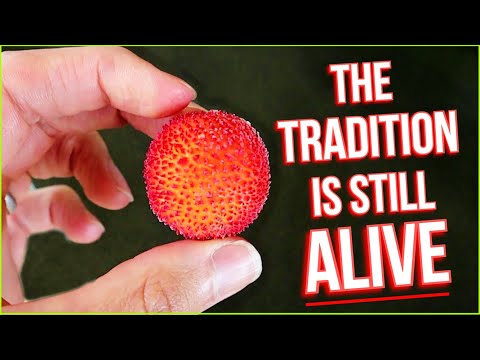
The fruit ripens in late autumn, turning from green to yellow to orange and finally to a deep crimson. The taste is unique—a gritty, custard-like texture with notes of peach, apricot, and mild strawberry. They are soft, so you won’t find them in supermarkets. You have to grow them to know them.
“The specific epithet ‘unedo’ comes from Pliny the Elder, meaning ‘I eat one.’ Some say it’s because the fruit is so good you only need one; others say it’s because it’s so bland you only want one. In my experience, a fully ripe, red Arbutus fruit is a complex delight.”
To get the most out of your harvest, you need the right tools and mindset. Here is what I keep in my shed specifically for my Strawberry Trees:
- Bypass Pruners: For removing dead wood and shaping the canopy in late winter.
- Elemental Sulfur: To lower soil pH if leaves start turning yellow with green veins (chlorosis).
- Bird Netting: The local mockingbirds love these fruits as much as I do.
- Gypsum: I add 2 pounds per planting hole to help break up our heavy clay without altering the pH too drastically.
As fruit enthusiasts at Exotic Fruits and Vegetables, we believe that the Strawberry Tree is the unsung hero of the edible landscape. It provides shade, beauty, and sustenance without demanding constant babying.
Growing Arbutus unedo connects you to a lineage of cultivators stretching back to ancient Rome. When you bite into that gritty, sweet red orb on a cool December afternoon, you aren’t just eating fruit; you are tasting the result of patience and proper selection.
So, go find that specialist nursery, check those roots, and get planting. The best time to plant was ten years ago; the second-best time is this weekend.









For kids, growing a strawberry tree can be a fun project! What are some kid-friendly ways to get started with this?
Regarding kid-friendly ways to get started, I recommend using a beginner’s gardening kit that includes a small strawberry tree sapling, soil, and instructions. This can be a great way to introduce kids to the basics of gardening and responsibility.
That’s a great idea! What kind of gardening kit would you recommend for kids?
There are many great options available, but I recommend looking for a kit that includes a strawberry tree sapling, a small pot, and some basic gardening tools. Some popular brands include Kid’s Gardening Kit by Green Thumb and Junior Gardener’s Starter Kit by Burpee.
From a botanical standpoint, it’s interesting to note that Arbutus unedo is a member of the Ericaceae family. This family includes other plants like blueberries and cranberries, which also require acidic soils.
That’s a great point about the Ericaceae family! It’s worth noting that these plants have evolved to thrive in acidic soils, which can be a challenge for gardeners with more alkaline soils. One strategy is to use elemental sulfur or peat moss to acidify the soil.
I’m thinking of using the strawberry tree as a decorative element in my garden. Has anyone tried pruning them into topiaries or other shapes? What are some tips for maintaining the shape?
Pruning strawberry trees into topiaries can be a fun and creative project! The key is to start with a young tree and prune regularly to maintain the desired shape. I recommend using clean, sharp pruning tools and making cuts just above a leaf node to encourage new growth.
I’ve found that Arbutus unedo is more sensitive to soil quality than other varieties. Has anyone else noticed this? I’ve had success with a mix of compost and perlite.
Yes, Arbutus unedo can be sensitive to soil quality. In addition to compost and perlite, I’ve also had success with adding a small amount of sulfur to lower the pH. It’s also important to avoid over-fertilizing, as this can damage the roots.
I’ve also noticed that Arbutus unedo can be sensitive to over-watering. What are some tips for avoiding this?
That’s a great point! One strategy is to check the soil moisture by sticking your finger into the soil up to the first knuckle. If the soil feels dry, it’s time to water. It’s also important to avoid getting water on the leaves or crown of the plant, as this can lead to rot.
Thanks for the tip! I’ll make sure to be more careful with my watering.
Just a heads up, I bought my strawberry tree from a local nursery for $15, but I’ve seen them online for $30+! Shop around, folks!