
If you have walked through a San Diego farmers market between September and January, you have likely caught a whiff of something distinctive. It is a perfume that smells like a mix of cheap strawberry candy, high-end eucalyptus oil, and fresh pineapple. That, my friends, is the aroma of Acca sellowiana, better known as the Feijoa or Pineapple Guava.
I remember the first time I encountered this fruit, long before I started farming professionally. I bit into it like an apple, skin and all. It was an assault on my taste buds—bitter, sour, and tough as old leather. I nearly swore off the fruit entirely. It took a patient mentor to show me that the magic lies inside, hidden beneath that tart green exterior. Today, I harvest about 300 pounds of these green gems annually, and I have made it my mission to ensure no one makes the same culinary mistake I did.
The Feijoa goes by many names depending on where you are. While we call it Pineapple Guava here in the States, you might hear it called Guavasteen in older horticulture books or simply Feijoa in New Zealand, where it is practically a national obsession.
Here at Exotic Fruits and Vegetables, we’ve found that 90% of bad feijoa experiences come down to poor timing. Unlike a banana that signals ripeness with a bright yellow coat, a feijoa remains stubbornly green. You cannot judge this book by its cover. The flavor profile of a perfectly ripe feijoa is a complex dance of mint, pineapple, and strawberry, with a texture that gritty and creamy all at once.

Selecting the Perfect Fruit: The Drop Test
Before you can eat the best feijoa, you have to find it. If you are growing these in your backyard or picking them at a U-Pick farm, here is the golden rule: never pick a feijoa from the tree. A feijoa is only truly ripe when it voluntarily drops from the branch to the ground. If you have to tug, twist, or pull, that fruit is filled with disappointment. The starches have not converted to sugars yet, and the texture will be woody.
When you are buying them at a market, you obviously cannot watch them fall. You need to rely on the touch test. Pick the fruit up and give it a gentle squeeze, exactly as you would a peach or an avocado. It should yield slightly to the pressure. If it feels like a golf ball, put it back or leave it on your counter for 3-4 days until it softens.
For the absolute best flavor, look for fruit that has a slightly uneven, bumpy surface. My smoothest, prettiest fruits often lack the intense aromatic punch of the gnarly, odd-shaped ones.
Ripeness Indicators Table
I created this guide based on years of sorting fruit for my customers. Use this to gauge what you have in your hand.
| State | Touch/Feel | Internal Appearance | Flavor Profile |
|---|---|---|---|
| Under-ripe | Rock hard, zero yield | Solid opaque white | Astringent, starchy, pine-sol taste |
| Perfectly Ripe | Yields like a ripe avocado | Clear jelly center (seed pulp) | Sweet, tart, floral, minty finish |
| Over-ripe | Mushy, distinct indentation | Brownish jelly, browning flesh | Fermented, slightly alcoholic |
The Classic Method: Slice and Scoop
This is the purist’s approach and the one I use when I am standing in the middle of the orchard taking a break. You do not need fancy tools—just a sharp knife and a teaspoon. The skin of the feijoa contains high amounts of tannins and compounds that can taste medicinal to American palates accustomed to sweeter fruits. By avoiding the skin, you get straight to the custard-like center.
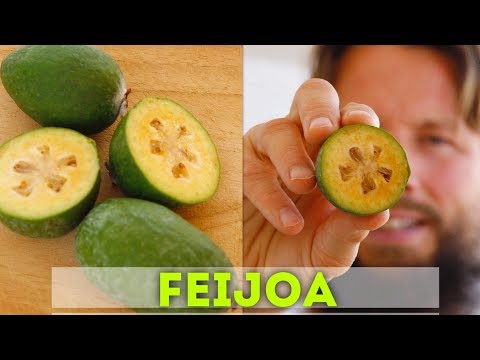
Cut the fruit in half crosswise (around the “equator”), not lengthwise. You will see a ring of granular, white flesh surrounding a clear, jelly-like center containing the seeds. This differentiation is important. The white flesh has a texture similar to a pear—gritty due to stone cells called sclereids—while the center is smooth.
Using a small teaspoon, scoop out the inside in one circular motion. It should pop out cleanly if the fruit is ripe. Pop the whole scoop in your mouth and let the flavors expand.
Ever wonder why some people claim feijoas taste like soap? It is usually because they scraped too close to the skin. The layer immediately adjacent to the green skin carries the most tartness. If you have a sweet tooth, leave a millimeter of white flesh attached to the skin when you scoop. If you prefer a sour kick—like a Sour Patch Kid candy—scrape it down to the green.
Culinary Adventures: Beyond the Spoon
While I eat about 5 pounds of these raw every October, cooking with feijoas opens up a different dimension of flavor. The heat breaks down the floral esters, toning down the “perfume” taste that overwhelms some people. Our team at Exotic Fruits and Vegetables loves incorporating the scooped pulp into savory dishes, which surprises most of our customers who only think of it as a dessert fruit.
Think of the feijoa as a high-acid ingredient, similar to how you might use rhubarb or cranberries. It cuts through fat beautifully. I once made a feijoa chutney to serve with pork chops, and the acidity balanced the rich meat perfectly. It was a revelation compared to the standard apple sauce. The gritty texture melts away upon cooking, leaving a thick, aromatic sauce.
Why limit yourself to sweet applications when the fruit has such a complex, herbal profile?
Flavor Pairings That Work
- Ginger and Black Pepper: The spicy heat complements the minty aftertaste of the fruit.
- Dairy: Yogurt, heavy cream, or mascarpone stabilize the acidity. Feijoa ice cream is legendary in New Zealand for a reason.
- Dark Chocolate: Use 70% cocoa or higher; the bitterness of the chocolate stands up to the intense aroma of the fruit.
- Almonds and Walnuts: The nutty crunch provides necessary textural contrast to the soft pulp.
Preserving the Harvest: Freezing Feijoas
If you have a tree, you know the panic. A feijoa tree does not give you fruit politely; it dumps its entire load over a three-week period. I often find myself with 40 or 50 pounds of fruit on the ground in a single morning. You cannot eat them all, and they only last about 5 to 7 days in the fridge before the internal jelly turns brown and tastes like bad cider.
Freezing is the best way to preserve them, but you have to move fast. Feijoa flesh oxidizes and turns brown within minutes of being exposed to air. It is remarkably fast, faster than an apple or an avocado. Brown pulp is safe to eat, but it looks unappealing in smoothies or baked goods.
Do not just throw whole fruit in the freezer. The texture upon thawing will be mushy and impossible to peel. You must process the fruit before freezing.
My Step-by-Step Freezing Protocol
- Prepare an Acid Bath: Before you cut a single fruit, fill a medium bowl with the pulp of two lemons (or 1/4 cup bottled lemon juice). The citric acid is the only thing that stops the browning.
- Scoop Directly into Acid: Cut, scoop, and drop the pulp immediately into the lemon juice bowl. Do not let it sit on a cutting board.
- Toss to Coat: Every few scoops, stir the bowl to ensure every bit of feijoa surface area is coated in lemon juice.
- Portion Control: I measure the pulp into 1-cup portions. This is the standard amount for most muffin or bread recipes.
- Freeze Flat: Place the portions in freezer-safe bags, squeeze out all the air, and flatten them. This ensures they freeze quickly and stack efficiently.
The Edible Flower Bonus
I would be remiss if I didn’t mention the other way to eat this plant. In May and June, long before the fruit arrives, the Pineapple Guava produces spectacular flowers. They have fleshy white petals and bright red stamens that look like exploding fireworks. Here is the secret: the petals are edible and taste like cotton candy mixed with cinnamon.
Only eat the petals, not the center reproductive parts of the flower. And do not pluck every flower, or you won’t get any fruit later in the year!
I usually harvest about 10% of the petals for salads. It adds a sweetness that confuses and delights guests. It is like sprinkling nature’s confetti on your spring greens. Just gently pull the white petal; it should detach easily without damaging the ovary that eventually becomes the fruit.
Why It’s Worth the Effort
Growing and eating feijoas is a labor of love. They bruise easily, they spoil quickly, and they look like small hand grenades. But the nutritional payoff is substantial. They are packed with fiber and Vitamin C—just three fruits provide nearly 50% of your daily requirement. But beyond the stats, it is the experience.
Eating a feijoa is like taking a mini-vacation to the tropics, right here in the Mediterranean climate of San Diego. Whether you are scooping them raw on a crisp November morning or blending them into a summer smoothie from your freezer stash, the flavor is unmistakable. So next time you see that bin of green, egg-shaped fruits, don’t walk past. Grab a handful, wait for the give, and scoop your way to happiness.
“It tastes like Christmas in California.” — A customer at my farm stand trying her first ripe feijoa.
Remember to cut the flower end off completely before scooping, as the remnants of the sepals are hard and unpleasant. With a little practice, you will be processing pounds of these in minutes. Happy eating!