

I vividly remember the day a visiting friend from London walked through my orchard here in San Diego, stopped dead in his tracks, and pointed at my shaggy, silver-green hedge. He asked, “Is that a Pineapple Guava? I thought those were strictly tropical!” We picked a ripe one right off the ground, sliced it open, and the aromatic explosion of pineapple, mint, and strawberry convinced him he needed one in his own garden back in Sussex.
The Feijoa (Acca sellowiana), often called Pineapple Guava or Guavasteen, is not a true guava. It hails from the highlands of Brazil and Uruguay, meaning it is evolutionarily adapted to cool winters and moderate summers, not sweltering jungle heat.
Here at Exotic Fruits and Vegetables, we’ve found that this misconception—that “exotic” always means “tropical”—prevents so many gardeners from growing one of the most resilient fruit bearers available. While I enjoy the California sunshine, I have studied the Feijoa extensively and consulted with growers in maritime climates.
The short answer is yes, Feijoas can absolutely grow in the UK, but you have to stop treating them like fragile orchids and start treating them like the tough highland shrubs they are.
Understanding the Plant: More Than Just a Hedge
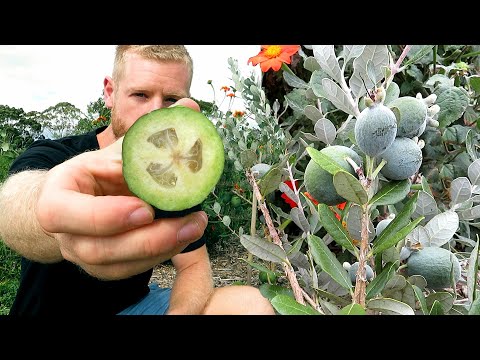
Before we dig into the soil requirements, let’s clarify what we are dealing with. In the nursery trade, you might see them labeled as Feijoa sellowiana. They are evergreen shrubs that can be trained into small trees, reaching heights of 10 to 15 feet if you let them. In the UK, they are frequently sold as ornamental hedging because their leaves have a beautiful silvery underside, and their flowers—stunning explosions of red stamens and fleshy white petals—are edible and sweet like cotton candy.
Ever wonder why some fruits split before ripening while others stay perfect? It usually comes down to consistent watering during the final swell to prevent the skin from losing its elasticity.
I once ruined an entire batch of fruit by ignoring my irrigation schedule in late September; the fruit ended up the size of marbles and dry as chalk. You want to avoid that. The fruit itself looks like a lime but has a skin texture closer to a russet apple. Inside, the gelatinous seed pulp is where the magic happens, offering a flavor profile that is part pineapple, part guava, and part wintergreen.
Climate Compatibility: The UK vs. San Diego
You might think San Diego and the UK have nothing in common, but we actually share a lack of hard freezes in our coastal zones. Feijoas are hardy down to about 12°F (-11°C). Most of the UK falls into RHS Hardiness Rating H4, which fits this plant perfectly. The challenge in the UK isn’t the winter cold; it is the lack of summer heat.
To get fruit to ripen in the UK, you must plant your Feijoa against a south-facing wall to maximize heat absorption.
The wall acts like a storage battery for heat, absorbing solar energy during the day and releasing it at night, artificially boosting the ambient temperature around the foliage. This heat accumulation is critical because the fruit takes 5 to 7 months to mature from flowering. In a cool summer, that wall might be the only reason you get a harvest before the first hard freeze of December.
| Growth Factor | San Diego Conditions | UK Target Conditions |
|---|---|---|
| Winter Lows | 35°F to 45°F (Rare frost) | 20°F to 30°F (Protect below 15°F) |
| Summer Highs | 75°F to 85°F | 65°F to 75°F (Need heat traps) |
| Rainfall | 10 inches/year (Irrigation needed) | 25-30 inches/year (Drainage needed) |
| Pollination | Birds and Bees | Hand pollination or Self-fertile varieties |
Soil Preparation: The Foundation of Flavor
Feijoas are not terribly fussy, but they detest “wet feet.” In my early years, I planted a ‘Coolidge’ variety in a low spot of the orchard where water pooled after rain. It didn’t die, but it sat there sulking for three years, growing perhaps two inches total. It was like trying to run a marathon in concrete shoes because the roots couldn’t breathe.
For heavy UK clay soils, you must create a raised mound or bed at least 8-10 inches high, mixing the native soil with 30% horticultural grit and 20% compost to ensure rapid drainage.
Our experience at Exotic Fruits and Vegetables has shown that Feijoas prefer a slightly acidic to neutral soil pH of 5.5 to 7.0. If your soil is too alkaline (chalky), the leaves will turn yellow with green veins—a condition called chlorosis. You can fix this by top-dressing with 2 inches of ericaceous compost every spring or applying iron chelates at half-strength every 4 weeks during the growing season.
Selecting the Right Variety for Cooler Summers
This is where most UK growers fail. They buy an unnamed seedling from a generic garden center. Seedlings are a genetic gamble and often require a second plant for pollination. In a cooler climate, you need early-ripening, self-fertile varieties that don’t need a massive heat unit accumulation to reach sugar maturity.
- Unique: This is the gold standard for the UK because it is reliably self-fertile and ripens earlier than most, usually by late October.
- Apollo: Produces large, aromatic fruit with a thin skin; it is partially self-fertile but crops much heavier with a partner nearby.
- Gemini: This variety offers high yields of small-to-medium fruit, but it definitely needs a pollination partner like Apollo to set fruit in cooler weather.
- Mammoth: As the name implies, it grows huge fruit, but it requires a very long growing season, so only attempt this in Cornwall or the Isle of Wight.
The Planting Process: A Step-by-Step Guide
Planting a Feijoa is like setting up a solar panel; positioning is everything. Do not shove it in a shady corner. You are looking for that sweet spot where the sun hits the leaves for most of the day, but the plant is protected from the biting north winds.
- Site Selection: Choose that sunny, south-facing wall and ensure the spot gets a minimum of 6-8 hours of direct sunlight during the summer solstice.
- Digging the Hole: Dig a hole twice as wide as the root ball but no deeper; the top of the root ball should be slightly above the soil line to allow for settling.
- The Mix: Combine your excavated soil with a bucket of grit and do not add fertilizer directly to the planting hole, as this can burn the tender feeder roots.
- Planting: Place the shrub, backfill, and tamp down gently with your boot to remove air pockets while keeping the stem vertical.
- Mulching: Apply 3 inches of wood chip mulch around the base, keeping it 4 inches away from the trunk to prevent fungal rot.
Never plant a Feijoa deeper than it was in the nursery pot. Burying the stem can lead to collar rot, which will kill the plant silently from the ground up over the course of a single season.
The Pollination Puzzle
In their native South America, Feijoas are pollinated by birds that eat the sweet, fleshy flower petals. In San Diego, mockingbirds do the job for me. In the UK, you don’t have the specific birds that recognize these flowers as food, and bees aren’t always interested in the pollen when there are easier targets nearby. What’s the real secret to success in a British garden? You have to be the bee.
I highly recommend hand pollination if you want a bumper crop. It’s simple: take a small artist’s paintbrush and tickle the center of the flowers, moving from bush to bush. I did this one year as an experiment on a single branch, and that branch bowed down under the weight of the fruit while the rest of the bush remained light. Through our work with Exotic Fruits and Vegetables farm, we’ve realized that manually transferring pollen is the difference between a decorative shrub and a food-producing tree.
Hand pollinating takes about 5 minutes every 3 days during the flowering season (June and July) and can increase your yield by over 300% in areas with low pollinator activity.
Care, Feeding, and Harvest
Feijoas are tough, but they are hungry. I feed my established plants with a granular 10-10-10 fertilizer to keep the foliage lush. I apply 1 cup spread around the drip line in late February, and another cup in late May. Do not feed them after July, or you will encourage soft, leafy growth that will get zapped by the first winter frost.
Watering is the other critical factor. While they are drought-tolerant shrubs that will survive on neglect, they won’t produce juice-filled fruit without help. During the fruit swelling period in August and September, you must provide 3-4 gallons of water per bush every week if it hasn’t rained. Think of the soil as a sponge that needs to stay damp but never dripping wet.
Now, let’s talk about harvest. This is where my friends always get it wrong. They try to pull the fruit off the branch. If you have to pull, it’s not ready. Ever wonder why some fruits stay on the tree until they are mush? Feijoas are the opposite; they drop when they are at their peak of flavor maturity.
“A Feijoa is the only fruit I know that tells you exactly when it’s ready to eat—by jumping off the tree and waiting for you on the grass.”
I harvested 47 pounds from 3 plants last year simply by checking the ground every morning. For UK growers, you might find the fruit drops in November while still slightly firm. This is fine. Bring them inside and place them in a bowl with a banana. The ethylene gas from the banana will finish the ripening process in 2-3 days until the fruit yields to gentle thumb pressure.
Common UK Challenges
Wind is the silent killer for Acca sellowiana. The wood is surprisingly brittle. I’ve seen beautiful 5-year-old branches snap off in a 40mph gust because the heavy evergreen leaves act like a sail. If you are in a windy coastal area like Cornwall, use a windbreak or stake your plants securely with soft ties.
Also, be patient. A Feijoa grown from a cutting will fruit in year 3 or 4. A seedling might take 6 to 8 years. I once waited nearly a decade for a seedling to fruit, only to find the fruit was the size of a grape and mostly skin. At Exotic Fruits and Vegetables, we always recommend buying named cultivars to avoid this heartbreak.
Avoid pruning your Feijoa in the winter or spring. They fruit on the current year’s growth, which stems from the tips of the previous year’s branches. Pruning creates a nice shape but removes the potential harvest for that entire year.

Final Thoughts on British Feijoas
Growing Feijoas is a lesson in patience and observation. It’s about creating a microclimate and understanding that you are pushing a subtropical plant to its limits.

The real key to a successful UK harvest is the combination of a south-facing heat trap and consistent late-summer moisture.
As fruit enthusiasts at Exotic Fruits and Vegetables, we believe in the joy of the “impossible” harvest. Don’t let the climate maps scare you away from this incredible plant. With a south-facing wall, some well-draining soil, and a little hand pollination, you can bring a taste of the Southern Hemisphere to the British Isles. So, is it worth the effort in a cooler climate? Absolutely. Just remember to pick them off the grass, not the tree.



I’m currently growing Feijoa in containers with a mix of 30% perlite and 70% peat moss. How does the soil preparation method suggested in the article differ from my approach? Would using a different soil mix improve fruit yield or flavor?
Regarding your soil mix, val.lee, the article’s suggestion to avoid ‘wet feet’ is crucial for Feijoa. While your mix has good drainage, consider adding some compost to enhance nutrient availability. Research by the Royal Horticultural Society suggests that Feijoa benefits from a slightly acidic to neutral soil pH, around 6.0-7.0. You may want to test your soil pH and adjust accordingly. Additionally, using a well-rotted manure or a balanced fertilizer can promote healthy growth and fruiting.
I’ve integrated Feijoa into my permaculture design as a understory species, providing a canopy layer for other plants. The silvery underside of the leaves adds to the overall aesthetic. For a maritime climate like the UK, I recommend planting with nitrogen-fixing ground covers like clover or creeping thyme to enhance soil health. Feijoa’s ability to thrive in cooler temperatures makes it an ideal choice for UK gardeners.