

There is a specific moment in late autumn here in San Diego that I wait for all year. It happens when I walk past the hedge on the south side of my property and a scent hits me—a perfume that smells like someone smashed a pineapple, a strawberry, and a handful of mint together. It’s the Feijoa, or strictly speaking, the Acca sellowiana. If you are looking for a plant that forgives your mistakes but rewards your attention with buckets of fruit, this is the one.

I currently manage about 45 mature bushes, and last season alone, we pulled in roughly 1,200 pounds of fruit. But getting from a nursery pot to that level of abundance requires more than just digging a hole and walking away.
The Feijoa doesn’t just grow; it survives where others fail, acting as the rugged backbone of a subtropical food forest.
Understanding Your Green Companion
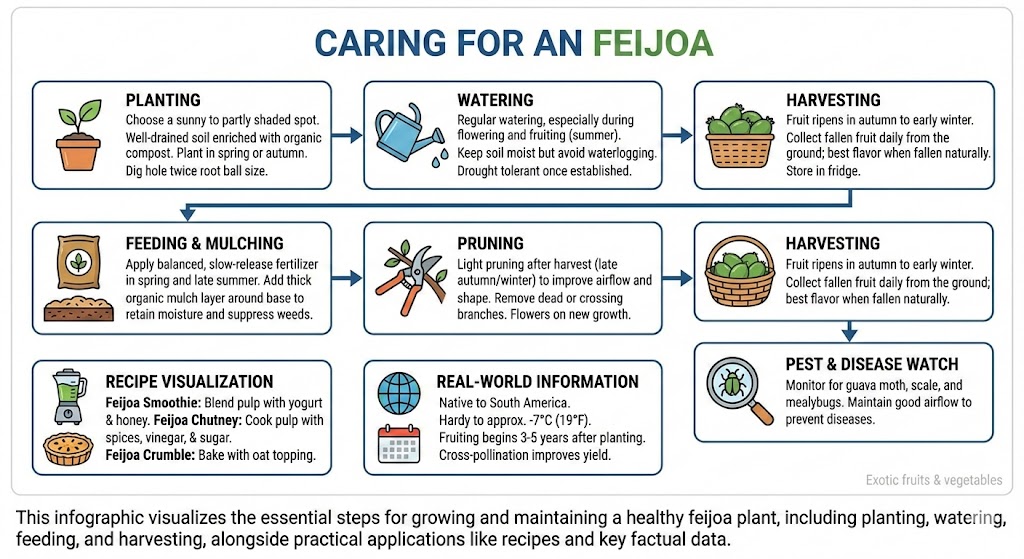
Before you grab a shovel, you need to understand what you are actually putting in the ground. The Feijoa is an evergreen shrub that can easily reach 15 feet tall if you let it run wild. While we call it a “guava,” it isn’t a true guava (Psidium genus). It hails from the highlands of southern Brazil, Uruguay, and northern Argentina. This origin story is good news for us because it means the plant is cold-hardy down to about 12°F, yet it thrives in our coastal heat.
Here at Exotic Fruits and Vegetables, we’ve found that the biggest misconception people have is that Feijoas are strictly tropical. They actually need a little bit of chill—about 50 to 100 hours below 45°F—to set fruit properly.
Without that winter dip, you get a beautiful ornamental bush with zero harvest. In San Diego, we usually get just enough chill, but if you are right on the beach, you might see lower yields than someone five miles inland.
Feijoa leaves are thick and leathery with a silver underside, an evolutionary adaptation to retain moisture during dry spells and reflect intense solar radiation.

The Setup: Soil and Sun
You cannot cheat on soil preparation. I once ruined an entire batch of young saplings by planting them directly into our native heavy clay without amendments; they drowned in the first heavy rain because the water had nowhere to go. Feijoas hate “wet feet.” You need a sandy loam that drains faster than a politician dodging a question.
When I plant now, I mix the native soil 50/50 with a blend of coarse sand and aged compost. I aim for a pH between 5.5 and 7.0. If your soil is too alkaline (above 7.0), the leaves will turn yellow while the veins stay green—a classic sign of iron chlorosis. If you see yellowing leaves, apply chelated iron as a foliar spray immediately to correct the deficiency.
Sun Exposure Strategies
How much sun is enough? I give my plants a minimum of 6 to 8 hours of direct sunlight. While they will grow in partial shade, they won’t fruit. Think of the sun as the engine that drives sugar production; less sun means tart, tiny fruit.
However, if you are in an inland valley where temperatures hit 100°F regularly, late afternoon shade prevents the leaves from scorching.
Watering: The “Soak and Dry” Method
Watering is where most people lose the battle. During the first two years, the root system is shallow and fragile. I water my new plantings with 2 gallons of water every 3 days during the summer. Once established, they become incredibly drought-tolerant, but “drought-tolerant” is a survival term, not a production term. Do you want the plant to just survive, or do you want fruit?
Inconsistent watering during fruit development causes the fruit to hollow out or drop prematurely before it has developed any sugar.
My irrigation runs on a drip system that delivers 1 inch of water per week during the fruiting season. Think of the soil like a battery storing nutrients; water is the current that moves those nutrients into the plant. If the circuit breaks (dry soil), the fruit stops growing. I mulch heavily—about 4 inches of wood chips—around the base. This keeps the roots cool and reduces evaporation by nearly 40%.
Fertilizing and Maintenance
I treat fertilizing Feijoas like feeding a teenager: they are always hungry during a growth spurt. I use a balanced 8-8-8 NPK fertilizer. I apply a half-cup per year of tree age, maxing out at 5 cups for a mature tree, split into three applications: February, May, and July. Never fertilize in late fall; you don’t want to encourage new tender growth right before the winter chill hits.
Through our work with Exotic Fruits and Vegetables farm, we’ve noticed that organic fertilizers like chicken manure work exceptionally well because they release nitrogen slowly. If you hit them with high-nitrogen synthetic fertilizers, you will get a massive, leafy bush that forgets to make flowers.
To improve fruit set, plant at least two different varieties (like Mammoth and Coolidge) within 20 feet of each other for cross-pollination.
Pruning: The Haircut Analogy
Pruning a Feijoa is a lot like giving a poodle a haircut; you can shape it however you want, but if you cut too deep, it looks ridiculous and takes forever to recover. I prune lightly in late winter to open up the center of the bush. This allows light to penetrate and reduces fungal issues. Never prune in the summer, or you will cut off the developing fruit wood.
Varieties Matter: A Quick Comparison
Not all Feijoas are created equal. I have tested over a dozen varieties, and here is how the top contenders stack up in our region:
| Variety | Fruit Size | Flavor Profile | Notes |
|---|---|---|---|
| Coolidge | Medium | Mild, sweet | Self-fertile, most reliable producer in CA. |
| Nazemetz | Large | Sweet, non-gritty | Excellent quality, needs a pollinator. |
| Mammoth | Very Large | Tart, complex | Softer fruit, great for pies/jams. |
| Apollo | Large | Aromatic, sweet | Thin skin, bruises easily, eat immediately. |
Harvesting: The Drop Test
Ever wonder why some fruits split before ripening? It is usually a water spike. But knowing when to harvest Feijoa is the real trick. Unlike an apple, you do not pluck a Feijoa off the tree. If you pull it and there is resistance, it is not ready. It will be bitter and rubbery.
I wait for the fruit to fall naturally. My morning routine in October and November involves walking the rows and picking up fruit from the ground. If you want to beat the bruises, give the branch a gentle shake. If the fruit falls, it is yours. If it holds on, come back tomorrow.
The best flavor happens when you bring the fruit inside and let it sit on the counter for 2 to 3 days until it yields slightly to thumb pressure.
I once tried to force harvest an entire bush before a storm. I picked 50 pounds of green fruit. I put them in paper bags with bananas to induce ripening, but they never sweetened up. They remained starchy and tart. A Feijoa must mature fully on the branch to develop its signature esters and sugars.
Culinary Uses: More Than Just a Spoon
Most people just cut them in half and scoop out the jelly-like center, avoiding the gritty skin. But we at Exotic Fruits and Vegetables believe in using the whole fruit. The skin is tart and sour, which balances the sweet interior perfectly if you slice it thin.
Here are my favorite ways to process the harvest:
- Feijoa Chutney: The tartness pairs perfectly with ginger and onions for a savory meat glaze.
- Infused Vodka: Slice three fruits into a mason jar of vodka and let it sit for two weeks.
- Smoothie Base: Freeze the scooped pulp in ice cube trays for a tropical morning kick.
- Salsa Verde: Swap tomatillos for firm Feijoas for a floral twist on taco night.
Troubleshooting Common Issues
What’s the real secret to keeping these plants pest-free? Honesty, they do most of the work themselves. However, I have battled Black Scale insects a few times. They look like little barnacles on the stems and secrete a sticky honeydew that causes sooty mold.
Avoid using broad-spectrum insecticides as they kill the bees required for pollination, which will guarantee a zero-yield year.
If I see scale, I use a horticultural oil spray in the dormant season. Another issue is fruit fly larvae, though this is rare in San Diego compared to more tropical zones. Sanitation is your best defense. Pick up fallen fruit daily. Rotting fruit on the ground is a luxury hotel for pests.

Steps to Success
- Site Selection: Choose a spot with 6+ hours of sun and drainage that allows water to pass through in under an hour.
- Planting: Dig a hole twice the width of the root ball. Mix 50% native soil with 50% compost/sand.
- Mulching: Apply 3-4 inches of mulch, keeping it 2 inches away from the trunk collar to prevent rot.
- Watering Schedule: Deep water twice a week for the first summer. Transition to weekly deep soaks thereafter.
- Feeding: Apply 8-8-8 fertilizer in February, May, and July.
- Harvest: Wait for gravity to do the work. Collect fallen fruit daily.
Why do we go through all this effort for a fruit that bruises if you look at it wrong?
Because the flavor is unreplicable. You cannot buy a ripe Feijoa in a supermarket because they have a shelf life of about five days. Growing them yourself is the only way to experience the true, floral complexity of this fruit. It connects you to the land in a way that buying an apple never will. When you slice open that first fruit of the season, the aroma fills the room, and you realize that every hour of pruning and watering was absolutely worth it.


Planting feijoa in san diego requires consideration of mature size, about 15ft tall. I space mine 10ft apart, allowing for good air circulation and sunlight penetration. Irrigation infrastructure is crucial, especially during dry spells.
Research from land-grant universities suggests feijoa requires chill hours to set fruit properly. In san diego, we typically get 50-100 hours below 45°F, but yields may vary depending on location. I’d love to see data on replication of results in different microclimates, has anyone tracked this?