
If you have ever walked through a San Diego garden in late May and spotted a bush exploding with red and white fireworks, you have likely met the Feijoa. Most folks know it as the Pineapple Guava or Guavasteen, but botanically, we are dealing with Acca sellowiana.

The bloom season here in Southern California is spectacular, but it can be tricky to navigate if you are new to the game. It is not as simple as waiting for bees to do their job. Through our work with Exotic Fruits and Vegetables farm, we have learned that understanding the specific mechanics of the Feijoa flower is the only way to guarantee a harvest. The flowers are hermaphroditic, meaning they possess both male and female parts, but they are notoriously fussy about how they interact.
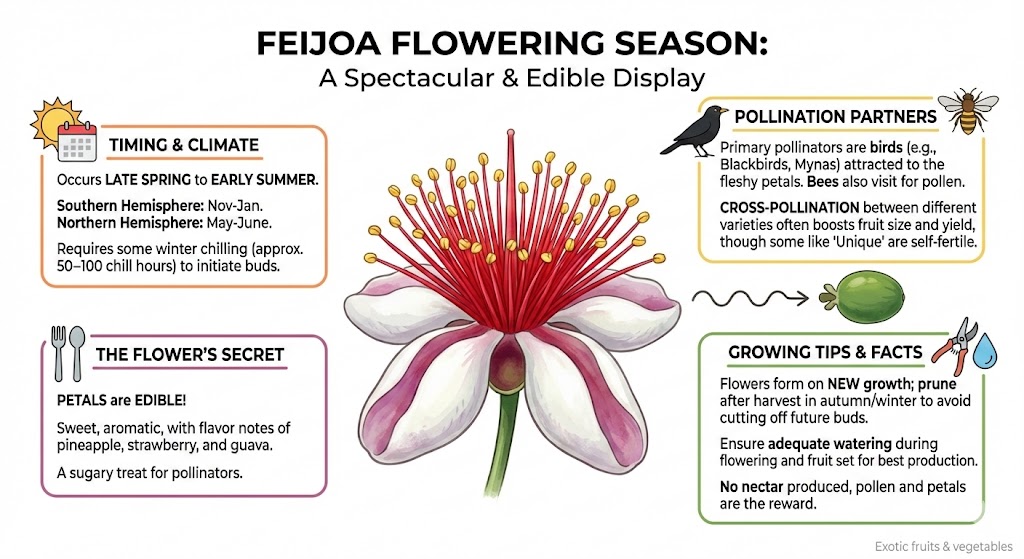
The Feijoa flower is easily identified by its fleshy, sweet-tasting white petals and a central burst of bright red stamens tipped with golden pollen. Unlike many fruit trees, the petals are edible and taste surprisingly like cotton candy or marshmallows.
The San Diego Bloom Timeline
In our coastal and inland valleys, the Feijoa doesn’t follow a strict calendar date; it follows the heat accumulation. Generally, you will see the first buds breaking in late April, with the peak bloom hitting us in May and tapering off by late June. This timing is crucial because it coincides with our “May Gray” and “June Gloom.” While the cloud cover keeps moisture up, the lack of intense heat helps the pollen remain viable longer.

I track my phenology data annually. In El Cajon and sharper inland valleys, blooming starts about two weeks earlier than my friends growing in coastal areas like La Jolla or Encinitas. The heat units accumulate faster inland. If your bush hasn’t flowered by July 1st, you are likely dealing with a fertility issue or a pruning error.
I once ruined an entire batch by pruning my hedges in March, thinking I was tidying up for spring. I cut off every single developing flower bud. Feijoas flower on new growth, but that growth initiates from the previous season’s wood. Never prune in spring; always wait until after harvest in late autumn or early winter.
The Pollination Puzzle: It’s Not the Bees
Here is where most local growers fail. You see bees buzzing around your citrus and assume they are taking care of the Feijoa too. They aren’t. Honeybees are actually poor pollinators for Acca sellowiana. They are too small to effectively bridge the gap between the pollen-dusty anthers and the sticky stigma (the female receptor). They visit the flower to scavenge pollen, but they rarely touch the stigma in the process.
So, who is doing the actual work in your garden? In their native South America, large birds and monkeys eat the petals and brush against the reproductive parts. Here in San Diego, we rely on Mockingbirds, Towhees, and Thrasher birds. These birds land on the bush to eat the fleshy, sugary petals. As they peck at the petals, their heads rub against the red stamens, transferring pollen to the stigma.
Ever wonder why some fruits split before ripening or why a massive bush yields only five fruits? The answer usually lies in poor pollination resulting in hollow or undeveloped seed cavities.
If you don’t have a bird-friendly garden, you have to be the bird. I hand-pollinate my prize cultivars to ensure 100% fruit set. It sounds tedious, but it takes about 10 minutes every three days during peak bloom.
Step-by-Step Hand Pollination Guide
- Wait until mid-morning, around 10:00 AM, when the dew has evaporated but the heat hasn’t dried out the stigma.
- Select a flower where the yellow pollen is fluffy and visible on the anther tips.
- Use your finger or a small artist’s paintbrush to collect the yellow dust.
- Locate the stigma—this is the single, central stalk that stands slightly taller than the surrounding red stamens.
- Gently dab the pollen onto the tip of the stigma until you see a visible yellow deposit.
- Move to a flower on a different bush if you are growing varieties that are not self-fertile (like ‘Mammoth’ or ‘Triumph’).
Varieties Matter: The Cross-Pollination Factor
A common misconception is that you only need one plant. While the ‘Coolidge’ variety is widely sold in California because it is self-fertile, the fruit quality is mediocre compared to others. I always plant at least two different varieties to increase genetic diversity and fruit size. Cross-pollination acts like a supercharger for fruit development; even self-fertile plants yield 30-40% larger fruit when cross-pollinated.
Our experience at Exotic Fruits and Vegetables has shown that planting a ‘Nazemetz’ adjacent to a ‘Trask’ creates a pollination synergy that doubles the yield of both bushes compared to growing them in isolation.
I have compiled a table of the cultivars that perform best in our San Diego County microclimates, detailing their flowering needs:
| Cultivar | Self-Fertility | Bloom Window | Flavor Profile |
|---|---|---|---|
| Coolidge | Yes (100%) | Mid-May | Mild, reliable, standard market variety |
| Nazemetz | Partially | Late May – June | Sweet, non-gritty, pear-like texture |
| Mammoth | No (Needs Partner) | Early June | Soft, very large, slightly acidic/tart |
| Apollo | Partially | Late May | Excellent flavor, large oval fruit |
Water and Nutrition During the Bloom
You cannot treat a flowering Feijoa like a cactus just because it is drought tolerant. While the plant won’t die without water, the flowers will abort immediately if the soil dries out completely. During the flowering stage, the plant is making a massive energy investment. I provide 5 to 7 gallons of water per mature plant once a week, increasing to twice a week if Santa Ana winds push temperatures above 90°F.
Soil moisture acts as the transport system for nutrients. If the soil is dry, the calcium and boron needed for pollen tube growth cannot move up the plant. I use a simple drip system with 1-gallon emitters spaced 12 inches apart around the drip line. I run it for an hour, dig a test hole, and ensure the moisture has penetrated at least 12 inches deep.
The Fertilizer Trap
Applying high-nitrogen fertilizer during bloom is like giving an espresso to a toddler at bedtime; you get wild, chaotic energy in the wrong direction. Nitrogen forces vegetative growth—leaves and stems—at the expense of flowers. I switch to a 0-10-10 or 5-10-10 (N-P-K) mix in April.
Avoid manure or blood meal during flowering season. The high nitrogen content will cause the plant to drop its flowers and push out green shoots instead.
I apply a liquid seaweed extract every two weeks as a foliar spray. This provides micronutrients like zinc and magnesium that support cell division in the developing fruit ovaries without spiking the nitrogen levels.
Eating the Flowers: A Grower’s Perk
One of the best kept secrets of growing Acca sellowiana is the culinary use of the petals. You can harvest the petals without hurting the fruit set, provided you leave the central reproductive parts intact. I gently pluck the fleshy white petals and toss them into spring salads. They add a sweet, tropical contrast to bitter greens like arugula.
As fruit enthusiasts at Exotic Fruits and Vegetables, we often recommend using the petals as a garnish for cocktails or deserts. The texture is velvety, not leafy. However, don’t strip the flower bare. I usually take two petals from a flower and leave the rest to attract the birds. If you take them all, the birds have no visual cue to visit, and your pollination rates will plummet.
Troubleshooting Flower Drop
It is heartbreaking to see the ground covered in white and red confetti. Some drop is natural; the plant self-thins because it cannot support thousands of fruits. However, excessive drop indicates a problem. My breakthrough came when I discovered that my irrigation timing was off. I was watering shallowly every day, which evaporated before hitting the roots.
In the heatwave of 2018, I lost 80% of my bloom in three days because I didn’t mulch heavily enough. The soil surface temperature baked the shallow feeder roots.
If you see massive flower drop, check these factors immediately:
- Heat Stress: If temperatures hit 100°F, spray the foliage with water in the late afternoon to cool the plant down (evaporative cooling).
- Humidity Issues: Feijoas love coastal humidity. If you are in a dry inland zone, the pollen dries out. Overhead misting in the morning can help viability.
- Wind Damage: Strong winds desiccate the flowers. I plant windbreaks using thicker native shrubs like Toyon on the windward side.
- Thrips: These tiny insects get inside the flower and eat the pollen. Shake a branch over white paper; if you see black specks moving, treat with Neem oil immediately (at dusk, to avoid hitting beneficial insects).
“The best fertilizer is the gardener’s shadow.” — This old adage is never truer than during Feijoa blooming. You need to be out there observing.

Final Thoughts on the Season
The Feijoa flowering season in San Diego is brief, intense, and absolutely rewarding. It requires you to shift your mindset from passive observer to active participant. You are managing moisture, managing birds, and sometimes managing the pollen transfer yourself.
What’s the real secret to success? It is observation. Watch the birds. Feel the soil. Taste the petals. Success with Feijoa is about synchronizing your care routine with the plant’s reproductive rhythm. When you see those red and white explosions, you know the clock is ticking, and the actions you take in those 4-6 weeks determine the sweetness of your autumn harvest.
We at Exotic Fruits and Vegetables believe that growing your own food connects you to the land in a way nothing else can. So, go check your bushes. If they are blooming, grab a Q-tip, or better yet, just sit back and watch the Mockingbirds do their dance. Just don’t forget to water deep.
There is no feeling quite like walking out in November and harvesting a fruit that you personally helped pollinate back in May. The flavor is always sweeter when you know the history behind it.
Remember that patience is the primary tool of the farmer; the Feijoa teaches this lesson every single spring. Happy growing, San Diego.


