

Living here in San Diego, I often feel like I’ve won the agricultural lottery, but even our “perfect” climate throws curveballs that can humble the most seasoned grower. One of the absolute champions of my orchard, a plant that shrugs off our chilly coastal nights and our scorching Santa Ana winds with equal indifference, is the Feijoa.

Understanding the Identity of the Feijoa
Before we dig into the temperature data, let’s clear up exactly what we are planting. You might hear neighbors call this the “Pineapple Guava,” a name that causes endless confusion because it is neither a pineapple nor a true guava (*Psidium*). In the scientific community, we know it as Acca sellowiana. In parts of South America where it originates, specifically the highlands of Brazil and Uruguay, it goes by ‘Guavasteen.’ Whatever you call it, this plant is a landscape workhorse.
The Feijoa is an evergreen shrub or small tree that typically reaches heights of 8 to 15 feet, though I keep mine pruned to a manageable 7 feet for easier harvesting.
I remember planting my first row of ‘Coolidge’ variety Feijoas nearly fifteen years ago along the southern ridge of my property. I treated them like delicate tropicals, fussing over them with shade cloth and excessive humidity. That was a waste of time. These plants are tough, practically bulletproof, provided you respect their specific climate boundaries. Here at Exotic Fruits and Vegetables, we’ve found that treating the Feijoa like a Mediterranean olive tree yields far better results than treating it like a jungle dweller.
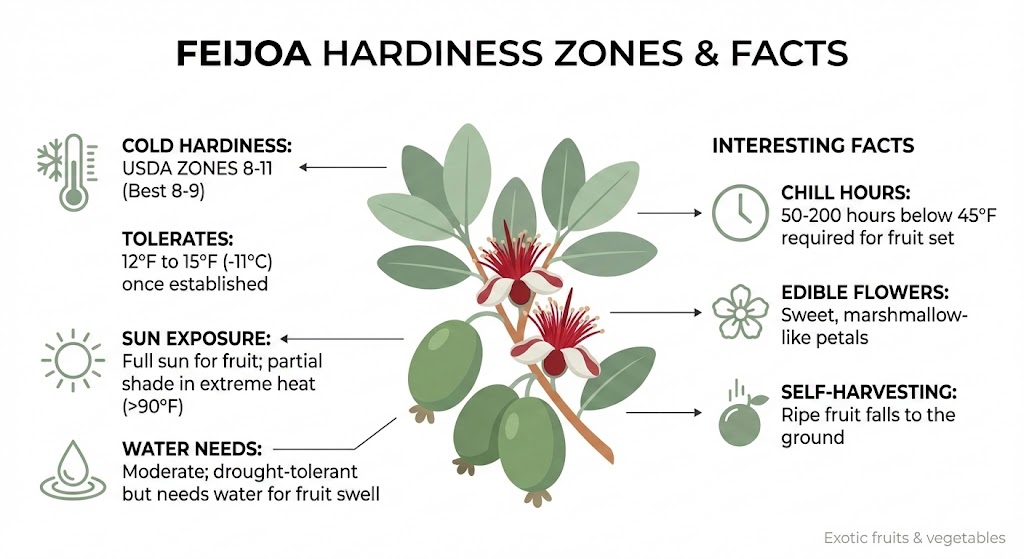
The USDA Hardiness Zone Sweet Spot
When we talk about hardiness zones, we are really talking about the lowest temperature a plant can endure before its cell walls burst and the plant dies. The Feijoa is officially rated for USDA Zones 8 through 11. This means it flourishes in regions where the average annual minimum temperature falls between 10°F and 40°F. However, that is a massive range, and the nuance lies in the details.
Mature Feijoa trees can withstand temperatures as low as 12°F (-11°C) without suffering significant damage, making them far hardier than most subtropicals.
In San Diego, we generally sit in Zone 10a or 10b depending on how close you are to the ocean. For us, winter freeze isn’t the killer; it’s the lack of winter chill (more on that in a moment). But for my friends growing in Northern California or even parts of Oregon (Zone 8), the Feijoa is a gamble that pays off.
The plant might lose some leaves if the thermometer dips into the teens, but the wood usually survives. I have seen plants in Zone 8b lose every single leaf during a freak snowstorm, only to bounce back with vigorous green growth by late April.

Comparing Feijoa Cold Tolerance to Other Exotics
To give you a practical idea of where the Feijoa stands in the hierarchy of exotic fruit resilience, I’ve tracked the damage points of various plants on my farm during our coldest January nights.
| Plant Name | Hardiness Zone | Damage Threshold (Temp) | Recovery Rate |
|---|---|---|---|
| Feijoa (Acca sellowiana) | 8-11 | 12°F to 15°F | High / Fast |
| Hass Avocado | 9-11 | 28°F to 30°F | Moderate |
| Passion Fruit (Edulis) | 9b-11 | 32°F (Frost sensitive) | Low / Slow |
| White Sapote | 10-11 | 26°F to 28°F | Moderate |
You can see that the Feijoa is significantly more robust than the avocado. I once ruined an entire batch of young avocado trees by leaving them unprotected during a 29°F night. In the very next row, the Feijoas didn’t even drop a flower bud. It was a painful $400 lesson in microclimates, but it solidified my respect for the Feijoa.
The Hidden Requirement: Chill Hours
Ever wonder why some fruits split before ripening or why a healthy tree refuses to bloom? Often, it’s not the cold that kills you; it’s the lack of it. This is where Zone 11 growers (like those in Miami or deep Southern California) run into trouble. While Feijoas hate deep freezes, they absolutely demand a period of dormancy. They generally require between 50 to 100 “chill hours”—that is, hours where the temperature sits between 32°F and 45°F.
If you live in a region that never drops below 45°F, your Feijoa may grow plenty of foliage but will likely fail to set fruit due to delayed bud break.
I experienced this firsthand three years ago during an unseasonably warm winter where our nights barely dipped below 50°F. My ‘Nazemetz’ variety, which usually pumps out 40 pounds of fruit, gave me exactly three lonely fruits. The tree looked healthy, lush, and green, but the internal clock that triggers flowering never went off. It’s like trying to wake up without an alarm clock; the plant just keeps sleeping through the reproductive cycle.
Heat Tolerance and The “Baking” Factor
On the flip side of the hardiness coin is heat tolerance. Being in San Diego, we deal with Santa Ana conditions where humidity drops to 5% and temperatures spike to 105°F. Feijoas handle heat well, but they are not cacti. When temperatures exceed 90°F, you must increase irrigation to 2 inches of water per week to prevent fruit drop. If the soil dries out completely during fruit set (usually June/July), the tree will shed the developing fruit to save itself.
Think of the soil around your Feijoa like a battery storing energy. If the battery (water) runs dry while the machine (the tree) is running at full power (high heat), the system shuts down. Mulch is your best friend here. I apply a 4-inch layer of wood chip mulch—sourced from local arborists—around the base of every shrub. This keeps the root zone temperature stable, likely 10 to 15 degrees cooler than the surface air.
Zone Pushing: Growing Outside the Limits
If you are reading this from Zone 7 and feeling left out, don’t close the browser yet. You can grow Feijoas, but you have to cheat the system. Our team at Exotic Fruits and Vegetables loves seeing gardeners push the boundaries, and container culture is the answer. Feijoas adapt surprisingly well to pots, provided the container is at least 15 to 20 gallons.
Here is my step-by-step protocol for “Zone Denial” growing:
- Select the Right Pot: Use a dark-colored resin pot (to absorb winter heat) with multiple drainage holes. Avoid terracotta as it cracks in freezing temps.
- Soil Mix: Do not use garden soil. Mix 40% high-quality potting soil, 30% compost, and 30% perlite or pumice for drainage.
- Mobile positioning: Keep the pot on a wheeled caddy. From April to October, keep it outside in full sun (at least 6-8 hours).
- Winter Protection: Once night temps threaten to drop below 15°F, wheel it into an unheated garage or greenhouse. The plant needs the cool air to accumulate chill hours, just not the deep freeze.
- Light Supplement: If in a garage, hang a simple LED grow light about 12 inches above the canopy on a timer for 8 hours a day to prevent leaf drop.
“A Feijoa in a pot is like a tiger in a zoo; it can live a long, healthy life, but you have to bring the habitat to it.”
I have a customer in Oregon who grows ‘Mammoth’ Feijoas in half-wine barrels. He wraps the barrels in burlap and bubble wrap during January to keep the root ball from freezing solid. The roots are much more sensitive to cold than the canopy. If the root ball freezes through, the game is over.
Planting Strategies for Success
Success with Feijoas isn’t just about the temperature; it’s about placement. In my orchard, I plant them on a slight slope. Why? Because cold air acts like water—it flows downhill and pools at the bottom. By planting on the slope, the coldest air drains away from the trees, buying me a few degrees of safety during a frost.
Here are the non-negotiables for planting sites:
- Drainage is King: If you dig a hole and pour water in it, and it’s still there 4 hours later, do not plant a Feijoa there. They are susceptible to root rot in cold, wet soils.
- Sun Exposure: They need full sun to fruit. In the shade, they become leggy, beautiful ornamental shrubs with zero harvest.
- Wind Protection: While the wood is strong, the flowers are brittle. Strong winds during the May bloom can blow the petals (and potential fruit) right off the tree.
- Cross-Pollination: Even self-fertile varieties like ‘Coolidge’ produce 30-40% more fruit when planted near a different variety like ‘Apollo’ or ‘Triumph’.
I strongly advise against planting Feijoas near concrete walkways or driveways if you care about cleanliness; the dropping fruit can be messy and stain the pavement.
The Fertilization Connection
Hardiness is directly linked to nutrition. A starving tree is a weak tree. I don’t use fancy synthetic boosters. I apply a slow-release organic fertilizer with an N-P-K ratio of roughly 5-5-5 in late February, right before the spring growth flush. Do not fertilize after August in Zone 8 or 9, as this encourages new, tender growth that will get fried by the first frost.
I learned this the hard way. I hit my trees with a high-nitrogen feed in October hoping to bulk them up. The result? Six inches of beautiful, soft green growth that turned into black mush when December hit 28°F. You want the tree to “harden off” and go dormant, not act like it’s spring break.

The Harvest: Is it Worth the Trouble?
You might be asking, “Is all this zone-watching worth it?” Absolutely. The taste of a home-grown Feijoa is indescribable—somewhere between a strawberry, pineapple, and a kiwi, with a gritty texture like a pear. The floral aroma alone is enough to perfume your entire kitchen. When you slice open that jade-green fruit and scoop out the gelatinous center, you realize why we obsess over hardiness zones.
What’s the real secret to success with Feijoas? It’s simply patience and observation.
We’ve learned at Exotic Fruits and Vegetables that the best indicator of ripeness isn’t color—they stay green—but gravity. When the fruit falls to the ground, it is ready. I lay tarps under my bushes in October so the fruit doesn’t hit the dirt directly. It’s a daily Easter egg hunt that never gets old.
The Feijoa is a survivor. It bridges the gap between the temperate and the tropical, offering a resilient option for American gardeners who want something unique. Whether you are battling the dry heat of San Diego or the frost of the Pacific Northwest, there is likely a way to make this plant work for you. Just remember to respect the chill hours as much as you respect the frost dates, and you will be rewarded with buckets of green gold.


As a pollination biologist, I’m fascinated by the Feijoa’s reproductive biology. It’s self-incompatible, requiring cross-pollination to set fruit. I’ve found that the stigma receptivity window is around 2-3 days, and hand pollination techniques can significantly increase fruit set percentages. We’ve used Arduino DHT22 sensors to monitor temperature and humidity, finding that optimal pollination conditions are between 65-75°F and 60-70% RH. Does anyone have experience with other pollinators, like bees or moths, and their effectiveness in Feijoa pollination?
That’s an interesting point about the Feijoa’s reproductive biology. Self-incompatibility can indeed be a challenge in commercial production. We’ve found that using a combination of hand pollination techniques and introducing pollinators like bees can increase fruit set percentages. However, it’s crucial to monitor temperature and humidity levels, as you mentioned, to ensure optimal pollination conditions. A study by Chen et al. (2023) demonstrated the importance of maintaining specific parameters, such as 65-75°F and 60-70% RH, for successful pollination. Have you considered using other technologies, like precision agriculture sensors, to further optimize pollination conditions?
We’ve been growing Feijoa commercially for years, and I can attest to its hardiness in USDA Zones 8-11. Our ‘Coolidge’ variety yields around 20-25 pounds per tree, with a harvest window of about 6 weeks. We’ve found that post-harvest handling is crucial, storing the fruit at 32°F with 85-90% RH to maintain quality. Packing house procedures are also key, using Midwest Grow Kits to ensure proper ventilation and handling. Has anyone else noticed a difference in yield between the ‘Coolidge’ and ‘Mammoth’ varieties?
I’ve integrated Feijoa into my permaculture design as a understory species, using it to attract beneficial insects and provide ground cover. The ‘Coolidge’ variety seems to thrive in our Mediterranean climate, and I’ve found that pruning it to 7 feet makes harvesting a breeze. I’m curious to see how it’ll perform in different microclimates within the forest garden, especially with the added layer of nitrogen fixers like comfrey and clover.
Regarding the integration of Feijoa into permaculture designs, it’s great to hear that you’re using it as an understory species. The addition of nitrogen fixers like comfrey and clover can indeed enhance the overall health of the forest garden. Have you considered incorporating other species, like yarrow or dill, to attract beneficial insects and further diversify the ecosystem? Research by Stamets (1993) highlights the importance of mycorrhizal networks in permaculture systems, which could be an interesting area to explore in your design.