

If you have ever walked past a shrub in late autumn and caught a whiff of something that smells like a mix of pineapple, mint, and expensive perfume, you have likely encountered the Feijoa. Botanically known as Acca sellowiana, and often called Pineapple Guava or Guavasteen, this plant is a staple here in our San Diego orchards.
While many folks rush to the nursery to buy a named cultivar in a 5-gallon pot, there is a profound satisfaction in growing these resilient shrubs from seed. It’s a longer road, certainly, but one that connects you deeply to the lifecycle of the plant.

Here at Exotic Fruits and Vegetables, we’ve found that customers are often baffled by the fruit’s rough, green exterior, only to be completely won over by the creamy, floral interior.
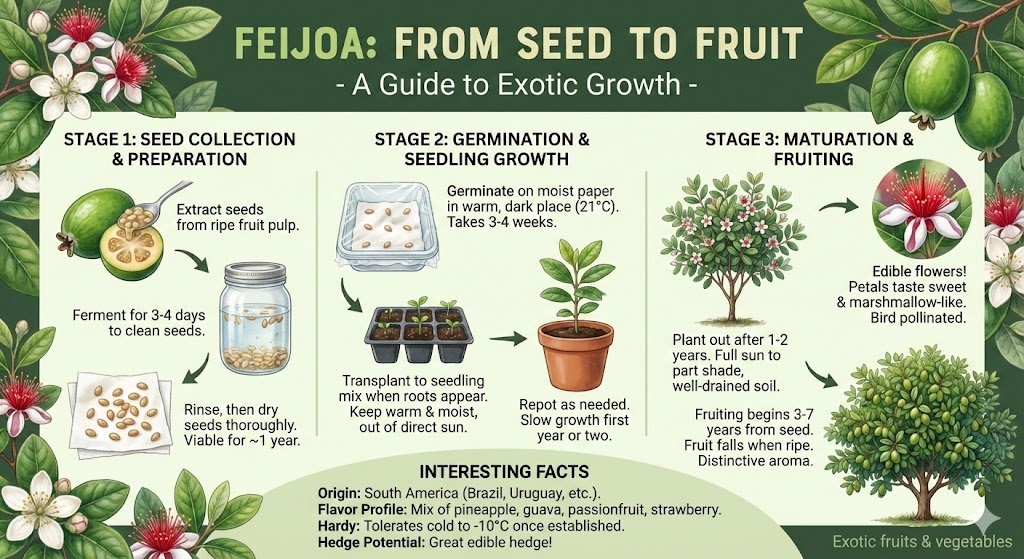
Why Bother Growing from Seed?
With so many grafted varieties like ‘Coolidge’ or ‘Nazemetz’ available, why would you spend years waiting for a seedling to fruit?
That is the million-dollar question. The answer lies in genetic diversity. Feijoas are not true-to-type from seed. This means if you plant a seed from a massive ‘Mammoth’ fruit, the resulting tree will be a unique individual, not a clone of the parent. In my years farming, I have seen seedlings that produce tiny, hard fruits, but I have also seen vigorous seedlings that outproduce the named varieties and offer unique flavor profiles.
Growing from seed also creates a stronger root system. Taproots on seed-grown trees tend to penetrate deeper into our clay-heavy San Diego soils compared to the often root-bound nursery stock. This deep rooting makes them more drought-tolerant once established—a critical trait when we are paying premium rates for water in Southern California.
Feijoa seeds remain viable for a year or more if kept dry and cool, but fresh seeds harvested directly from the fruit have germination rates near 90%.
Sourcing and Preparing Your Seeds
You can buy dried seeds online, but for the best results, you should extract them yourself. Wait until late autumn, usually October or November in our zone, when the fruit naturally drops from the tree. Do not pick them; if they are hanging on the branch, they aren’t ready.
I once ruined an entire batch by trying to scrub the pulp off immediately under running water. The slippery mucilage around the seeds is stubborn. I learned the hard way that fermentation is the key to clean seeds. It acts like a biological scrub brush, eating away the sugary coating that inhibits germination.

The Extraction Process
- Scoop and Soak: Cut the ripe fruit in half and scoop the gelatinous center containing the seeds into a glass jar. Add about 2 inches of water.
- Ferment: Let the jar sit at room temperature (around 70°F) for 3 to 4 days until the mixture gets bubbly and slightly smelly. This fermentation kills off pathogens and breaks down the pulp.
- The Float Test: Add more water and stir vigorously. Good, viable seeds will sink to the bottom. The pulp and bad seeds will float. Pour off the floating debris.
- Rinse and Dry: Repeat the rinsing until the water is clear and you have only clean seeds at the bottom. Spread them on a paper towel to dry for 24 hours.
The Germination Game
Germinating Feijoa is a test of patience. It’s like waiting for a teenager to wake up on a Saturday morning—it happens on its own schedule, not yours. I use standard 1020 nursery trays filled with a sterile seed-starting mix. Do not use garden soil here; our local soil is too heavy and loaded with pathogens that cause damping-off disease in young seedlings.
Sow the seeds on the surface of the moist mix and barely cover them—about 1/8th of an inch of vermiculite is perfect. They need a bit of light to trigger germination. Keep the soil temperature between 70°F and 75°F. In San Diego, if you are starting these in a garage or unheated greenhouse during winter, you will absolutely need a heat mat. Without consistent warmth, they will sit dormant for months.
Never let the seed tray dry out completely. A single day of bone-dry soil can kill the germinating embryo, but conversely, soggy soil will rot them. Aim for the consistency of a wrung-out sponge.
Expect to see the first green loops pushing through the soil in 3 to 6 weeks. My breakthrough came when I discovered that covering the tray with a clear plastic humidity dome accelerated germination by a full week. Just make sure to remove it once the seedlings touch the plastic to prevent mold issues.
Seedling Care and Transplanting
Once your seedlings have two sets of true leaves, they are ready for their first move. I transplant them into 4-inch pots using a high-quality potting mix amended with 30% perlite for drainage. Feijoas despise wet feet. If the roots sit in water, the plant will stall and leaves will yellow.
Growth is agonizingly slow the first year. You might only get 6 to 8 inches of growth. Do not panic. The plant is building a massive root system underground. Think of it like an iceberg; the real action is happening below the surface.
Apply a diluted liquid fertilizer, such as fish emulsion (2-4-1 NPK), every two weeks at half-strength. Young roots burn easily from synthetic granular fertilizers.
Planting Out: The San Diego Strategy
When your sapling hits about 18 inches tall—usually year two—it is ready for the ground. Choose your spot wisely. While Feijoas can tolerate partial shade, they produce the best fruit yield with at least 6 to 8 hours of direct sunlight. In the blazing heat of El Cajon or Escondido, afternoon shade can prevent leaf scorch, but on the coast, give them full exposure.
Our experience at Exotic Fruits and Vegetables has shown that Feijoas are remarkably adaptable to soil pH, tolerating our alkaline 7.5 soil better than citrus. However, they prefer a pH of 5.5 to 7.0. Dig a hole twice as wide as the pot and incorporate 30% organic compost into the backfill. Do not bury the trunk deeper than it was in the pot; deep planting causes collar rot.
Watering and Feeding
Here is where many growers fail. They treat Feijoa like a cactus because it is “drought tolerant.” While the plant will survive on rainfall alone once established, it won’t produce good fruit. To get juicy, large fruit, you need to water consistently during fruit set and development (late summer to autumn).
- Year 1-2: 2 gallons of water every 3-4 days.
- Year 3+: Deep soak the drip line with 5-10 gallons once a week.
- Mulching: Apply 3-4 inches of wood chip mulch to retain moisture.
For nutrition, I use an 8-8-8 organic fertilizer. Feed them once in late winter before the new growth push, and again in early summer. Avoid nitrogen-heavy fertilizers late in the year, as this promotes tender growth that can be damaged by winter cold.
Avoid pruning your Feijoa into a formal hedge if you want fruit. The flowers appear on new growth, and shearing off the outer layer removes almost all potential fruiting wood.
The Long Wait: Managing Expectations
Growing from seed requires a shift in perspective. You are not just growing a fruit; you are stewarding a life. Seedling Feijoas typically take 3 to 5 years to begin flowering. Even then, you need to consider pollination. Feijoas are technically self-fertile, but let me be clear: cross-pollination drastically increases yield and fruit size.
Ever wonder why a solitary bush produces only a handful of fruits? It’s lonely. I always recommend planting at least two different seedlings or varieties close together (about 5-8 feet apart) to allow bees to move pollen between them. Birds are actually the primary pollinators in their native South America, eating the sweet flower petals, but here in the US, bees do the heavy lifting.
Comparison: Seed vs. Cutting
| Feature | Seedling | Cutting/Grafted (Named Variety) |
|---|---|---|
| Time to Fruit | 3-5 Years | 1-2 Years |
| Root System | Deep Taproot (Drought Resistant) | Fibrous, Shallower |
| Fruit Quality | Variable (Genetic Lottery) | Guaranteed/Consistent |
| Cost | Almost Free | $30 – $80 |
Harvesting: The Gravity Test
Harvesting Feijoa is unique because the fruit tells you when it is ready. If you pull a fruit from the branch and you have to tug, it is not ripe. The flavor will be astringent and rubbery. The best method is the “drop” method.
“The best Feijoa is the one that threw itself at the ground.”
We at Exotic Fruits and Vegetables always recommend spreading a tarp or a thick layer of straw under your bushes starting in late September. Every morning, go out and collect the fruit that has fallen. If you absolutely must pick from the tree, only take fruit that detaches with the gentlest upward lift. Once off the tree, bring them inside. They are perfect when the flesh yields slightly to a thumb press, similar to a ripe avocado.
The Reward
When you finally slice into a fruit from a tree you raised from a tiny speck of a seed, the taste is incomparable. It is gritty near the skin like a pear, but the center is a jelly-like explosion of tropical flavors. You can eat them fresh, scooping the center with a spoon, or turn them into jams, chutneys, and even Feijoa wine.
There is also an aesthetic bonus. The flowers of the Feijoa are spectacular—fleshy white petals with bright red stamens. And yes, the petals are edible! They taste like cotton candy and cinnamon. Our team at Exotic Fruits and Vegetables loves sprinkling these petals over spring salads for a pop of sweetness and color.
Growing Feijoa from seed is one of the most forgiving entry points into exotic fruit gardening. Even if the fruit turns out small, you have grown a beautiful, drought-tolerant, evergreen ornamental that feeds the local pollinators.

Final Thoughts
Is growing Feijoa from seed the fastest way to fill your fruit bowl? Absolutely not. But is it the most rewarding? I believe so. It teaches you to read the soil, watch the weather, and appreciate the slow, steady rhythm of nature. In a world that demands instant gratification, waiting four years for a piece of fruit is a radical act of patience.
So, are you ready to get your hands dirty and plant a legacy in your garden? The next time you eat a Feijoa, save those seeds. You might just breed the next great variety right there in your backyard.


tried growing feijoa from seed, but no flowering after 2 yrs, what’s the deal?
so i’ve been growing feijoas in my backyard in san diego for a few years now, and i have to say, the ones i grew from seed are doing way better than the ones i bought from the nursery. they’re more drought-tolerant and produce these tiny, sweet fruits that are perfect for snacking. has anyone else had a similar experience? i’m thinking of starting a small feijoa farm and would love to hear about other people’s experiences with growing these amazing plants
I’ve found that feijoas grown from seed tend to have a more robust root system, similar to what’s seen in plants grown using the ‘Stamets Growing Gourmet’ method. This is particularly important in San Diego’s clay-heavy soils, where drought tolerance is crucial. I’ve had success with the ‘Mammoth’ variety, but it’s essential to provide optimal conditions, including 85-90% RH and pH 6.0-6.5. Has anyone else noticed a difference in flavor profiles between seed-grown and grafted feijoas?
just wanted to share my experience with growing feijoas from seed. i’ve been tracking my progress on r/feijoagrowers, and i’ve noticed that the seedlings that receive more direct sunlight tend to produce more fruit. i’ve also been using a combination of Midwest Grow Kits and Arduino DHT22 to monitor the temperature and humidity levels, which seems to be making a big difference. has anyone else experimented with different growing conditions to optimize feijoa production?
from a botanical perspective, it’s fascinating to note that feijoas are not true-to-type from seed, which means that each seedling will have a unique genetic makeup. this is due to the process of heterozygosity, where the seeds are produced through cross-pollination. this phenomenon is also observed in other species, such as the guava (Psidium guajava), which is a close relative of the feijoa. further research is needed to fully understand the implications of this on feijoa cultivation and breeding programs