

Standing in my orchard here in San Diego, surrounded by the sweet, musky scent of ripening feijoas, I often get asked the same question by visitors staring at their own barren bushes: “How long do I actually have to wait for these things to fruit?” It is the million-dollar question for anyone growing Acca sellowiana.

I have been growing these hardy subtropics in our heavy clay and sandy loam soils for years, and I can tell you that the answer isn’t a simple number; it is a formula involving genetics, patience, and a bit of horticultural manipulation.
While commonly called Pineapple Guava, the feijoa isn’t a true guava (Psidium). It belongs to the Myrtaceae family and hails from the highlands of southern Brazil, Uruguay, and northern Argentina. This distinction matters because their care requirements differ significantly from the tropical guavas we also grow.
The Propagation Factor: Seeds vs. Cuttings
The biggest variable in your timeline is how your plant started its life. Many nurseries sell seedlings because they are cheap and easy to produce, but they are practically a gamble with your time. A feijoa grown from seed is a wild card.
If you plant a seed today, you are looking at a marathon, not a sprint. Seedlings typically take 3 to 5 years to produce their first flower, and sometimes up to 6 years to set decent fruit. I once nurtured a batch of seedlings from a massive ‘Mammoth’ fruit I found at a farmer’s market. I watered them, fed them, and waited. It took four and a half years before I saw a single red-and-white blossom. When fruit finally came in year five, it was the size of a golf ball—hardly the ‘Mammoth’ I expected.
Here at Exotic Fruits and Vegetables, we’ve found that patience is the biggest fertilizer when dealing with seedlings, but cloning is the shortcut.

Plants propagated from cuttings, layering, or grafting are genetically mature from day one. They “think” they are already adults. Consequently, a layered or grafted feijoa can flower the very next season after planting, though I usually strip those flowers off to let the roots establish. Realistically, you will get a harvestable crop in 2 to 3 years.
Always ask your nursery if the plant is a named variety (vegetatively propagated) or a seedling. If it has a specific name like ‘Nazemetz’, ‘Coolidge’, or ‘Apollo’, it’s likely a clone and will fruit years faster than a generic “Feijoa” label.
Typical Fruiting Timeline by Method
To give you a clearer picture of what to expect, I’ve broken down the timelines based on how you start. I use this schedule to plan my own orchard expansions.
| Propagation Method | Time to First Flower | Time to Significant Harvest | Risk Level |
|---|---|---|---|
| Seedling | 3-5 Years | 5-7 Years | High (Variable fruit quality) |
| Cutting / Layering | 1-2 Years | 3-4 Years | Low (Identical to parent) |
| Grafting | 1-2 Years | 2-3 Years | Low (Vigorous rootstock helps) |
The “Self-Fertile” Myth and Pollination Delays
Ever wonder why you have a lush, green, five-year-old bush that blooms like crazy but never holds fruit? I learned this lesson the hard way. Early on, I planted a single ‘Coolidge’ bush—a variety widely touted as self-fertile. I figured one bush was enough for my small test plot.
Three years went by. It bloomed spectacularly. I saw bees. Yet, by November, I had maybe three tiny, sad fruits. I felt cheated. The reality hit me when I consulted a fellow grower in Vista. Even “self-fertile” varieties are mediocre producers in isolation. They need a partner.
Do not rely on a single plant if you want a heavy crop. While some varieties can self-pollinate, cross-pollination increases yields by up to 100% and significantly increases the size of the individual fruit.
I planted a ‘Nazemetz’ about six feet away from my lonely ‘Coolidge’ the following spring. The difference was night and day. That autumn, the branches were practically dragging on the ground from the weight of the crop. If your feijoa is old enough to fruit but isn’t producing, the lack of a pollination partner is the mostly likely culprit.
Think of pollen like a key and the stigma as a lock. Self-pollination is like using a sticky, rusty key—it might work eventually, but it takes effort. Cross-pollination is a master key that slides in effortlessly, unlocking the plant’s full potential.
Climate Requirements: The Chill Factor
San Diego is a paradise for growing, but feijoas have a quirk: they actually like it a little chilly. They aren’t tropicals like mangos; they are subtropics that evolved in highlands. To set a good crop, they require between 50 to 100 chill hours (hours between 32°F and 45°F).
In our coastal zones, we sometimes barely scrape by this minimum. In the inland valleys like El Cajon or Escondido, you get better cold snaps, which result in heavier flowering. If you are right on the beach and your feijoa is taking forever to fruit, it might simply be too cozy. The plant grows leaves all year but lacks the thermal trigger to shift into reproductive mode.
Is your bush getting too much nitrogen? Feijoas are light feeders. If you pump them with Miracle-Gro or high-nitrogen lawn fertilizer, they will thank you by growing six feet of lush foliage and zero flowers. Are you growing a hedge or a fruit bush?
Our experience at Exotic Fruits and Vegetables has shown that switching to a fertilizer with a lower nitrogen number and higher potassium/phosphorus (like a 4-8-8 blend) in late winter can shock a lazy plant into blooming. I apply 1 cup of organic granular fertilizer per inch of trunk diameter in February and again in May. Never fertilize after August, or you’ll encourage soft growth that hates the winter cold.
Accelerating the Harvest: Care Tips
You can’t force nature, but you can certainly nudge it. If you want to shave time off your wait, you need to treat the soil like a battery. You want it charged with consistent, slow-release energy, not erratic spikes.
- Water Deeply, Not Frequently: Feijoas are drought-tolerant *survivors*, but they are not drought-tolerant *producers*. To get fruit fast, I give my mature bushes 10-15 gallons of water once a week during the summer. Shallow sprinkling every day encourages surface roots that dry out instantly.
- Mulch is Mandatory: I lay down 4 inches of wood chip mulch from the drip line to the trunk (leaving a tiny gap at the base). This keeps the shallow feeder roots cool. Hot roots equal plant stress, and stressed plants drop their fruit prematurely.
- Sunlight Positioning: These plants need at least 6 to 8 hours of direct sun. I once tried growing one in the partial shade of an Avocado tree. It grew leggy, reached for the light, and took two extra years to flower compared to its sisters in full sun.
Avoid pruning your feijoa into a formal shape if you want fruit. Feijoas bear fruit on the current season’s growth, emerging from the tips of one-year-old wood. If you hedge them tight like a boxwood, you are literally cutting off next year’s harvest.
Harvesting: The Waiting Game Ends
One of the most common mistakes I see—and I did this myself my first year—is picking the fruit from the bush. You see a nice green oval, you squeeze it, it feels firm, and you yank it off. You take a bite, and it tastes like bitter styrofoam.
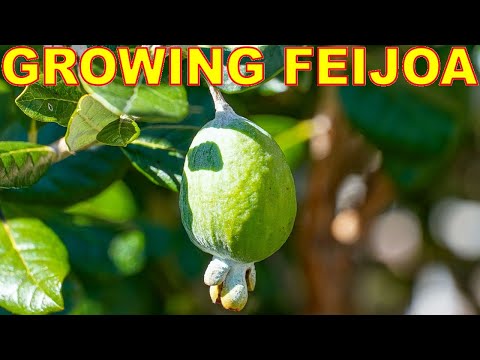
Feijoas are unique because they generally do not change color when ripe. They stay green. The only reliable indicator of ripeness is gravity; the fruit is ready when it falls to the ground.
Through our work with Exotic Fruits and Vegetables farm, we’ve developed a “shake test.” If I suspect the season is peaking, I place a tarp under the bush and give the main trunk a gentle shake. Anything that drops is ready to eat immediately or within a day or two.
Recommended Varieties for San Diego
- Apollo: Large, oval fruit. Thin skin. Very tasty but needs a pollinator for best yield. Early to mid-season.
- Nazemetz: My personal favorite. Pear-shaped, non-gritty pulp. Excellent pollinator for others. Late ripening (Oct-Dec).
- Mammoth: Huge fruit, somewhat softer. Best for fresh eating, not storing. needs a pollinator.
- Coolidge: The standard self-fertile variety. Smaller fruit, reliable, but flavor is less complex than Nazemetz.
“Growing feijoas teaches you that the best things in life land at your feet when you stop grasping for them.” — A sentiment shared by many orchardists.
Troubleshooting: Why is it Taking So Long?
If you are past the 4-year mark with a grafted tree and still seeing nothing, run through this checklist. Are you planting it in a lawn? Grass is a fierce competitor for nitrogen and water. I always clear a 3-foot diameter circle around the trunk. Are you pruning too late in the season? Pruning after July removes the wood that sets flower buds for the next spring.
Another issue is heat waves during flowering. If we get a Santa Ana wind event (95°F+ and dry air) in May or June while the bush is blooming, the flowers can desiccate and drop before setting fruit. During these events, I mist the foliage in the early morning to keep humidity up.
Beware of the “June Drop.” It is normal for the plant to drop 50-70% of its tiny fruitlets in early summer. The plant is self-regulating because it knows it can’t support hundreds of fruits. Do not panic and dump fertilizer on it, or you will cause it to drop the rest.
Final Thoughts
So, how long do feijoas take to fruit? If you buy a grafted plant and put it in the ground this weekend, treat it to deep watering and find it a companion, you will likely be eating fruit in three autumns. If you toss a seed in a pot, you are signing up for a five-year engagement.
The flavor of a homegrown feijoa—a mix of pineapple, strawberry, and mint with a gritty pear-like texture—is worth every month of the wait. In a world of instant gratification, this plant demands you slow down and observe the seasons. Keep the water steady, keep the pruners in your pocket, and let the fruit fall when it’s ready.



omg i tried growing feijoa from seed and it took forever! 4 years and the fruit was so small lol. now i’m trying with cuttings and layering, fingers crossed!
Research by UC Davis shows feijoa seedlings take 3-5 years to produce first flower, while cuttings can fruit in 1-2 years. I’ve seen this in our regional variety trials.
Regarding the UC Davis research, it’s worth noting that the study also found that feijoa seedlings grown in warmer climates can produce fruit faster than those grown in cooler climates. This is likely due to the increased rate of photosynthesis and cell division in warmer temperatures.
I’ve been growing feijoas in my backyard in San Diego for 5 years now, and I can attest that the waiting game is real. But the flavor is so worth it! Has anyone tried grafting feijoas onto other rootstocks?
I’m not convinced that feijoas are worth the hype. I mean, they’re just a fancy guava, right? And the yield is so low compared to other fruits. Can someone explain to me why they’re so popular?
That’s an interesting point about the yield of feijoas. While it’s true that they may not produce as much fruit as other varieties, the unique flavor and nutritional profile of feijoas make them a valuable addition to any orchard. In fact, feijoas are rich in antioxidants and have been shown to have potential health benefits.
I’ve been experimenting with feijoa propagation using a combination of layering and grafting. I’ve found that using a rooting hormone like Clonex can increase success rates by up to 30%. Has anyone else tried this method?
About your question on feijoa propagation, using a rooting hormone like Clonex can indeed increase success rates. However, it’s also important to consider the specific growing conditions and soil quality when propagating feijoas. For example, feijoas prefer well-draining soil with a pH between 6.0-6.5, and consistent moisture levels can help promote healthy root development.