

If I had a nickel for every time someone stopped by my farm stand here in San Diego asking to buy a “male” Feijoa tree to go with their “female,” I’d probably have enough to buy a whole new acre of land in Escondido. It is easily the most common misunderstanding about this incredible plant.
You might know it as the Pineapple Guava, or by its scientific handle, Acca sellowiana (formerly Feijoa sellowiana). Whatever you call it, the confusion about its gender is preventing thousands of gardeners from getting a single piece of fruit.

Here at Exotic Fruits and Vegetables, we’ve found that the real issue isn’t gender, but social anxiety—botanically speaking, of course. While they have all the necessary equipment to reproduce, many varieties simply refuse to accept their own pollen. They are self-sterile, requiring a different genetic individual nearby to set fruit.
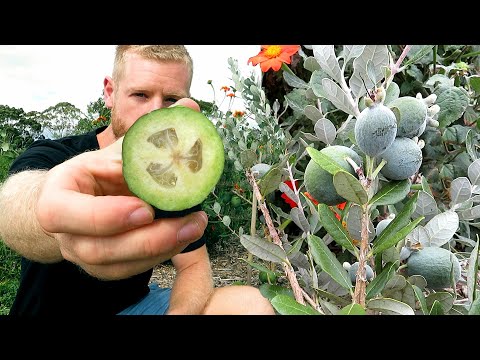
The name “Pineapple Guava” is a bit of a misnomer that confuses buyers. While related to the true guava (Myrtaceae family), it is much more cold-hardy, surviving temps down to 12°F, and tastes like a complex blend of pineapple, strawberry, and wintergreen mint.
The Biology: Why Your “Couple” Might Be a Bad Match
So, if every flower is a hermaphrodite, why do so many solitary trees remain barren? Imagine trying to high-five yourself; you can do it, but it’s not as effective as high-fiving someone else. In the plant world, we call this self-incompatibility. The pollen from a ‘Mammoth’ variety tree cannot fertilize the stigma of the same tree, or even another ‘Mammoth’ clone next to it. Chemical barriers in the style preventing the pollen tube from growing down to the ovary.
I once ruined an entire batch by planting two rows of ‘Triumph’ Feijoas isolated in a new field, thinking they would cross-pollinate because there were twenty trees. I got zero fruit that year. Why? Because they were all cuttings from the same mother plant. Genetically, they were the same individual. To get fruit, you need genetic diversity.
Ever wonder why your single tree flowers beautifully every May but drops every single bloom by July without setting a single fruit?
This is where the “male/female” myth started. People planted two trees, got fruit, and assumed they had a pair. In reality, they just had two different varieties that were compatible. For us in California, where space is at a premium, understanding which varieties play nice together is critical.
Pollination: Birds vs. Bees
Another fascinating aspect of Feijoa biology is how they get the pollen from point A to point B. In their native range in South America, and even in New Zealand where they are huge crops, blackbirds and mynas do the work. The plant has evolved a sugary, fleshy flower petal specifically to attract birds. The birds eat the petals, get dusted with pollen, and fly to the next tree.
In San Diego, I’ve watched mockingbirds and towhees tearing into the flowers. Honeybees will visit Feijoa flowers to gather pollen, but they are inefficient pollinators for this species because they don’t touch the stigma often enough. The stigma extends far past the anthers. If you want guaranteed fruit set, you cannot rely solely on local insects; you need bird activity or your own two hands.
Choosing the Right Varieties for San Diego
If you only have space for one tree, you must choose a self-fertile variety. However, even self-fertile varieties produce 30-50% more fruit when cross-pollinated. I always tell my customers to plant a hedge if possible.
Our experience at Exotic Fruits and Vegetables has shown that mixing a self-fertile type with a large-fruiting self-sterile type gives you the best of both worlds. The self-fertile tree acts as a reliable “male” donor for the picky tree, while also setting its own crop.
Here is a breakdown of the varieties I currently grow and track:
| Variety Name | Fertility Type | Fruit Size | Notes |
|---|---|---|---|
| Coolidge | 100% Self-Fertile | Small to Medium | The standard CA variety. Reliable, heavy bearer, but fruit can be smaller. |
| Nazemetz | Partially Self-Fertile | Large | Excellent flavor, pear-shaped. Needs a pollinator for best crops. |
| Mammoth | Self-Sterile | Huge | Softer fruit, very wrinkled skin. MUST have a partner or you get nothing. |
| Apollo | Partially Self-Fertile | Large/Oval | Vigorous upright growth. Great flavor, very aromatic. |
For the San Diego coastal climate, ‘Nazemetz’ is my top recommendation for flavor, but if you absolutely can only plant one tree in a pot on a balcony, ‘Coolidge’ is the only safe bet that guarantees a harvest.
How to Hand Pollinate (Be The Bird)
If you are stuck with a self-sterile tree and no room for a partner, or if your local birds are slacking off, you can take matters into your own hands. Hand pollination is simple, but timing is everything. Pollen is most viable between 11:00 AM and 2:00 PM when the humidity drops slightly.
- Gather your tools: I use a small artist’s paintbrush (camel hair is softest) or simply my fingers.
- Collect the pollen: Find a flower where the yellow anthers are fluffy and releasing golden dust. If you have a neighbor with a tree, go snip a few flowering branches and bring them home in water.
- The Transfer: Gently brush the yellow pollen onto the central stigma (the single tall stick in the middle) of your target flowers.
- Repeat: You need to do this every 2-3 days during the bloom season (usually May-June) as new flowers open.
Do not assume that seeing pollen on the flower means it has been pollinated. Feijoa pollen is heavy and sticky; it does not blow in the wind like corn pollen. It requires physical transfer.
Cultivation: Treating Your Soil Like a Battery
Growing Feijoas is not difficult, but growing good Feijoas requires specific inputs. Think of your soil as a battery storing nutrients; if you don’t charge it, the plant can’t draw energy when it’s time to fruit.
In our local sandy loam or clay soils, drainage is usually the main concern. Feijoas hate “wet feet.” I plant all my trees on mounds raised 8-10 inches above the grade. I amend the native soil with 30% compost and use 5 pounds of gypsum per 100 square feet to break up the clay.
Watering: The Fruit Size Secret
What’s the real secret to success regarding fruit size? Water timing. Feijoas are incredibly drought tolerant—they will survive on 5 inches of rain a year. But surviving isn’t fruiting. If you stop watering in August because the flowers are gone, your fruit will be the size of marbles and hollow inside.
I apply 1.5 inches of water per week consistently from fruit set (July) through harvest (October/November). My breakthrough came when I installed drip irrigation emitting 2 gallons per hour for 90 minutes every 3 days. The fruit size doubled compared to the year I hand-watered sporadically.
Never allow the tree to undergo severe water stress in September. The tree will prioritize its own survival and abort the fruit, dropping them while they are still rock-hard and immature.
Fertilization Requirements
These trees are hungry nitrogen consumers during the vegetative flush. I use a balanced organic fertilizer. Applying 1 pound of 8-8-8 fertilizer per inch of trunk diameter, split into three applications (February, May, and July), works wonders. Don’t feed them after August, or you will stimulate new soft growth that will get nipped by our winter chill.

Harvesting: The Gravity Test
Harvesting Feijoa is unique because the tree tells you when it’s ready. Unlike apples that you pull, a Feijoa is best when it falls to the ground. However, in a commercial setting or a tidy garden, we don’t want fruit lying in the dirt.
I use the “touch test.” I gently lift the fruit. If it detaches with zero resistance, it is ripe. If you have to pull, twist, or yank, walk away. It is not ready. Eating an unripe Feijoa is like eating a astringent bar of soap; it will ruin the experience for you forever.
- Fresh Eating: Scoop out the center jelly with a spoon.
- Baking: Use the whole fruit (peeled) in muffins; the texture mimics cooked pear.
- Infusions: We steep the skins in vodka for a week to make a wildly aromatic extract.
- Jams: The high pectin content makes it gel easily without additives.
One of the best unintended benefits of growing Feijoas is the edible petals. Before the fruit even forms, you can harvest the petals (leave the rest of the flower intact for fruit set) and sprinkle them on salads. They taste like cotton candy!
Final Thoughts
We at Exotic Fruits and Vegetables believe in growing food that you cannot find in the average supermarket. The Feijoa fits this perfectly. It doesn’t travel well, it bruises easily, and its shelf life is only about 7 days. That makes it the ultimate home-garden fruit.
So, stop looking for a “male” tree. Go out and find a ‘Coolidge’ and a ‘Nazemetz’, plant them 5 to 8 feet apart, and get ready for a tropical explosion in late autumn. It’s like having a little piece of the jungle right here in San Diego, minus the humidity.
“The best time to plant a Feijoa was five years ago. The second best time is today, just make sure you bring a friend for it.”
Remember to mulch heavily with 3-4 inches of wood chips to retain that critical soil moisture during our Santa Ana wind events. Happy growing, and enjoy the harvest!



What’s the cheapest Feijoa variety to start with? Can I use homemade fertilizers?
Regarding the cost of Feijoa varieties, some of the more affordable options include ‘Mammoth’ and ‘Triumph’. However, it’s worth noting that these varieties may require more maintenance and care. Homemade fertilizers can be a great option, but make sure to balance the nutrient content to avoid burning the roots. A mix of 10-10-10 NPK with added organic matter like compost or manure can be a good starting point.
I’ve found that integrating Feijoa into a permaculture food forest guild can be really beneficial. I plant them with nitrogen-fixing ground covers like clover and comfrey, and use companion planting with species like nasturtiums to attract beneficial insects. The key is to create a diverse and resilient ecosystem. I’ve seen significant improvements in soil health and fruit production when using this approach. Has anyone else had success with this method?
That’s an interesting point about integrating Feijoa into a permaculture food forest guild. Research has shown that diverse ecosystems can lead to improved soil health and increased biodiversity. The use of nitrogen-fixing ground covers and companion planting with beneficial insect attractors can be a great way to create a resilient and productive ecosystem. We’ve seen similar results in our own experiments with Feijoa and other exotic fruits. Have you considered incorporating other species, like kiwi or passionfruit, into your guild to further enhance the ecosystem?