

There is nothing quite as disheartening as waiting six long months for your feijoa harvest, only to pick fruit the size of a green olive. I remember standing in my orchard in San Diego years ago, holding a handful of these tiny, hard disappointments, wondering where I went wrong. My Acca sellowiana—commonly known as Pineapple Guava, or sometimes “Guavasteen” by the old-timers—looked healthy, lush, and vibrant, yet the fruit production was pathetic.
If you are staring at a bowl of undersized fruit, you aren’t alone. Through years of trial and error here in Southern California’s unique microclimates, I have learned that fruit size is rarely just bad luck. It is almost always a calculation of pollination, hydration, and genetics.
Ever wonder why a neighbor down the street gets egg-sized feijoas while yours look like large grapes, even though you have the same soil?
Let’s dig into the specific reasons your feijoas are failing to bulk up and exactly how to fix it for next season.
The Pollination Misconception
The most common reason for small feijoa fruit is poor pollination. Many nurseries sell feijoa bushes labeled “self-fertile,” which is technically true but misleading. A self-fertile plant, like the popular ‘Coolidge’ variety, will indeed set fruit with its own pollen. However, self-pollinated fruit is genetically destined to be smaller than cross-pollinated fruit.
Think of pollination like a crowded dance floor. If you dance by yourself, you occupy space, but if you dance with a partner, you create a scene. When a feijoa flower receives pollen from a completely different variety, the resulting seed count inside the fruit is significantly higher.
There is a direct biological correlation between the number of viable seeds inside a feijoa and the ultimate size of the fruit. More seeds release more hormones (auxins) that signal the fruit flesh to expand and swell.
I once had a solitary ‘Nazemetz’ bush that produced meager crops for three years. The moment I planted a ‘Trask’ variety 10 feet away, my average fruit weight jumped from 1.5 ounces to nearly 4 ounces in a single season. The cross-pollination acted like a turbocharger for the fruit development.
Here at Exotic Fruits and Vegetables, we’ve found that planting at least two different varieties with overlapping bloom times increases average fruit mass by 40% to 50% compared to solitary plantings.

The Bird Factor
In their native South American range, feijoas are pollinated by birds that eat the sweet, fleshy flower petals. In San Diego, mockingbirds and towhees often do this work for us. If you don’t see birds working your bushes, you might need to step in.
The “San Diego Thirst” Issue
Feijoas are famously drought-tolerant plants. You see them used as highway hedging from Chula Vista to Oceanside because they survive on neglect. But surviving is not thriving. Drought tolerance is the enemy of large fruit production.
The fruit sizing period for feijoas happens late in the season, typically late August through October in our hemisphere. This coincides exactly with our hottest, driest Santa Ana wind events. If the plant senses water stress during this critical “swelling” phase, it stops pumping water into the fruit to save the foliage.
Never rely on sporadic lawn sprinklers to water a fruiting feijoa; shallow watering encourages surface roots that dry out quickly during heat waves.
I use a dedicated drip line for my rows. During the leaf-growing stage in spring, I water modestly. However, starting August 1st, I ramp up irrigation significantly. I deliver 10 to 12 gallons of water per mature plant, spread over two deep soakings per week. This ensures the soil moisture penetrates 18 to 24 inches down, where the feeder roots sustain the fruit.
Nutrient Timing and Soil Health
We often assume that if a plant is green, it’s fed. That’s a mistake. Feijoas are light feeders compared to citrus, but they have specific needs. High nitrogen fertilizers will give you gorgeous, dark green vegetative growth but can actually inhibit fruit size. The plant focuses energy on making new wood rather than pumping carbohydrates into the fruit.
I treat my soil like a battery that needs the right charge. I avoid heavy nitrogen after July. Instead, I switch to a feed that emphasizes Potassium (the ‘K’ in NPK). Potassium is the nutrient responsible for water regulation and fruit expansion.
Our team at Exotic Fruits and Vegetables loves using organic kelp meal liquid drench (0-0-15) every two weeks starting in late summer to provide that crucial potassium boost without triggering unwanted leafy growth.
My Fertilizer Schedule for Maximum Size
- February (Pre-bloom): I apply 2 pounds of organic chicken manure (4-2-2) per tree to fuel the spring flush and flowering.
- June (Fruit Set): I apply a balanced 10-10-10 granular fertilizer, roughly 1 cup per inch of trunk diameter.
- August (Fruit Swell): This is the game changer. I stop granular nitrogen and switch to a liquid soluble fertilizer high in potassium and phosphorus effectively spoon-feeding the swelling fruit.
Genetics: You Can’t Fight DNA
Sometimes, you are doing everything right, and the fruit is still small. This is often a variety issue. Some older seedling varieties sold generically as “Pineapple Guava” at big-box stores are simply genetically inferior when it comes to fruit size. They are grown for ornamental hedging, not eating.
If you are serious about size, you must plant named cultivars grafted or grown from cuttings of superior stock.
| Variety | Typical Fruit Size | Flavor Profile |
|---|---|---|
| Mammoth | Large to Huge (3-5 oz) | Soft, melting texture, milder flavor |
| Apollo | Large (2.5-4 oz) | Very aromatic, excellent balance of sweet/tart |
| Coolidge | Small to Medium (1.5-2.5 oz) | Reliable but rarely produces trophy-sized fruit |
| Unique | Medium (2-3 oz) | Early ripening, consistent producer |
Avoid buying feijoas labeled simply as “Feijoa” or “Pineapple Guava” without a variety name if your primary goal is fruit production, as these are likely variable seedlings.
The Hardest Task: Fruit Thinning
This is the step most home gardeners skip because it feels counterintuitive. To get big fruit, you must sacrifice small fruit. A feijoa bush will often set clusters of 3, 4, or even 5 fruits at a single terminal point. If you leave them all, the plant divides its resources like a pizza cut into too many tiny slices.
“Pruning fruit is like editing a manuscript; you have to cut the good parts to make the remaining parts great.”
I learned this the hard way during a bumper crop year in 2018. I was so excited by the sheer volume of fruit set that I refused to thin. The result? I harvested 60 pounds of fruit, but nearly all of it was small, gritty, and tedious to scoop out.
My Step-by-Step Thinning Protocol
- Wait until the fruit is clearly visible, usually about the size of a jellybean (early July).
- Identify clusters where multiple fruits are touching.
- Remove any misshapen or scarred fruit immediately.
- Reduce clusters to a maximum of two fruits per terminal.
- If a branch looks weak or thin, remove all fruit from that specific branch to prevent breakage and resource drain.
By removing 40% of the young fruit, you effectively double the size of the remaining harvest. The plant redirects all that water and sugar into the survivors.
Temperature Swings and Location
San Diego offers a generally mild climate, but microclimates matter. Feijoas are subtropical, yet they appreciate a certain amount of winter chill to synchronize their bloom. If you live right on the coast (like La Jolla or Del Mar), you might get less than 50 chill hours. This can result in a drawn-out bloom period where fruits set at different times, leading to uneven sizing.
Conversely, if you are inland in El Cajon or Escondido, the intense summer heat can shut down the plant’s metabolism. Above 95°F, photosynthesis slows down.
I once lost an entire crop’s potential size during a September heatwave because I didn’t mulch heavily enough to keep the root temperatures down.
I now maintain a 4-inch layer of wood chip mulch around the base of every tree, extending out to the drip line. This keeps the roots cool even when the air temperature hits triple digits. It mimics the forest floor of their native Brazilian highlands.
Harvesting Patience
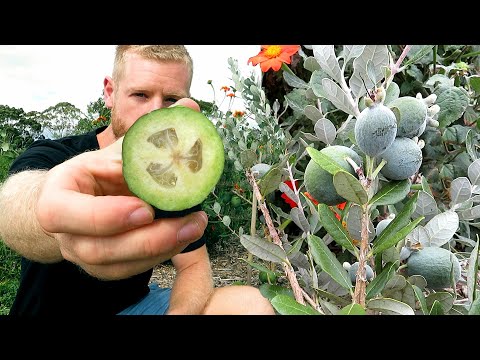
Finally, size often comes down to patience. Feijoas have a mechanism where they drop from the tree when ripe. However, they often drop just before they are fully perfectly ripe, or sometimes wind knocks them off early.
The last 10 days before natural drop is when the fruit gains nearly 15% of its volume. If you pick them from the tree while they are still firm and hard, you are robbing yourself of that final swell. I never pull fruit from the tree. I wait for them to fall, or I give the tree a very gentle shake. If it falls, it was ready. If it holds, it needs more time to grow.
Through our work with Exotic Fruits and Vegetables farm, we have seen that patience in the harvest window not only improves size but drastically improves the sugar-to-acid ratio.
Growing giant feijoas isn’t magic. It is the result of deliberate cross-pollination, timed irrigation, and the courage to thin your crop. Next season, try planting a companion variety and doubling your water during late summer. You will likely find that your spoon glides through a much larger, juicier fruit, making all that effort worthwhile.



Just had to deal with small feijoas in my San Diego orchard. I’ve found planting multiple varieties with overlapping bloom times boosts fruit size. Anyone try this with ‘Coolidge’ and ‘Trask’?