
There is nothing quite like standing in your own backyard on a warm San Diego morning, reaching up, and gently twisting a ripe fig off the branch. The skin gives slightly under your thumb, and a drop of nectar—what we growers call the “honey tear”—oozes from the eye of the fruit. If you have only ever eaten those dry, crunchy cookies from the grocery store, you haven’t actually tasted a fig. The fresh experience is closer to eating jam right out of the jar, but with complex notes of berry, hazelnut, and caramel that vary wildly depending on the cultivar.
Here at Exotic Fruits and Vegetables, we’ve found that the biggest barrier to entry for new growers is simply being overwhelmed by the choices. With over 800 varieties in existence, picking the “best” one feels impossible. But through trial, error, and a lot of sticky fingers, I have narrowed down what truly performs in American soil.
Understanding the Fig: More Than Just a Fruit
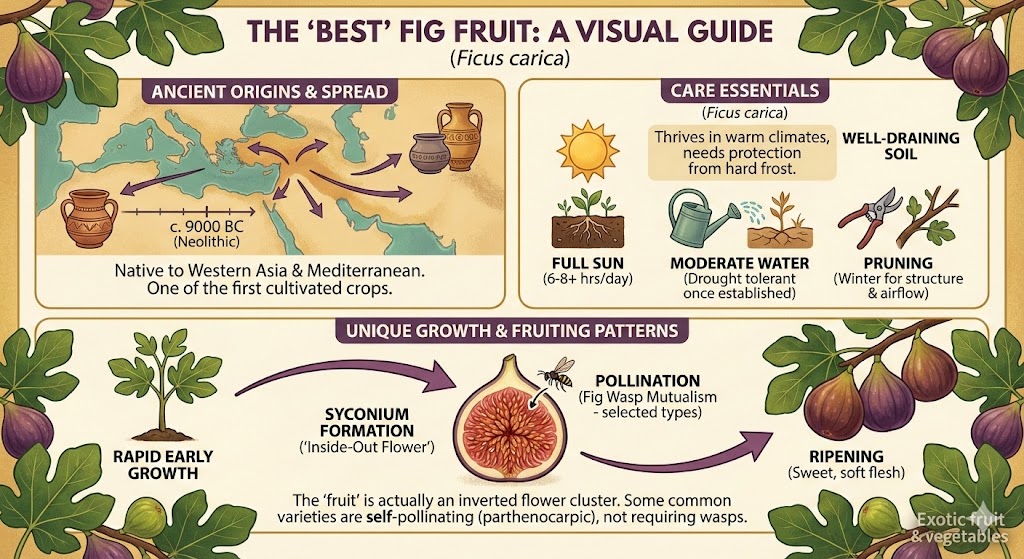
First, let’s get technical for a moment. The fig is technically a syconium—an inverted flower. Those tiny crunching seeds inside are the actual fruit, while the fleshy part we love is the stem tissue that has swelled up to hold them. This biological quirk is why figs are so sensitive to environmental changes; you are essentially eating a flower bouquet.
Did you know that many common figs grown in the US are parthenocarpic? This means they produce fruit without pollination. Unlike the Smyrnas grown in Turkey that require the specific Blastophaga psenes wasp to enter the fruit, varieties like Black Mission and Brown Turkey ripen all on their own.
In San Diego, we are blessed with a climate that mimics the Mediterranean almost perfectly. However, I once ruined an entire batch by assuming “Mediterranean” meant they didn’t need water. I let a young celeste tree go dry during a Santa Ana heatwave, thinking it would toughen up. Instead, it dropped every single leaf and fruit within 48 hours. It survived, but I lost a whole year of production. The lesson? Drought-tolerant does not mean drought-loving.

The Contenders: Best Varieties for the US Gardener
So, what differentiates a supermarket fig from a backyard gem? It usually comes down to skin thickness and sugar content. Commercial growers need thick skin for shipping; home growers want skin that melts in your mouth.
I have compiled a comparison of the top performers based on flavor complexity and reliability in zones 7 through 10.
| Variety Name | Skin/Flesh Color | Flavor Profile | Best Use |
|---|---|---|---|
| Black Mission | Purple-Black / Strawberry Red | Classic rich, jammy, earthy sweetness | Fresh eating, drying |
| Panache (Tiger Fig) | Yellow with Green Stripes / Crimson | Bright berry flavor, less “figgy” musk | Gourmet plating, fresh |
| Violette de Bordeaux | Dark Purple / Deep Red | Intense raspberry jam, high acidity balance | Preserves, cheese boards |
| LSU Purple | Glossy Red-Purple / Amber | Mild, high sugar, maple notes | Humid climates, fresh |
If I had to choose just one for pure flavor, the Violette de Bordeaux wins every time. It is small, ugly, and cracks easily, but the taste is pure raspberry candy. However, if you are looking for a workhorse that pumps out fruit like a factory, the Black Mission remains the king of California.
For those gardening in smaller spaces or containers, look for the “Little Miss Figgy” mutation. It stays under 6 feet tall naturally but produces full-sized fruit comparable to the Violette de Bordeaux.
Site Selection and Planting Strategy
Where you put your tree dictates 90% of your success. Figs are sun worshippers. They need a minimum of 8 hours of direct, unfiltered sunlight daily. If you plant them in the shade of a large oak or on the north side of your house, you will get beautiful lush green leaves and absolutely zero fruit. The tree interprets shade as a signal to grow tall to find light, rather than focusing energy on fruit production.
Our experience at Exotic Fruits and Vegetables has shown that soil preparation is the step most people skip, and it haunts them later. Figs love a pH between 6.0 and 6.5. They hate “wet feet.” If your soil has high clay content, like much of San Diego, you must amend it.
The Planting Protocol
- Dig the Right Hole: Excavate a hole that is three times as wide as the pot but no deeper than the root ball. We want the roots to spread laterally.
- The “Perk” Test: Fill the empty hole with water. If it hasn’t drained in 12 hours, you need to build a raised bed or choose a different spot. Stagnant water causes root rot within days.
- Amend Wisely: Mix your native soil 50/50 with high-quality compost. Do not use pure potting mix in the ground, or the roots will never venture out into the native soil.
- Plant High: Place the tree so the top of the root ball is 2 inches above the surrounding soil level. Mound the soil up to it. This compensates for settling and ensures drainage.
- Mulch Heavily: Apply 3 to 4 inches of wood chip mulch in a donut shape around the tree, keeping it 6 inches away from the trunk to prevent collar rot.
Avoid fertilizing your fig tree heavily with nitrogen. If you dump a bag of high-nitrogen lawn fertilizer near your tree, you will trigger vegetative growth at the expense of fruit. The tree becomes a giant bush of leaves, and the few fruits that form will often split or taste bland.
Care and Maintenance: The Art of the Prune
Think of pruning as traffic control for the plant’s energy. If you let the tree do what it wants, it will create a dense canopy where sunlight cannot penetrate. No sun on the branches means no fruit initiation.
I use the “Open Vase” method. I cut out the central leader trunk when the tree is young to force side branching. This keeps the tree short enough to harvest without a ladder and allows air to circulate through the center. Airflow is your best defense against fungal issues like rust.
My breakthrough came when I discovered “pinching.” When a new green branch grows 5 or 6 leaves long during the active season, I pinch off the very tip. This shocks the branch just enough to stop it from growing longer, forcing it to send energy into the tiny fruitlets at the base of the leaves. Since I started doing this, my yield per branch has nearly doubled.
Figs are incredibly resilient. Even if you make a mistake and cut a branch you shouldn’t have, the tree will vigorously regrow. It is very hard to kill a fig tree with pruning shears.
Troubleshooting Common Nightmares
Ever wonder why some fruits split before ripening? It usually happens when you water inconsistently. If the tree goes dry and then gets a sudden deluge of water (from a hose or rain), the roots rush that water to the fruit. The inside flesh expands faster than the skin can stretch, and pop—your fig splits open. Once it splits, it begins to ferment immediately.
To prevent splitting, maintain consistent soil moisture by providing 10-15 gallons of water per week for established trees during the summer, rather than small daily sprinkles.
Then there are the pests. In Southern California, the Green Fig Beetle is my nemesis. They are iridescent, clumsy, buzz like miniature lawnmowers, and they love soft fruit. I don’t use pesticides because I eat the skin. Instead, I use exclusion bags. These are small organza mesh bags (like you see at weddings) tied around the individual fruits as they start to soften.
Be extremely careful with the white milky sap that bleeds from cut branches or unripe figs. This latex contains ficin, an enzyme that causes serious photodermatitis. If you get it on your skin and then go out in the sun, you can end up with painful blisters that look like burns.
Harvesting: The Sweet Reward
Harvesting figs is not like harvesting apples; they do not ripen off the tree. If you pick a fig that is firm, it will remain firm and tasteless on your counter until it rots. You have to wait for the droop.
A ripe fig signals you in three ways:
- Color Change: Deep purple, brown, or yellow depending on variety.
- The Droop: The neck softens, and the fruit hangs straight down, no longer perpendicular to the branch.
- Texture: It should feel like a partially filled water balloon.
When I harvest, I go out in the early morning while the fruit is still cool. Warm figs bruise instantly. Never pull the fruit straight down; lift it upward toward the branch, and the stem should snap cleanly without tearing the skin.
What’s the real secret to success with figs? It is patience during the “breba” crop.
Figs often produce two crops. The first, called the breba crop, grows on last year’s wood in early summer. It is often smaller and less flavorful. The main crop, which grows on new wood in late summer or fall, is the main event. Don’t judge your tree by its brebas.

Culinary Potential
We at Exotic Fruits and Vegetables believe in eating seasonally, and fig season is a sprint, not a marathon. Fresh figs have a shelf life of about 48 to 72 hours in the fridge before they start to sour.
I love slicing them in half, stuffing a nugget of goat cheese inside, wrapping them in prosciutto, and grilling them for 2 minutes. The heat caramelizes the natural sugars, creating a flavor bomb that hits every part of the palate. If you have a glut of fruit, drying them is the best way to preserve that flavor. A dehydrated Black Mission fig tastes almost exactly like a date.
“A fig tree looks at the ground, but dreams of the sun.” – Old Italian Proverb
Growing Ficus carica connects you to an agricultural tradition spanning thousands of years. It is a forgiving, generous plant that asks for little more than a sunny spot and some thoughtful pruning. If you treat your soil like a living ecosystem rather than just dirt, your fig tree will reward you with pounds of fruit for decades.
The next time you see a sapling at the nursery, don’t just walk past. Imagine the taste of that honey-sweet nectar on a warm August afternoon. Dig the hole. It’s worth it.