
Standing in my orchard in East County San Diego, staring up at a dormant fig tree against our crisp winter sky, I often feel a mix of excitement and responsibility. To the uninitiated, a fig tree—or Ficus carica to the botanically inclined—looks like a tangled mess of grey wood during dormancy. But to those of us who live for the harvest, that tangle is a roadmap to next season’s sweetness. I’ve learned the hard way that if you don’t control the tree, the tree controls you, turning your backyard into a jungle of unreachable fruit and fermenting mess.
There is an old saying among Mediterranean growers that I take to heart: “You should prune a fig tree until you think you’ve killed it, and then prune it some more.”
Figs are incredibly vigorous growers, especially here in Southern California where our mild winters barely slow them down. Left to its own devices, a standard ‘Black Mission’ or ‘Brown Turkey’ can easily shoot up 6 to 10 feet in a single season. I remember my first year farming here; I was timid with the shears. I treated my fig trees like delicate roses. The result? A twenty-foot canopy where the best fruit was strictly for the crows, and the lower branches were so shaded they produced nothing but disappointment.
Understanding How Figs Fruit
Before you make a single cut, you have to understand the engine of the tree. This is where most home growers get tripped up. Figs produce fruit in two distinct waves, and knowing the difference determines how you prune.
The Breba crop develops on the previous year’s mature wood (old growth). The Main crop develops on the current season’s green shoots (new growth).
Some varieties, like the ‘Desert King’ or ‘Lampeira,’ are famous for their heavy Breba crops. If you prune these trees back heavily in winter, you are literally cutting off your spring harvest. However, most common varieties we grow in San Diego, such as ‘Black Mission,’ ‘Kadota,’ and ‘Panache’ (Tiger Fig), are “main crop” heavy. These varieties thrive on aggressive pruning because they produce fruit on the new wood that explodes out of the tree once temperatures hit that 70°F mark in spring.
Be careful! Fig sap contains ficin, a latex enzyme that can cause serious dermatitis and burns on your skin whenever it is exposed to sunlight. Always wear long sleeves and gloves when cutting.
Here at Exotic Fruits and Vegetables, we’ve found that understanding your specific variety’s fruiting habit is the difference between a bucket of fruit and a bucket of leaves. For 90% of the varieties sold in local nurseries, you are safe to prune for new wood, but always check your tag.
The Tools You Actually Need
Don’t overcomplicate your gear. You don’t need a garage full of equipment, but you do need sharp, clean tools. Dull blades crush the cambium layer, inviting disease and dieback.
- Bypass Pruners: I use Felco 2s, but any high-quality bypass pruner works. Do not use anvil pruners; they crush the stem.
- Loppers: For branches between 1 and 2 inches thick. You need good leverage here.
- Pruning Saw: For the main scaffolds thicker than 2 inches. A folding silky saw is my go-to.
- Rubbing Alcohol (70%): I keep a spray bottle on my hip. Sterilize your blades between trees to prevent the spread of Fig Mosaic Virus.
Step-by-Step: The Open Vase Method
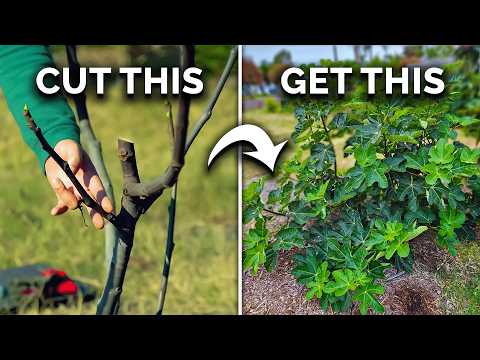
The goal of pruning a fig tree is to create an “open vase” or “wine glass” shape. Think of your tree’s leaves as solar panels. If the center of the tree is cluttered with branches, sunlight cannot penetrate to the lower canopy, and you will produce zero fruit in the middle of the tree. We want light to hit every single leaf.
- The Clean Up: Start by removing the “3 Ds”—Dead, Damaged, and Diseased wood. Remove any suckers growing from the base of the trunk (unless you are trying to rejuvenate an old tree). These suckers are energy vampires that steal nutrients from the main fruit-bearing branches.
- Establish Scaffolds: Identify 3 to 5 main branches that grow outward from the trunk at a nice 45-degree angle. These are your “scaffolds.” Everything else that competes with these or crosses through the center of the tree must go. It feels drastic, but cut them flush to the collar.
- Heading Back: Now, shorten your chosen scaffolds. On a vigorous ‘Brown Turkey,’ I will cut back the previous year’s growth by as much as 50% to 70%. I look for an outward-facing bud—a small bump on the branch pointing away from the center—and make my cut 1/4 inch above it at a slant.
- The Sunlight Check: Stand back. Can you throw a football through the middle of the tree without hitting a branch? If not, you haven’t taken enough out of the center.
Pro Tip: Make your cuts at a slant away from the bud. This ensures that when it rains or the morning dew settles, water runs off the cut and doesn’t pool on the delicate bud, which causes rot.
I once ruined an entire batch of ‘Kadota’ figs by leaving the canopy too dense. We had a humid spell in late August—rare for San Diego, but it happens—and the lack of airflow inside that dense bush created a perfect incubator for fungal rust. I lost 40 pounds of fruit to mold because I was too greedy to thin the branches.
Variety-Specific Pruning Guide
Not all figs behave the same. Through our work with Exotic Fruits and Vegetables farm, we have compiled data on how different varieties respond to the knife. Here is a breakdown of common local varieties and their specific needs.
| Variety | Primary Crop | Pruning Severity | Avg. Yield per Mature Tree |
|---|---|---|---|
| Black Mission | Main Crop (Heavy) | Aggressive (remove 50-70% of new growth) | 50-60 lbs |
| Desert King | Breba (Spring) | Light (Only thin crowding, keep tips intact) | 30-40 lbs |
| Brown Turkey | Main Crop | Moderate to Aggressive | 45-55 lbs |
| Panache (Tiger) | Main Crop (Late) | Aggressive (needs heat to ripen) | 35-45 lbs |
Ever wonder why some fruits split before ripening? It is often due to inconsistent watering schedules or a canopy that traps too much humidity against the fruit skin.
Summer Maintenance: The Pinch
Most guides stop at winter pruning, but real production happens in the summer management. Once your tree is leafed out and pumping energy in June, I do something called “pinching.”
When a new green branch grows out to about 5 or 6 leaves long, I reach in and simply pinch off the very tip of the growing shoot. This breaks Apical Dominance. Basically, the tree wants to grow tall to outcompete neighbors for light. By pinching the tip, you send a hormonal signal down the branch that says, “Stop growing tall and start making figs.”
I started pinching my ‘Panache’ figs five years ago, and my harvest window moved up by three weeks. In San Diego, beating the late-season pests by three weeks is a massive victory.
Fertility and Soil Management
Pruning removes a massive amount of stored energy (wood) from the plant. You need to replenish that “battery” if you expect a heavy crop. Figs are not terribly hungry compared to citrus, but they are heavy potassium consumers.
February: Apply 1 pound of fertilizer for every year of the tree’s age (up to 10 lbs max).
May: Apply a half-dose to support fruit swell.
Water: This is where people fail. Figs have shallow, spreading roots. They need consistent moisture—about 1.5 inches of water per week during the heat of summer—but they hate “wet feet.”
If you are growing in the heavy clay typical of inland San Diego, you must amend your soil with gypsum and run your drip lines for shorter, more frequent intervals to prevent root rot.

Common Mistakes and How to Avoid Them
I see the same errors in backyard orchards every year. The biggest one is the “stub cut.” When people remove a branch, they leave a 2-inch stub sticking out from the trunk. This stub will die back, rot, and provide a perfect entry tunnel for beetles and fungus to enter the main trunk. Always cut to the branch collar—the swollen ring where the branch meets the trunk.
Another mistake is pruning too early. In San Diego, we can get warm spells in December that trick trees into waking up. If you prune in early December, you might stimulate new growth that will get fried by a January frost. Wait until late January or early February when the tree is in its deepest sleep.
Don’t paint the cuts! Old advice suggested painting pruning cuts with tar or sealant. Modern arboriculture proves this actually traps moisture and bacteria inside the wound. Let the tree heal itself in the open air.
Final Thoughts for the Harvest
Pruning is intimidating until you realize that the fig tree wants to survive. It is a weed in its native habitat. You are merely the traffic controller, directing the flow of energy from wood production into fruit production.
Our passion at Exotic Fruits and Vegetables drives us to experiment constantly, but the basics of airflow and light penetration never change. Grab your shears, wait for the leaves to drop, and open up that center. When you are eating a sun-warmed, jammy fig in August, you’ll know every cut was worth it.
Remember: A well-pruned fig tree should look sparse and skeletal in winter. If it looks “nice and full” after you prune, go back and take out another 20%.
What’s the real secret to success? It isn’t a magic fertilizer or a lunar calendar. It’s the courage to make the cut. Happy growing.