
Standing in my orchard here in San Diego, the morning marine layer—what we locals lovingly call “May Gray” or “June Gloom”—is just burning off to reveal the sun. While many fruit trees sulk in this cool, damp coastal start to the day, one tree in my collection stands out as an absolute workhorse. I’m talking about the Osborne Prolific fig. If you have struggled with figs that sour before they ripen or split open at the first sign of humidity, you are looking at the solution to your problems.
Through our work with Exotic Fruits and Vegetables farm, we have tested dozens of varieties to see which ones can truly handle the microclimates of Southern California. The Osborne has consistently proven itself to be a survivor. It doesn’t demand the blistering desert heat that a Black Mission requires to sugar up, and it produces a crop that is as beautiful as it is delicious. Whether you have acres of land or just a sunny patio for a half-wine barrel planter, this variety deserves a spot in your rotation.
The Osborne fig is botanically classified as Ficus carica, but you might hear old-timers or nursery labels refer to it as “Archangel” or “Neveralla.” These aren’t different plants; they are synonyms for the same genetic variety that originated in England before making its way to our shores.
Understanding the “Neveralla” Mystery
I remember when I first started establishing my orchard, I bought two saplings: one labeled “Osborne Prolific” and another labeled “Neveralla.” I planted them twenty feet apart, expecting different growth habits. Three years later, I stood there scratching my head, looking at identical lobed leaves and tasting the exact same opal-tinted flesh from both trees.
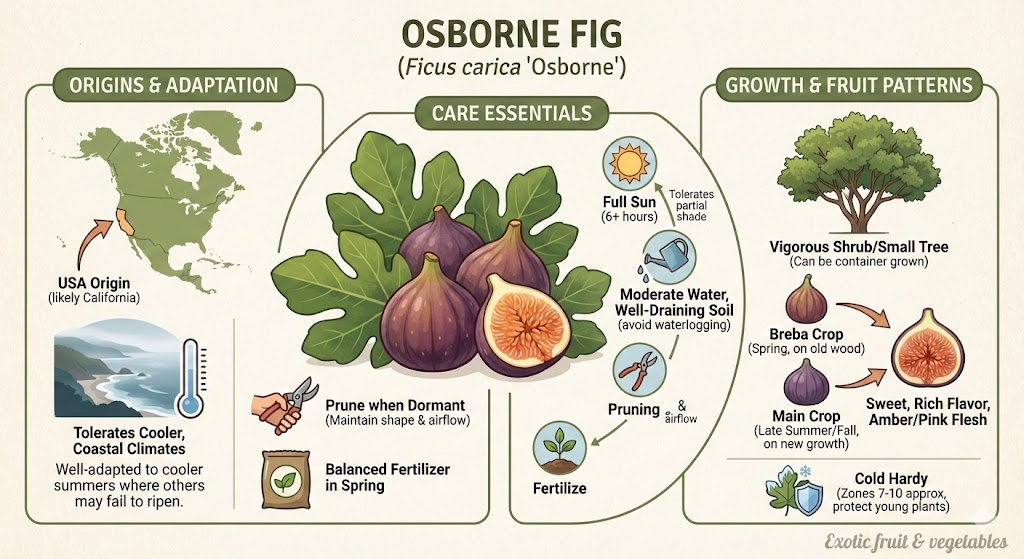
This fig is distinct because of its skin color. It isn’t quite black, and it certainly isn’t green. It ripens to a purplish-brown, sometimes described as bronze, often with a heavy bloom (that waxy white coating) that makes it look dusty. Inside, the flesh is amber to pink, offering a flavor that reminds me of brown sugar and pleasant berry notes, without the overwhelming “jamminess” you get from darker figs.
Ever wonder why some fruits split before ripening while others stay intact?
The answer usually lies in the “eye” or ostiole of the fruit. The Osborne has a partially closed eye. This is a critical structural advantage. A tight eye prevents moisture from entering the fruit interior, which stops internal rot and souring, and it acts as a gatekeeper against dried fruit beetles. In a coastal environment where humidity fluctuates, an open-eye fig is basically a petri dish for mold. The Osborne is a vault.

Site Selection and Soil Preparation
You cannot just stick a stick in the mud and expect premium fruit. Figs are forgiving, but they are not magical. To get a harvest that weighs down branches, you need to prepare the site with intention. In San Diego, our native soil is often heavy clay or decomposed granite. Neither is perfect on its own.
I recommend amending your planting site to create a sandy loam texture. I aim for a mix of 60% native soil and 40% organic compost. You want drainage that moves water through the root zone in under an hour. If you dig a test hole 12 inches deep, fill it with water, and it’s still sitting there 4 hours later, you need to build a raised bed or mound the soil up 12 to 18 inches. Wet feet will kill a fig tree faster than a drought ever will.
For container growers, use a potting mix consisting of 40% peat moss, 30% pine bark fines, and 30% perlite. This ratio ensures oxygen reaches the roots, preventing the anaerobic conditions that lead to root rot.
Planting: A Step-by-Step Guide
Getting the tree in the ground correctly sets the trajectory for its entire life. I treat planting day like a surgical procedure—clean, organized, and precise. Here is the protocol I use for every Osborne Prolific I put in the ground:
- Dig the right hole: Excavate a hole that is two times the width of the root ball but no deeper than the pot it came in. The trunk flare (where roots meet stem) must sit 1-2 inches above the surrounding soil grade to allow for settling.
- Inspect the roots: If the roots are circling the pot, I take a sterilized knife and slice vertically down the sides of the root ball in four places. This signals the plant to generate new feeder roots outward rather than continuing to spiral.
- Backfill without pockets: Fill the hole with your amended soil mix. I use a hose to gently water the soil in as I fill, which collapses air pockets. Air pockets are death traps for roots; they dry out the tissue and prevent nutrient uptake.
- Mulch heavily: Apply a 3 to 4-inch layer of hardwood wood chips from the drip line to within 3 inches of the trunk. Do not pile mulch against the bark; that causes collar rot. The mulch regulates soil temperature, keeping it below 85°F even when the air temperature hits 100°F.
Our experience at Exotic Fruits and Vegetables has shown that skipping the mulch layer in Southern California reduces water retention by up to 50%. You end up watering twice as much for the same result. Mulch acts like a lid on a pot; it keeps the moisture where it belongs.
Watering and Nutrition Strategy
Figs are often touted as “drought tolerant,” and while a mature tree won’t die without water, it won’t produce edible fruit either. To get juicy figs, you need consistent hydration. During the first two years, I give my trees 10 gallons of water per week, split into two 5-gallon applications. Once established, I switch to deep watering every 10 to 14 days during the summer, delivering about 2 inches of water across the root zone.
Inconsistent watering is the primary cause of fruit drop. If the tree senses a water deficit while holding fruit, it will abort the crop to save itself. Consistency is more important than volume.
Fertilizing is where many home growers go wrong. They dump high-nitrogen lawn fertilizer on their trees and end up with eight feet of lush green growth and zero figs. Nitrogen promotes leaves; potassium and phosphorus promote fruit.
Thinking of soil as a battery storing nutrients helps visualize the process. You need to charge that battery before the heavy draw of fruiting begins. I use a granular organic fertilizer with an N-P-K ratio of 5-5-5 or 4-6-6 in late winter, just as the buds swell. I apply 1 cup per inch of trunk diameter. Here is a breakdown of how the Osborne compares to other common varieties regarding care:
| Feature | Osborne Prolific | Brown Turkey | Black Mission |
|---|---|---|---|
| Cold Hardiness | Excellent (Down to 10-15°F) | Good (Down to 15°F) | Moderate (Down to 20°F) |
| Heat Requirement | Low (Ripens in cool summers) | Moderate | High (Needs intense heat) |
| Eye Structure | Partially Closed (Resists rot) | Open (Prone to souring) | Semi-open |
| Flavor Profile | Sweet, caramel, opal flesh | Mild sweetness, reddish flesh | Rich, jammy, strawberry flesh |
Pruning and Maintenance
Pruning a fig tree is like giving a shaggy dog a haircut—it looks drastic, but it’s necessary for health and hygiene. The Osborne is vigorous. If left unchecked, it becomes a dense thicket where sunlight cannot penetrate. Fruit requires sunlight to synthesize sugars. No sun on the branch means bland fruit.
I prune my trees in January while they are fully dormant. My goal is an open-center “vase” shape. I select 3 to 4 main scaffold branches and remove everything else. This airflow reduces fungal issues like rust, which can be a nuisance in coastal zones. The goal is to allow a bird to fly through the center of the tree without touching its wings on a branch.
What’s the real secret to success with pruning? Courage. You have to be willing to cut off healthy wood to structure the tree for the future. I remove about 30% of the previous year’s growth annually.
Harvesting the Bounty
The anticipation of harvest is the hardest part. A fig does not ripen off the tree. If you pick it firm, it stays firm (and tastes like cardboard). You must wait for the “neck droop.” The stem of the fruit will lose its rigidity, and the fig will hang down vertically. The skin should yield to gentle pressure, feeling like a water balloon filled with gel.
One specific harvest I remember fondly involved a batch of Osbornes I used for a grilled appetizer. The skin is thin enough that it chars beautifully without becoming tough, and the interior turns into a molten caramel delight.
I check my trees daily during harvest season, which usually runs from August through October here in San Diego. The Osborne produces a “breba” crop (early crop on last year’s wood) in early summer, but the main crop in late summer is superior in flavor and texture.
We at Exotic Fruits and Vegetables always recommend eating them fresh within 24 hours of harvest. However, if you have a bumper crop, the Osborne is versatile. Here is how we utilize the surplus:
- Fig Jam: The high sugar content means you need very little added pectin.
- Dehydration: Slice them in half; the closed eye means less internal spoilage during drying.
- Grilled: Halved, brushed with olive oil, and served with goat cheese.
- Freezing: Flash freeze whole figs on a baking sheet before transferring to vacuum bags.
Do not wash your figs until immediately before you eat them. Washing introduces moisture to the delicate skin, which accelerates mold growth even inside a refrigerator.
Troubleshooting Common Issues
Even with the best care, things go wrong. In San Diego, our biggest nemesis isn’t cold; it’s the critters. Ground squirrels and birds love figs just as much as we do. I once ruined an entire batch by trying to net the tree too late. The birds had already identified the ripening fruit, and they found gaps in my netting that I missed. They pecked holes in 80% of the crop in one afternoon.
Now, I use organza bags—the kind used for wedding favors. I tie one bag over each individual fig when it starts to change color. It is labor-intensive, yes, but it guarantees a 100% spotless harvest free from beak marks and beetle larvae.
Another issue is Fig Rust. This fungal infection shows up as rusty orange spots on the underside of leaves late in the season. While it looks alarming, it rarely kills the tree. It just forces early dormancy. Cleaning up fallen leaves is your best defense to prevent spores from overwintering.

Final Thoughts
Growing the Osborne fig has been one of the most rewarding experiences of my farming career. It bridges the gap between the finicky, heat-loving varieties and the bland, commercial store-bought options. It offers a resilience that is perfectly suited to our fluctuating climate.
“The best time to plant a tree was 20 years ago. The second best time is today.” – Chinese Proverb
If you have been on the fence about adding a fruit tree to your landscape, let this be your sign. The investment of time and soil will pay you back in pounds of sugar-sweet fruit for decades. Patience is the only fertilizer that you cannot buy at the store, but it yields the highest returns. Get your hands dirty, plant an Osborne, and I promise, your future self will thank you with every bite.