
There is absolutely nothing—and I mean nothing—more heartbreaking in the orchard than reaching for a plump, purple fig, anticipating that honey-jam texture, only to bite into something that feels like a mouthful of sawdust. It’s a texture that instantly sucks the moisture right out of your mouth. If you are growing Ficus carica (the common fig) here in the States, specifically in warm zones like our patch in San Diego, you have likely encountered this “dry fruit” phenomenon at least once. It leaves you standing there, holding a half-eaten fruit, wondering where you went wrong.
I’ve been growing figs for years on our plot, managing everything from the dark, brooding ‘Black Mission’ to the striped beauty of ‘Panache’ (Tiger Fig). Early on, I assumed that because figs are native to the Mediterranean and the Middle East, they wanted bone-dry conditions. I was dead wrong. Through trial, error, and plenty of desiccated fruit, I learned that juicy figs are a balancing act of biology and hydrology.
Here at Exotic Fruits and Vegetables, we’ve found that the difference between a jammy delight and a dry disappointment usually comes down to three critical weeks in the fruit’s development cycle.
Ever wonder why some fruits on the same tree ripen perfectly while others turn into leather bags? The answer usually lies underground.
Understanding the “Inside-Out” Flower
To fix the problem, you have to understand what you are actually eating. A fig isn’t technically a fruit in the botanical sense; it’s a syconium. Think of it as a flower that decided to bloom inwardly. Those hundreds of tiny crunchy seeds inside? Those are the actual drupelets or fruits.
When you bite into a dry fig, you are essentially biting into a bouquet of withered flowers. If the plant undergoes stress while those internal flowers are maturing, they abort the sugar-production process and turn fibrous. The skin might continue to color up, tricking you into thinking it’s ripe, but the interior tells the true story of resource scarcity.
The ostiole, or the small eye at the bottom of the fig, is your window into the fruit’s health. If that eye opens too early due to dryness, it allows air to enter, drying out the internal florets before they can gelatinize into that delicious jam texture we crave.
The Water Equation: It’s Not What You Think
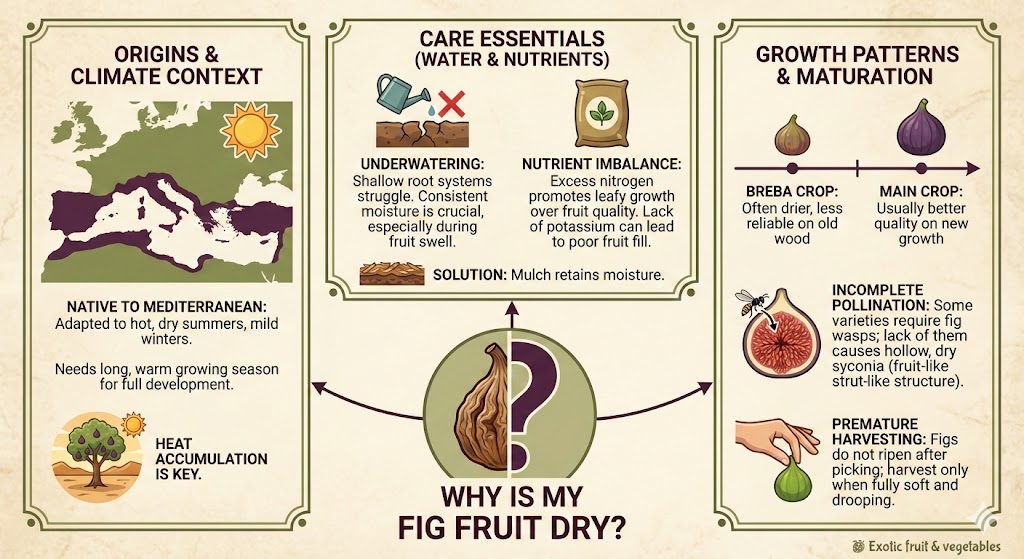
The most common culprit for dry figs is inconsistent watering during the final swell. Many growers hear “drought tolerant” and assume that means “no water needed.” While a fig tree won’t die without water, it certainly won’t produce edible fruit. In our sandy loam soil here in San Diego, a mature fig tree needs approximately 15 to 20 gallons of water per week during the heat of July and August.
I once ruined an entire batch of ‘Brown Turkey’ figs by turning off the irrigation in late August, thinking I would concentrate the sugars. Instead of concentrating flavor, I shut down the tree’s vascular system. The sap flow stopped, and the fruits simply dehydrated on the branch. It was a 40-pound harvest destined for the compost bin because the texture was like chewing on dry sponge.
This is where the soil texture matters. If you are growing in heavy clay, that 15 gallons might drown the roots. If you are in sandy soil like us, that water might drain away in an hour. You must maintain soil moisture equivalent to a wrung-out sponge consistently at a depth of 6 to 12 inches below the surface.
Inconsistent watering is worse than consistently low water. If you let the soil dry out completely and then flood it, the fruit won’t just be dry; it will split open, inviting ants and souring beetles to the party.
The Nitrogen Trap
We often assume that if a plant isn’t performing, it needs food. But feeding a fig tree the wrong food is a guaranteed way to get dry, insipid fruit. Figs are vigorous growers. If you pump them with high-nitrogen fertilizers (like a 20-5-5 lawn fertilizer), the tree shifts into vegetative mode.
Our experience at Exotic Fruits and Vegetables has shown that excessive nitrogen forces the tree to prioritize lush, green leaves over the hydration of the fruit. The leaves act like water pumps, transpiring massive amounts of moisture into the atmosphere. If the canopy is too dense from over-fertilization, the leaves will literally rob water from the fruit clusters to keep themselves turgid.
Recommended Nutrient Ratios
Instead of heavy nitrogen, you want to focus on potassium and phosphorus, which aid in fruit maturation and water regulation within the plant cells. I use a slow-release organic mix. Here is a breakdown of what works best for fruit quality:
| Nutrient Profile (N-P-K) | Frequency | Effect on Fruit Texture |
|---|---|---|
| 5-5-5 (Balanced) | Monthly (Mar-July) | Maintains steady growth without forcing excessive leafing. Keeps fruit hydrated. |
| 0-10-10 (Bloom Booster) | Once in late July | Focuses energy on sugar production and cell wall elasticity, reducing dryness. |
| High Nitrogen (Blood Meal) | Avoid after April | Causes dry, pithy fruit and excessive sap flow to leaves. |
Think of the soil acting as a battery storing nutrients. You want a slow, steady discharge of energy, not a sudden surge. Using organic compost or worm castings provides this steady “voltage” that keeps fruit filling out gradually and juicy.
Sunscald and Heat Stress
San Diego sun is intense, but even in cooler climates, direct heat can cook the fruit on the branch. While figs love sun (they need at least 8 hours of direct light), the fruit itself can suffer from sunscald if the humidity drops too low. When the ambient temperature hits 95°F or higher, the tree enters survival mode and closes the stomata on its leaves.
When this happens, the water transport stops. If the fruit is directly exposed to the baking sun without leaf cover, it internalizes that heat. I’ve measured the internal temperature of a dark purple fig sitting in the sun at 115°F, while the air temp was only 90°F. At that temperature, the fruit is literally cooking and drying out.
The “Leaf Taco” technique: Prune your tree to a vase shape, but leave enough upper canopy leaves to act as a parasol. You want the light to hit the leaves, not the fruit skin directly, especially in the afternoon.
Harvest Timing: Patience is Everything
What’s the real secret to success? Knowing exactly when to pick. Unlike bananas or avocados, figs do not ripen after they are picked. If you pull a fig off the tree when it is firm, it will remain dry and crunchy forever. It will soften slightly as it rots, but it will never develop juice.
A ripe fig should droop on its stem, almost as if the neck has broken. The skin should be soft, and for many varieties, you might see tiny fissures or cracks in the skin. This indicates that the internal pressure of the sugar syrup has expanded the fruit to its maximum capacity.
Never pull a fig that is standing perpendicular to the branch. Even if the color is right, if it’s standing up, the sap flow is still pushing into it, and the conversion of starches to sugars is incomplete. You will get a mouthful of dry latex flavor.
Troubleshooting Your Dry Figs
Sometimes, the specific type of dryness tells you the specific problem. I use this mental checklist when walking the rows:
- Dry and Hard: This is usually an unripe harvest or a lack of pollination (for Smyrna types). If it feels like an apple, it wasn’t ready.
- Dry and Shriveled (on tree): This is water stress or root damage (gophers love fig roots). The tree cut off the supply line.
- Dry and Spongy: This is often a nutrient issue or a variety trait (some figs are meant for drying, not fresh eating).
- Dry with Brown Dust: This is likely the work of the Fig Rust Mite or internal pests.
Speaking of varieties, you must know what you are growing. Some figs, like the ‘Kadota’, are naturally drier and thicker-skinned because they are commercially used for canning and drying. If you want a dripping-wet fig experience, you should be looking at different genetics.
“Pruning is like giving the plant a haircut—you do it for style, but also to remove the dead weight so the body can thrive.”
The “Caprification” Factor
Did you know some figs need a specific wasp to be edible? Most home garden varieties like ‘Black Mission’ or ‘Brown Turkey’ are “common” figs—they are parthenocarpic, meaning they produce fruit without pollination. However, if you accidentally bought a “Smyrna” type (like the famous Calimyrna), it requires the Blastophaga psenes wasp to enter the fruit and pollinate it.
In the US, outside of commercial orchards in California that release these wasps, this natural process doesn’t happen. The fruit grows to the size of a marble, turns dry and yellow, and falls off. If your figs never get larger than a golf ball and drop while dry, you likely have a variety that requires a pollinator that doesn’t exist in your zip code.

Actionable Steps to Save Your Crop
If you notice your current crop starting to look lackluster, you can intervene. It isn’t always too late to save the late-season flush. Here is my immediate protocol for reviving a stressed tree:
- Deep Soak Strategy: Place a hose at the base of the trunk on a slow trickle for 2 hours. Do this twice a week. Surface sprinkling does nothing for the deep taproots.
- Mulch Heavily: Apply 3 to 4 inches of wood chips or straw from the trunk out to the drip line. Mulch reduces soil moisture evaporation by up to 70%, keeping the root zone cool and hydrated.
- Foliar Feed with Seaweed: I spray a liquid kelp solution on the leaves in the evening. This helps the plant handle heat stress and encourages the uptake of existing water.
- Thin the Fruit: If the tree is loaded with hundreds of figs and they all look small, remove 30% of them. It is better to have 50 amazing, juicy figs than 100 dry ones.
- Check for Gophers: Walk around the base of the tree. If the ground feels spongy, gophers might be eating the roots, cutting off water uptake.
As fruit enthusiasts at Exotic Fruits and Vegetables, we encourage you to look at your soil as a living ecosystem. A fig tree planted in dead, dry dirt will give you dead, dry fruit. But a tree planted in soil rich with organic matter, covered in mulch, and watered deeply will reward you with that jammy, sweet nectar that makes growing your own food worth the effort.
Avoid planting figs in pots smaller than 15 gallons. Root-bound figs are notoriously difficult to keep hydrated, leading to chronically dry fruit regardless of how often you water.
Farming is 50% observation and 50% reaction. Go out there, stick your finger in the soil, check the leaf turgidity, and look at the eye of the fig. Your trees are talking to you; you just have to learn to speak their language. Don’t settle for dry fruit—adjust your water, check your nutrients, and wait for that perfect droop.
The perfect fig is not an accident; it is a result of consistent moisture management and patience.