If you have ever walked through a San Diego orchard in late October, you know exactly when the feijoas are ready without even looking at the ground. The scent hits you first—a powerful, floral perfume that smells like someone smashed a pineapple into a strawberry patch and dusted it with mint.

The answer, I have found after years of trial and significant error, is baking. Specifically, feijoa muffins. This isn’t just a way to use up excess fruit; it is the best way to translate that complex, gritty, aromatic flavor profile into something approachable for people who might be scared of the raw fruit’s jelly-like texture. The heat of the oven mellows the medicinal notes that turn some people off, leaving behind a fragrant, moist crumb that rivals any banana bread you have ever tasted.
Ever wonder why most tropical fruit recipes call for excessive amounts of sugar? It is usually to mask the lack of acidity, but feijoas bring their own tartness that balances the sweetness perfectly.
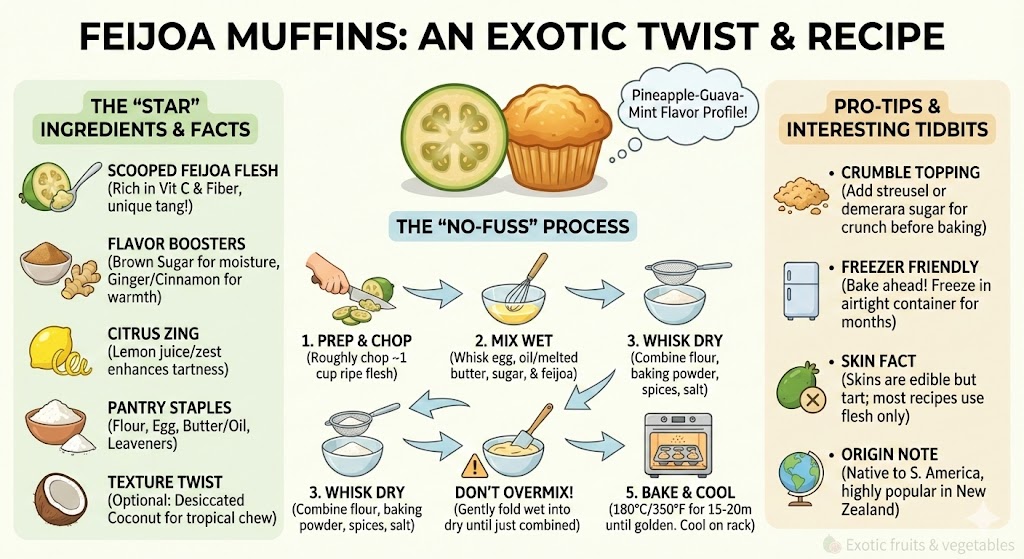
Understanding Your Main Ingredient
Before we fire up the oven, we need to talk about the fruit itself. The Pineapple Guava, or Guavasteen as some locals still call it, is deceptive. It looks like a small, green lime, but the skin is bitter and tough. The magic is inside. The flesh has a texture somewhere between a pear and a kiwi, with a gelatinous center containing the seeds. When baking, you cannot simply toss them in whole.
I treat my feijoa harvest like a mining operation. You are digging for the “green gold” inside the skin. For this recipe, you need the fruit to be dead ripe—soft to the touch, slightly wrinkled, and preferably fruit that has fallen to the ground naturally. Fruit picked directly from the branch often lacks the sugar development needed for baking, resulting in a tart, grassy flavor profile that ruins the muffin.
Here at Exotic Fruits and Vegetables, we’ve found that the aromatic compounds in feijoa skin are ten times stronger than in the flesh, so zest a small amount of the green skin into your batter for a massive flavor boost.
Preparing the fruit is the most labor-intensive part of this process. You need to slice the fruit in half and scoop out the flesh with a spoon. I usually set up a station at my kitchen island with a “flesh bowl” and a “compost bowl.” It takes me about 15 minutes to scoop enough fruit for a double batch, but the effort pays off. Unlike apples which hold their shape, feijoa flesh dissolves slightly into the batter, acting as a moisturizer similar to mashed banana or applesauce.

The Farmer’s Feijoa Muffin Protocol
This recipe is designed to produce 12 high-domed muffins. I have tweaked the ratios over the last five seasons to ensure they don’t turn into dense, gummy pucks—a common issue when baking with wet tropical fruits.
Dry Ingredients
You will need 1 ½ cups of all-purpose flour. I prefer unbleached flour because it has a slightly higher protein content which helps structure the muffin against the heavy fruit. Add 1 teaspoon of baking powder and ½ teaspoon of baking soda.
The soda is crucial because feijoas are acidic (pH around 3.0-3.5), and the soda reacts with that acid to create carbon dioxide bubbles, giving you a better rise. Include ½ teaspoon of salt to cut the sugar, and if you have it, ¼ teaspoon of cardamom. Cardamom pairs with feijoa far better than cinnamon does.
Wet Ingredients
You need 1 large egg, room temperature. Cold eggs can seize up your oil, leading to uneven mixing. Use ½ cup of vegetable oil or melted coconut oil. I experimented with butter, but oil keeps the muffins moist for days longer. You need ¾ cup of granulated sugar—brown sugar makes the batter too heavy in this specific application. Finally, the star of the show: 1 cup of smashed feijoa pulp. Do not puree it smooth; you want small chunks of the gritty flesh for texture.
I once ruined an entire batch by using a blender on the fruit; it released too much water and the muffins came out with the texture of rubber glue. Always mash by hand with a fork.
Step-by-Step Instructions
- Preheat your oven to 375°F (190°C). I find 350°F is too low to get that nice bakery-style dome on the top; the higher heat activates the leavening agents faster.
- Grease a standard 12-cup muffin tin generously with butter or use parchment liners. If you are using liners, give them a quick spray of oil anyway, as feijoa batter is notoriously sticky.
- In a large mixing bowl, whisk together the sugar, oil, and egg until the mixture is pale yellow and smooth. This emulsion is critical for a tender crumb.
- Stir in the 1 cup of hand-mashed feijoa pulp. If you decided to grate in some zest (highly recommended), add it now.
- In a separate bowl, sift together the flour, baking powder, baking soda, salt, and spices. Sifting isn’t just for fancy pastry chefs; it ensures you don’t bite into a lump of bitter baking soda.
- Gently fold the dry ingredients into the wet ingredients using a silicone spatula. Stop mixing the second the last streak of flour disappears. Over-mixing develops gluten, which is great for pizza but terrible for muffins.
- Divide the batter evenly among the 12 cups. They should be about ¾ full.
- Bake for 20 to 25 minutes. Test for doneness by pressing gently on the top of a muffin; it should spring back immediately.
- Let them cool in the pan for exactly 5 minutes before transferring to a wire rack. If you leave them in the hot pan, the bottoms will steam and get soggy.
Our team at Exotic Fruits and Vegetables loves adding a crunchy topping made of chopped macadamia nuts and coarse sugar to contrast the soft interior of the muffin.
Troubleshooting and Texture Science
Baking with fresh fruit is always a gamble because water content varies. A feijoa harvested after a rainstorm in November will have more water than one harvested during a Santa Ana wind event in October. If your batter looks like soup, add another tablespoon of flour. If it looks like cookie dough, add a splash of yogurt or buttermilk.
Think of the flour as a sponge. If you have too much liquid from the fruit, the sponge gets saturated and leaks, causing the muffin to collapse. If you have too little liquid, the sponge dries out and crumbles. You are aiming for a consistency that is spoonable but not pourable.
Avoid using under-ripe fruit at all costs. I tried baking with firm, tart feijoas once, and the metallic, piney flavor did not bake out, making the muffins taste like floor cleaner.
Comparison: Feijoa vs. Banana Muffins
To give you an idea of how these behave compared to a standard muffin recipe, I’ve tracked the differences in my kitchen logs.
| Feature | Banana Muffin | Feijoa Muffin |
|---|---|---|
| Moisture Content | Moderate | High (requires careful balancing) |
| Sugar Requirement | Low (bananas are very sweet) | Medium (needs sugar to balance tartness) |
| Texture | Dense and heavy | Light and slightly gritty (like pear) |
| Flavor Profile | Sweet, monolithic | Floral, tangy, complex |
Variations for the Adventurous Baker
Once you master the base recipe, you can start treating the feijoa muffin as a canvas. The flavor is robust enough to stand up to other strong ingredients. I have found that adding texture is usually the best move, as the fruit itself is soft.
- Ginger Kick: Add ½ cup of crystallized ginger chops. The heat of the ginger cuts through the floral aroma of the feijoa beautifully.
- Coconut Trope: Swap the vegetable oil for coconut oil and add ½ cup of shredded unsweetened coconut. It leans into the tropical nature of the fruit.
- White Chocolate: Dark chocolate overpowers feijoa, but white chocolate chips complement the creamy, tart nature of the fruit.
- Crumble Top: A simple streusel of butter, flour, and brown sugar prevents the top from drying out and adds a professional finish.
My neighbor Dave, who claims to hate ‘weird California fruits,’ ate three of these in one sitting before asking what was in them. That is the power of a good muffin.
The Harvest Reality
It is important to be realistic about yields. Growing Acca sellowiana is a waiting game. My bushes produced nothing for the first three years. Now, in year seven, I am pulling 40 to 50 pounds of fruit per season. A single muffin batch uses about 6-8 large fruits. This means during peak season, I am baking three times a week just to keep up with the drop.
I realized early on that freezing the pulp is a viable option, but it changes the texture. Fresh is always better. However, if you must save your harvest, scoop the flesh, mix it with a teaspoon of lemon juice to prevent browning, and freeze it in 1-cup portions—exactly what you need for one batch of muffins.
Do not attempt to freeze whole feijoas. Upon thawing, the internal structure collapses completely, turning the inside into brown slush that is unusable for baking.

Why This Matters
Why go through all this trouble for a muffin? Because eating seasonally connects you to your land in a way that buying a blueberry muffin at a coffee shop never will. When you bite into a warm feijoa muffin, you are tasting the specific sunlight and rain of that season. You are tasting the fact that you beat the squirrels to the fruit that morning.
Through our work with Exotic Fruits and Vegetables farm, we have seen that people are desperate for connection to their food. Baking with something as unique as feijoa provides that connection. It is a conversation starter. It is a way to educate your palate beyond the standard apple-banana-orange triad that dominates our grocery stores.
The best part about these muffins is that they actually taste better the next day. The moisture from the fruit migrates through the crumb, making them even softer after 24 hours in an airtight container.
So, check under your bushes. If you see those green, egg-shaped fruits hiding in the mulch, grab them. Heat up the oven. Your kitchen is about to smell better than it has all year. What’s the real secret to success? It isn’t the fancy mixer or the expensive oven; it’s simply waiting for the fruit to fall.