

The autumn air here in San Diego gets a specific, heavy sweetness around late October that signals one thing to me: the Pineapple Guava harvest is peaking. If you have ever walked past a basket of these green, egg-shaped fruits, you know they smell like a perfume factory exploded in a candy shop.
But once you get them home, confusion often sets in. I have seen customers stare at a crate of Acca sellowiana (that’s the scientific name, though we often just call them feijoas or guavasteens) with a look of pure bewilderment.
Have you ever bought an exotic fruit only to let it rot on the counter because you were too intimidated to cut it open?
You are not alone in that hesitation. The feijoa is a complex beast. It is not like a banana where you just peel and go, and it is not quite like an apple where you bite right in—unless you enjoy a mouthful of bitter, sour skin. After decades of cultivating these beauties on my plot in the San Diego hills, I have learned that pairing them correctly is the difference between a culinary epiphany and a sour face.

Understanding the Flavor Profile Before You Pair
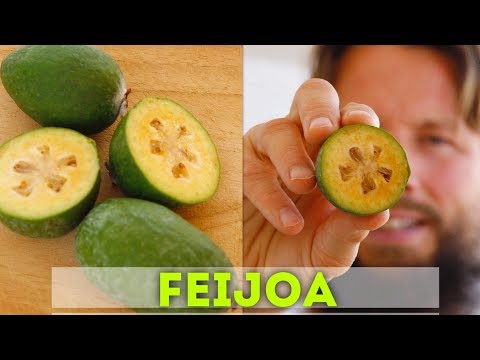
To know what to eat feijoas with, you have to understand what is happening inside that green skin. The flavor is a chaotic mix of strawberry, pineapple, and wintergreen mint, with a texture that is gritty near the skin (like a pear) and jelly-like in the center.
Botanists refer to the gritty texture in feijoas as stone cells or sclereids. These are the same structures that give pears their characteristic crunch, and they become less pronounced as the fruit moves from firm to fully ripe.
Here at Exotic Fruits and Vegetables, we’ve found that the most common mistake rookies make is assuming the fruit is sweet all the way through. It is not. The flesh is sweet-tart, but the skin is loaded with tannins and sour compounds. This dictates your pairings: you need ingredients that either cushion that acidity or lean into the floral aromatics.
The Breakfast Table: Dairy and Grains
My absolute favorite way to utilize a bumper crop—I am talking about those weeks when I harvest 50 pounds off just four trees—is incorporating them into breakfast. Dairy acts as a neutral canvas that allows the floral “perfume” of the feijoa to shine without competing.
Yogurt and Oatmeal
You should treat feijoa pulp like a high-end jam. Scoop out the flesh of two ripe feijoas and stir it directly into plain Greek yogurt. The fat in the yogurt (stick to 5% fat or higher) coats the tongue and mellows the tartness. If you add a drizzle of raw honey, you bridge the gap between the creamy dairy and the acidic fruit.
I recently discovered that adding 1/4 teaspoon of cardamom to feijoa oatmeal creates a flavor explosion. The spice mimics the wintergreen notes in the fruit, making the whole bowl taste like a warm chai tea.
For oatmeal, do not cook the fruit with the oats. The heat destroys the delicate vitamin C (about 32.9mg per 100g) and kills the fresh minty top notes. Stir the raw pulp in right before you eat.
Savory Applications: Salads and Cheese Boards
Most people pigeonhole fruit into the dessert category, but feijoas are essentially the chameleons of the kitchen. Think of feijoa as the bridge between the tartness of a granny smith apple and the tropical punch of a kiwi. This versatility allows them to stand up to strong savory flavors.
The Cheese Plate
If you are hosting a dinner, slice the feijoas into rounds (leaving the skin on for thin slices is okay if they are paper-thin) or serve the scooped pulp alongside cheese. They pair exceptionally well with:
- Brie or Camembert: The creaminess neutralizes the acidity.
- Goat Cheese (Chevre): The tang of the goat milk matches the tang of the fruit.
- Sharp Cheddar: Provides a salt contrast that highlights the tropical sweetness.
“Feijoa is the only fruit I know that can look a sharp cheddar in the eye and not blink.” — A fellow San Diego orchardist.
Salads with Bitter Greens
I once ruined an entire dinner party salad by using iceberg lettuce and sweet dressing with feijoas; it was a cloying mess. The secret is bitterness. You need greens like arugula, radicchio, or kale.
Here is a pairing breakdown based on my kitchen experiments:
| Base Ingredient | Complementary Herb/Spice | Why It Works |
|---|---|---|
| Arugula | Black Pepper | The peppery green cuts the floral sweetness. |
| Roast Pork | Rosemary | Fatty meat needs acid; rosemary echoes the piney notes. |
| White Fish | Cilantro | Replaces lemon/lime with a more complex citrus profile. |
| Dark Chocolate | Ginger | Bitterness of cacao balances the high sugar/acid ratio. |
Cooking and Baking: The Science of Heat
When you apply heat to pineapple guava, the flavor changes. The minty notes evaporate, and the strawberry-pineapple flavor deepens.
Chutneys and Salsas
Our team at Exotic Fruits and Vegetables loves creating savory chutneys to preserve the harvest. Feijoas have high pectin content, so they thicken naturally without needing piles of added sugar or cornstarch.
Here is my go-to process for a Quick Feijoa Salsa that pairs perfectly with fish tacos:
- Scoop the flesh of 6 large feijoas and rough chop them (aim for 1/4 inch cubes).
- Immediately toss with 1 tablespoon of fresh lime juice to prevent browning (oxidation happens in minutes).
- Mix in 1/2 cup of finely diced red onion and 1 minced serrano pepper for heat.
- Add 1/4 cup chopped cilantro and a pinch of sea salt.
- Let it sit in the fridge for 30 minutes to let the flavors meld before serving.
Watch out for oxidation. Feijoa flesh turns an unappealing brown almost instantly upon contact with air. You must have your acid source (lemon or lime juice) ready before you even cut the fruit.
Baking Muffins and Crumbles
Baking with feijoas is similar to baking with bananas, but with more moisture. If you swap feijoa pulp into a banana bread recipe, reduce the liquid (milk or water) by about 15% to account for the fruit’s water content.
My breakthrough came when I stopped pureeing the fruit for breads. Now, I fold in rough chunks. This creates pockets of jammy intensity in the finished loaf rather than a uniform, subtle flavor.
Ever wonder why some fruit muffins get soggy bottoms? It is usually excess moisture sinking to the base. Coating your feijoa chunks in a tablespoon of flour before folding them into the batter prevents them from sinking and ensures an even bake.
Beverage Pairings
We cannot talk about consumption without mentioning drinks. The aromatic oils in feijoas are soluble in alcohol and sugar syrup.
- Smoothies: Blend feijoa with spinach, banana, and coconut water. The green color of the spinach masks the oxidation browning.
- Cocktails: Infuse vodka with feijoa skins (flesh removed) for 3 days. The result is a piney, floral spirit perfect for a twist on a Moscow Mule.
- Tea: Dried feijoa skins added to black tea steep into a fragrant brew similar to Earl Grey but fruitier.
Never blend the skins into a smoothie unless you have a high-powered industrial blender and a lot of sweeteners. The texture will remain fibrous and the flavor will be overwhelmingly bitter.
Conclusion
Eating feijoas is an adventure in balancing the sweet, the tart, and the floral. Whether you are scooping them raw on a Tuesday morning or simmering them into a chutney for Sunday roast, the key is respecting their complexity. Do not try to bury their flavor; complement it with fats, spices, or bitter greens.

We at Exotic Fruits and Vegetables believe in connecting people with the land through flavor. So next time you see that crate of green Acca sellowiana, grab a handful. Your cheese board, your morning oats, and your taste buds will thank you.
“To eat a feijoa is to taste the very essence of late autumn—cool, sweet, and lingering.”
Now, go grab a spoon and dig in. Don’t let those fragrant green gems go to waste.




Just harvested 20 lbs of feijoas from my rooftop container garden in San Diego! Used a mix of 5-gallon containers with espalier training. Anyone have tips on optimizing yields per square foot?
Regarding optimizing yields per square foot, our experience with feijoa container gardens suggests that using a well-draining mix and maintaining a pH between 6.0-6.5 can significantly improve productivity. We’ve also seen benefits from using dwarf rootstocks and pruning for better air circulation. For a rooftop setup, consider using windbreaks and ensuring your containers are securely fastened to prevent wind damage. In terms of yields, we’ve achieved up to 3 lbs per square foot in ideal conditions.
Currently pairing feijoas with brie on my cheese board. How does the article’s suggestion of using goat cheese compare in terms of flavor profile? What’s the mechanism behind the tang matching the fruit’s acidity?
About the flavor profile comparison between brie and goat cheese with feijoas, the article highlights the creaminess of brie neutralizing the acidity, while the tang of goat cheese matches the fruit’s tang. This is due to the casein in goat cheese binding to the tannins in the feijoa skin, creating a balanced taste experience. The mechanism involves the fat content in both the cheese and the fruit interacting to smooth out the flavor. If you’re looking to try something new, you might also consider pairing feijoas with a sharp cheddar to contrast the sweetness and acidity.