

Two of the creamiest fruits I handle both get called custard, and people assume that makes them cousins. It does not. Durian and custard apple share a spoonable, custard-like flesh and almost nothing else, and the gap between them starts in my own yard, where one grows happily and the other refuses to live at all.
The naming causes half the confusion. “Custard apple” is a loose label for several fruits in the Annona family, and in California the one you will actually find, and the one I grow, is the cherimoya, Annona cherimola. Durian is a different plant from a different continent entirely, the tropical Durio zibethinus, and lining the two up side by side is a useful way to understand what each one really is.
At our Exotic Fruits and Vegetables stand I sell cherimoya off my own trees and durian only as imported frozen pods, which tells you most of the story before we even start. One fruit is a local crop for me, and the other is a souvenir I have to fly in from the tropics.
Two custard fruits with almost nothing else in common
Set them next to each other and the contrast is almost comic, a spiky green hand grenade beside a smooth green pinecone. They come from separate botanical families, separate climates, and separate halves of the planet, and they meet only in the vague creaminess of the flesh inside.
The durian side
Durian belongs to the mallow family, Malvaceae, and hails from the rainforests of Borneo and Sumatra. It grows large and armored, often 2 to 7 pounds, sheathed in hard spikes, with thick pods of rich yellow flesh wrapped around a single big seed. Southeast Asia crowns it the “king of fruits”, and its aroma announces it long before you see it.
The custard apple side
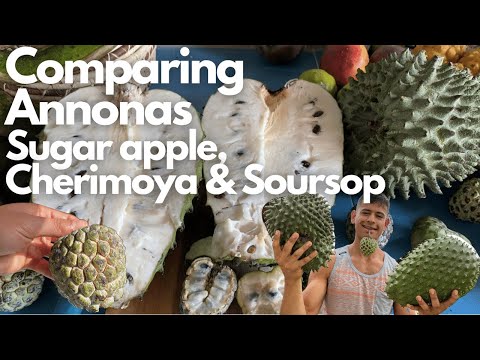
Cherimoya comes from the Annonaceae family and the highlands of the Andes, where it earned the nickname “Pearl of the Andes”. The fruit is heart-shaped and modest, usually well under a pound, with a leathery green skin patterned like overlapping scales or an artichoke. Inside sits soft white flesh studded with hard black seeds, and Mark Twain once called it “the most delicious fruit known to man”.
The custard apple name is shared across the Annona group, which includes sugar apple, soursop, and atemoya, while the strict “custard apple” usually points to Annona reticulata. Cherimoya is the sibling grown across coastal California, which produces roughly three quarters of the US crop from Santa Barbara down to San Diego.
Growing them, and why only one lives in my yard
This is where the two fruits split hardest, and where my San Diego farm settles the argument. Durian is strictly tropical, wants warm nights and heavy humidity, and dies in a cold snap, which rules out most of the mainland United States. Cherimoya is subtropical and far tougher about temperature.
Cherimoya shrugs off a light frost and grows in zones 9 to 11, while durian dies once nights fall into the mid-40s Fahrenheit, so my coastal hills that kill a durian in one winter suit a cherimoya just fine. The catch with the custard apple is pollination, since its flowers rarely set on their own outside the Andes.
If your winters dip into the 40s and you have dreamed of a durian tree, are you ready to build a heated greenhouse for it, when a cherimoya would fruit outdoors in the same yard with none of that fuss?
Each cherimoya flower usually has to be hand-pollinated with a small brush, transferring pollen in a narrow window as the bloom shifts from female to male. I spend evenings in spring doing exactly that, dabbing flower after flower, which is why the fruit carries a premium price. Durian, by contrast, I have never fruited here at all, and I no longer try.

The first cherimoya I hand-pollinated and carried to ripeness tasted like banana and pineapple whipped into vanilla cream. Standing in the orchard eating a fruit I had pollinated by hand months earlier felt like a small miracle, and no durian will ever give me that on this land.
- Winter lows no colder than the upper 20s Fahrenheit, ideally zones 9 to 11.
- Hand-pollination of most flowers, since the natural pollinators are absent here.
- A mild, frost-light site rather than the deep tropical heat durian demands.
- Patience for a fruit that ripens off the tree over several days.
Whether your own site can carry a custard apple comes down to your winter lows and your patience with pollination, so I point curious growers to a tool that scores a location against cherimoya’s real tolerances before they plant.
Loading calculator...
On the plate: smell, taste, texture, and seeds
Smell is the first thing that separates them, and it is not close. Durian throws a powerful sulfurous aroma that clings to rooms and gets it banned from hotels and transit systems, while cherimoya smells faintly sweet and floral, mild enough that nobody has ever banned it from anything.
Taste tells a subtler story. Durian is rich, fatty, and savory-sweet, with a custard-and-almond depth and a pungency that divides people on first bite. Cherimoya is gentle and dessert-sweet, tasting of banana and pineapple with hints of pear and vanilla, and it wins over almost everyone immediately.
Do not expect one to stand in for the other. Hand a durian lover a cherimoya and they may find it tame, while a cherimoya fan biting into durian for the first time often recoils at the savory funk. They scratch completely different itches.
Both fruits hide a real hazard in their seeds. Durian seeds are mildly toxic raw but turn edible once boiled or roasted, whereas cherimoya seeds are genuinely dangerous, packed with neurotoxic compounds. Never crush or eat the seeds of either fruit, since cherimoya’s contain annonacin and were historically ground into insecticide.
Cherimoya seeds are toxic and must be spat out whole, never chewed or blended. Crushed seed material can cause serious harm, the skin is inedible, and juice from crushed seeds reaching the eyes has caused severe irritation. Heavy, regular consumption of Annona fruit has also been linked in some studies to nerve effects, so treat it as a pleasure to enjoy in moderation.
| Feature | Durian | Custard apple (cherimoya) |
|---|---|---|
| Family | Malvaceae | Annonaceae |
| Origin | Borneo, Sumatra | Andean highlands |
| Typical size | 2 to 7 lb, spiky | Under 1 lb, scaly |
| Smell | Powerful, sulfurous | Mild, sweet, floral |
| Taste | Rich, savory-sweet, pungent | Sweet, banana and pineapple |
| Climate | Strictly tropical | Subtropical, frost-tolerant |
| Grows in San Diego | No | Yes |
Where the flesh itself is concerned, both reward a spoon. You eat a ripe cherimoya by halving it and scooping the custard straight from the skin, while durian gets pulled apart into pods by hand. On the numbers, the two diverge again, since durian is a genuinely heavy food and cherimoya is a light one.
Durian carries roughly twice the calories and far more fat than custard apple, at about 147 calories and 5 grams of fat per 100 grams against cherimoya’s 75 or so calories and almost no fat. Both bring useful fiber and potassium, and both offer a modest dose of vitamin C, but durian’s richness comes from real fat while cherimoya’s sweetness is mostly sugar.
Loading calculator...
The verdict: which one to reach for
Price and access decide a lot here. Cherimoya is a premium fresh fruit grown in California and sold mainly from late fall into spring, expensive because of that hand-pollination but genuinely local. Durian reaches most of the United States frozen and imported, priced high for a fruit that traveled from the tropics, and rarely sold fresh.
Which one you should buy depends entirely on what you want from it.
- Choose cherimoya for an easy, crowd-pleasing dessert fruit you scoop cold with a spoon.
- Choose durian when you want an intense, savory, once-in-a-while experience with real richness.
- Pick cherimoya if you are nervous about strong smells or sharing a fridge with other food.
- Pick durian if you already love bold, fermented, funky flavors and want the king of them.
- Grow cherimoya if you garden in a mild zone, and simply buy durian frozen instead.
To ripen a cherimoya, leave it at room temperature until it yields to gentle pressure like a ripe avocado, speeding it up in a paper bag with a banana. Only move it to the fridge once soft, and eat it within a couple of days.
My own verdict is that these fruits are not rivals so much as answers to different questions. Cherimoya is the everyday pleasure I can grow, share with anyone, and hand to a child without a second thought, and durian is the dramatic special occasion I import a few times a year.
One fruit is a friend you see every week. The other is the wild relative who visits once a year and rearranges the room.
Try both if you can, because knowing them side by side teaches you more about each than either does alone. Start with a ripe cherimoya to learn what gentle tropical custard tastes like, then brave a durian when you are ready for the loud, unforgettable opposite.









Finding a decent cherimoya in the Pacific Northwest is an expensive headache. I usually have to wait for winter and head to Uwajimaya or H Mart in Seattle, where they import them from California. They charge upwards of 8.99 a pound, and since the fruit is heavy with those dense seeds, a single cherimoya easily runs me 10 to 12 dollars. To select a good one, I look for a slight give when pressed gently near the stem, similar to an avocado, and a pale green color rather than dark green. If it is brown and mushy, it is already turning black inside. As for durian, my local Asian markets sell frozen whole Monthong durians for about 6.99 a pound, but the real prize is finding thawed, pre-packaged Musang King pods. Those cost almost 30 dollars for a small tray, but the flavor is far more complex than the standard frozen pods. I always shake a whole durian if I find one fresh; if you hear the seeds rattling inside, the flesh has shrunk slightly, indicating it is ripe and creamy.
Regarding the pricing on the West Coast, cherimoya costs remain high because hand-pollination is extremely labor-intensive. In my orchard, I have to manually collect pollen from male-phase flowers in the late afternoon and apply it to female-phase flowers with a camel-hair brush. This process must happen within a tight four-hour window, otherwise the fruit will not set. Concerning your tip about shaking durian, that is actually a reliable method used by professional graders in Thailand. When the fruit is fully ripe, the pulp pulls away from the inner shell, allowing the seeds to rattle. For imported frozen pods, look for a deep golden hue rather than pale yellow, as this indicates the fruit was harvested at full maturity before freezing.
That makes sense about the hand-pollination labor driving up the price. I tried a cheaper cherimoya last month that was small and lumpy, and now I realize it was probably poorly pollinated. I will definitely look for the golden hue on my next H Mart run.
Misshapen, lumpy cherimoyas are indeed the result of incomplete pollination, where only a few seeds inside were fertilized. The flesh around those unfertilized spots remains hard and does not develop, leading to a gritty texture. Paying a bit extra for well-shaped, symmetrical fruit is usually worth it for the smooth texture.
Both of these are incredibly nutrient-dense, but the sugar profile is something to watch if you are managing insulin levels. Cherimoya is packed with soluble fiber, which helps slow down glucose absorption, but it still contains about twenty grams of sugar per hundred grams of fruit. It is an excellent source of vitamin B6, which supports neurotransmitter function, and vitamin C. On the other side, durian is a powerhouse for potassium and healthy monounsaturated fats, making it much heavier digestively. It contains high levels of sulfur compounds, which explains the strong odor and also provides antioxidant benefits. Some people experience a warming sensation in their stomach after eating durian due to these active compounds, which can trigger mild indigestion if eaten in large quantities.