

People new to tropical fruit lump durian and soursop together all the time, since both are big, green and covered in spikes. That surface resemblance hides two fruits that are barely related and could hardly be more different in smell, taste and the way they treat your body. After growing one and importing the other for years, I can lay out an honest head-to-head.
Two spiky fruits, barely related
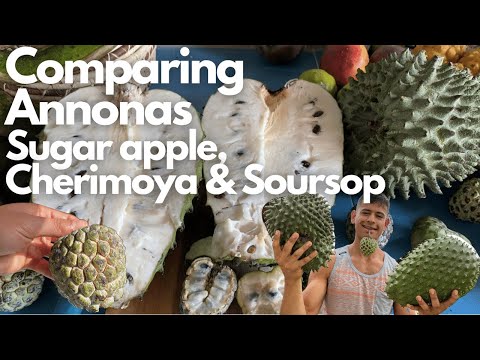
Durian is Durio zibethinus, a member of the mallow family that also gave us cotton and okra. Soursop is Annona muricata, part of the custard-apple family alongside cherimoya and sugar apple, and it answers to graviola, guanabana and sirsak depending on where you are. The two fruits sit in completely separate botanical families and share no close kinship.
The spikes give the game away once you touch them. Durian wears hard, sharp thorns that will draw blood if you grab one wrong, while soursop is covered in soft spines that bend under a fingertip. We grow a couple of soursop trees on our Exotic Fruits and Vegetables plots, sheltered from the rare San Diego cold snap, while every durian I write about arrives imported, because one tree suits this climate and the other never will.
Soursop hides its softer nature behind a prickly shell. The green skin is inedible on both fruits, but under it durian holds thick lobes of custard around a few large seeds, while soursop packs white, fibrous pulp studded with many black ones.
Then there is the smell, which is the fastest way to tell them apart with your eyes closed. Soursop gives off a mild, pleasant aroma of tropical fruit, nothing like the pungent, sulfurous reek that gets durian banned from hotels and airplanes. Have you ever assumed the two must be related just because both look like green medieval weapons? The nose settles that argument in a second.
- Thorns: durian’s are hard and sharp, soursop’s are soft and bendy.
- Smell: durian reeks of sulfur, soursop smells of tropical fruit.
- Seeds: durian holds a few big ones, soursop hides many toxic ones.
- Heft: durian feels dense and heavy, soursop lighter for its size.
Taste and what is inside
The flavors head in opposite directions. Ripe durian is a rich, savory-sweet custard with notes of caramel, roasted onion and almond, heavy and buttery on the tongue. Soursop is bright and tangy, a juicy blend of strawberry, pineapple and citrus with a creamy edge, closer to a tropical sorbet than a dessert cheese.
For anyone who loves creamy fruit but cannot stand durian’s smell, soursop is the easy win. It delivers a custardy texture and a big tropical flavor with an aroma that welcomes people in rather than clearing the room.
Texture splits them too. Durian is dense and smooth, almost like a set pudding, while soursop is softer, wetter and threaded with fibers, the kind of flesh you scoop and slurp rather than slice. You eat durian in solemn lobes and you eat soursop by the messy spoonful over a sink.
Scoop soursop straight from the shell with a spoon and flick out the black seeds as you go. Blended with a little lime and water it makes an agua fresca that many people enjoy more than the fruit eaten plain.
| Trait | Durian | Soursop |
|---|---|---|
| Family | Malvaceae | Annonaceae |
| Spikes | Hard, sharp thorns | Soft, bendy spines |
| Smell | Pungent, sulfurous | Mild, pleasant, fruity |
| Taste | Rich, savory-sweet custard | Bright, tangy, citrus-cream |
| Calories per 100 g | About 147, high fat | About 66, low fat |
| Seeds | A few large | Many, toxic |
The nutrition gap is just as wide. Durian carries more than double soursop’s calories per serving, most of it from fat and sugar, while soursop is light, high in fiber and loaded with vitamin C. One fruit is an indulgence you ration, the other is a fruit you can eat by the bowl.
Never eat soursop seeds. The large black seeds contain annonacin, a compound toxic to nerve cells, and heavy long-term consumption of the fruit and its extracts has been linked in some regions to a Parkinson-like condition. Scoop the seeds out, enjoy the pulp in moderation, and treat the graviola cancer-cure claims online as unproven marketing rather than medicine.
Durian carries its own caution, milder but real. Skip alcohol around durian, since its sulfur compounds slow the enzyme that clears alcohol and can leave you flushed and sick. Ever bitten down on a soursop seed by accident? Spit it out and move on, because the pulp is the only part you want.

Growing them and the price gap
These two fruits ask very different things of a grower. Durian is a rainforest giant that climbs tens of meters, demands steady tropical heat, and takes four to seven years to fruit before dropping its crop on the ground. Soursop is a modest evergreen that tops out around eight or nine meters, tolerates frost-free subtropics, and often needs hand pollination to set a decent crop.
Durian’s real drawback outside Southeast Asia is cost and access. A single good imported fruit can run more than a whole bag of soursop, and the freshest, tree-dropped durian never reaches most Western markets at all.
That difference in difficulty drives a real gap in price and availability. The tool below runs the orchard economics for durian, the pricier and slower of the two to establish, which is worth a look if you are weighing it as a serious planting.
Loading calculator...
For a home grower in a marginal climate, the choice is often made for you.
- Durian needs true tropics and rarely fruits outside them, even under glass.
- Soursop survives in warm subtropics if you shield it from frost and wind.
- Soursop fruits younger and smaller, so a backyard tree is realistic.
- Durian stays a spectator crop for most growers outside Southeast Asia.
Soursop has a short shelf life and a fragile skin, so it bruises and ripens unevenly and does not travel or store like sturdier fruit. Buy it when it yields slightly to a press and eat it within a couple of days, rather than stockpiling it the way you might with hardier produce.
The two fruits even sit differently in your body by traditional reckoning. Durian is treated as intensely heaty in Chinese medicine, the reason people chase it with cooling drinks, while tangy soursop falls on the cool side of that ledger. The calculator below gauges durian’s heatiness so you can balance a heavy session, a concern soursop simply does not raise.
Loading calculator...
Which one should you try?
Pick soursop if you want an approachable, refreshing fruit you can grow in a warm backyard and eat without emptying the room, and pick durian if you are after the deep, decadent custard that earns its title as king of fruits. They are not really rivals, since one is a bright everyday tropical treat and the other is a rich, polarizing splurge. If your climate is subtropical, soursop is the fruit you can actually own, while durian stays the trophy you fly in or travel for. Try both back to back at least once, seeds removed and windows open, and you will never confuse the two spiky green strangers again.








Buying a whole imported fresh durian at H Mart last weekend set me back sixty-two dollars. What a massive waste of money. It smelled like raw sewage and tasted exactly like rotten onions mixed with old sweet cream. I had to throw almost the entire thing in the outdoor trash bin. Do not believe the online hype about this being a gourmet delicacy, it is totally repulsive.
I want to make the soursop agua fresca mentioned in the article, but fresh guanabana is impossible to find in Ohio. Can I use frozen cherimoya pulp from the local Hispanic market as a direct substitute instead? Soursop tastes to me like a mix of ripe pineapple and strawberry with a splash of lime. Since cherimoya has that same custard texture, I am hoping the flavor profile works out similarly in a blended drink.
Regarding your substitution question, frozen cherimoya pulp is an excellent alternative, though you will need to adjust the recipe slightly. Both fruits belong to the Annonaceae family, so they share a similar velvety texture. However, soursop contains significantly more citric and malic acid than cherimoya. Cherimoya is much sweeter and lacks that sharp, tangy edge. If you use the cherimoya pulp for your agua fresca, add two tablespoons of fresh lime juice and a tiny splash of white grapefruit juice to recreate that bright tropical acidity.
Thank you, that makes a lot of sense. I actually have some key limes in the fridge right now, so I will use those to balance out the sweetness of the cherimoya. I can not wait to try making this over the weekend.