
If you have ever walked past a neighbor’s yard in November and seen a shrub decorated with what looks like dangling red Christmas ornaments, you have likely spotted the Strawberry Tree fruit. Most people in San Diego treat these as purely decorative, sweeping the fallen “mess” into the green bin without a second thought.
That is a tragedy. While I spend my days farming, I am an eater first, and I am here to tell you that these bumpy little spheres are one of the most underappreciated culinary experiments you can have in your kitchen.
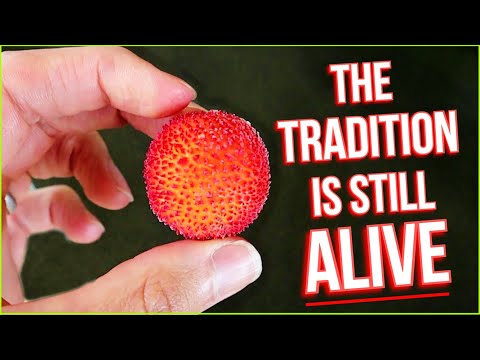
The fruit is botanically classified as a berry, specifically a red berry with a rough, tubercular surface. While it resembles a strawberry from ten feet away, up close it looks more like a lychee that decided to wear a spiky sweater.
I remember the first time I convinced a skeptical customer at a farmer’s market to try one. She grimaced, expecting the tart bite of a wild strawberry, but her face softened into confusion and then delight. It’s not a strawberry; it’s a mood. The flavor is a complex mix of apricot, guava, and mild peach, wrapped in a texture that confuses the uninitiated.
The Flavor Profile: What Are You Actually Eating?
Let’s be honest about the texture because that is where people get hung up. The skin is gritty. It contains stone cells (sclereids), similar to what you find in a pear, but more pronounced. Biting into a Strawberry Tree fruit is like eating a creamy tropical custard that has been rolled in fine sugar sand.
Here at Exotic Fruits and Vegetables, we tell our customers to think of it less as a snacking berry and more as a “texture experience.” The flesh inside is soft, yellow-orange, and pasty—in a good way. It melts on the tongue once you get past the skin.
Have you ever tasted a fruit that changes flavor entirely depending on the hour you pick it? A firm red fruit is sour and astringent, while a soft red fruit is a sugar bomb.
The Ripeness Spectrum
Unlike bananas or avocados that ripen on the counter, the Arbutus unedo fruit stops developing flavor the moment you pull it from the branch. You have to know exactly when to strike.
| Color Stage | Texture | Flavor Profile | Best Use |
|---|---|---|---|
| Yellow | Rock hard | Bitter, astringent, tannic | DO NOT EAT |
| Orange | Firm/Crunchy | Sour, dry mouthfeel | Decoration only |
| Bright Red | Firm | Mildly sweet, mealy | Salads, slicing |
| Deep Red/Dark | Mushy/Soft | Sweet, boozy, honey-like | Raw eating, jams, fermentation |
Nutritional Powerhouse or Sugar Rush?
We often obsess over acai or goji berries, but this Mediterranean transplant holds its own. These fruits are packed with Vitamin C—some studies suggest they have higher concentrations than oranges. They are also loaded with antioxidants, specifically anthocyanins, which give them that deep red hue.
However, you need to be careful. These fruits contain a naturally high amount of sugars that ferment rapidly while still hanging on the tree.

If you eat a bowl of over-ripe, mushy fruits, don’t be surprised if you feel a mild buzz or a heavy stomach. It’s nature’s way of saying “slow down.”
Culinary Applications: Getting Past the Grit
While I enjoy a handful of them raw while I’m working in the orchard, the kitchen is where they truly shine. The key is processing them to remove that gritty skin.
The absolute best way to prep these fruits is to simmer them with a splash of water until they break down, then pass the mash through a fine-mesh sieve or a food mill. This gives you a silky, bright orange purée that rivals any apricot jam.
Our team at Exotic Fruits and Vegetables loves using this purée as a base for sauces. The natural sweetness pairs incredibly well with savory dishes. Try mixing the purée with chipotle peppers and brushing it over pork ribs; the floral notes of the fruit cut right through the fat.
A Portuguese Tradition: Medronho
You cannot talk about this fruit without mentioning Portugal. In the Algarve region, they don’t bother making muffins; they make moonshine. They distill the fermented mash into a clear, potent brandy called Aguardente de Medronhos (Firewater of the Strawberry Tree). It smells like fruit and tastes like fire.
While I don’t run a distillery, I do make a “San Diego Winter Cordial.” Here is how I do it:
- Macerate: Smash 2 cups of ripe fruit in a bowl with 1 cup of sugar. Let it sit for 24 hours to draw out the juices.
- Infuse: Add the fruity syrup to a bottle of good quality vodka or white rum. Add a vanilla bean.
- Wait: Store it in a dark closet for 6 weeks. Shake it every time you remember it exists.
- Strain: Filter it through a coffee filter to remove all the sediment and grit.
Storage and Preservation
This fruit is ephemeral. Once you pick it, the clock starts ticking loud and fast. You have about 24 hours at room temperature before they collapse into a fermented puddle. In the fridge, you might get 3 days.
Do not wash the fruit until you are ready to use it. The rough skin traps moisture, and washing them prematurely promotes mold growth within hours.
If you have a bumper crop (and a mature tree can easily drop 20 pounds of fruit), freezing is your friend. Wash them, dry them thoroughly, and freeze them whole on a baking sheet. Frozen Strawberry Tree fruits are excellent smoothie additives, acting like ice cubes that add creaminess and Vitamin C.
Myths and Legends
There is a strange duality to this fruit in history. The Romans called it *unedo* (“I eat one”), implying that one was enough because the taste wasn’t worth a second bite. Yet, in Madrid, the city’s coat of arms features a bear reaching up to eat these very fruits. Why would a bear work so hard for a fruit that isn’t tasty?
“The bear knows what the Roman didn’t: the fruit isn’t about the first bite, it’s about the aftertaste and the feeling of warmth it leaves in your belly.”
I tend to side with the bear. The flavor is an acquired taste for the modern palate that is used to high-fructose corn syrup, but it is an honest, earthy flavor that connects you to the season.

Final Recommendations
If you are lucky enough to spot these in a market or have a friend with a tree, approach them with an open mind. Don’t expect a strawberry. Expect a tropical, gritty, sweet custard ball.
We at Exotic Fruits and Vegetables believe that diversity in our diet is key to health and happiness. Eating a Strawberry Tree fruit is a small act of rebellion against the standardized apples and bananas of the grocery store world. It’s wild, it’s unpredictable, and it’s delicious if you know what you’re doing.
Always cut the fruit open before eating it whole; because they are sweet and grown without pesticides, they are occasionally home to small larvae that enjoy the fruit as much as we do.
Next time you see those red ornaments on the bush, pick the darkest, softest one you can find. Close your eyes, ignore the bumps, and taste the sunshine stored inside.

Strawberry tree height and spread

Strawberry tree soil requirements

How fast does strawberry tree grow?

How to propagate strawberry tree?

Strawberry tree yellow leaves

Strawberry tree roots

Myrica Rubra Vs Arbutus Unedo

How to grow strawberry tree from seed?

Caring for strawberry tree

Hard pruning strawberry tree

Strawberry tree leaf

Strawberry tree fruit Vs lychee

How to prune strawberry tree?

Where to buy strawberry tree?

Are strawberry tree fruit edible?

Can you grow strawberry tree in a pot?

Strawberry tree Marina flowers

Strawberry tree seed

Strawberry tree benefits

Strawberry tree growing zone

When to prune strawberry tree?
